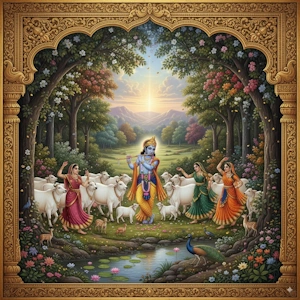
Vrindavana Is Not a Place, It Is an Inner Experience
ज्येष्ठः – वृद्धतमो ज्येष्ठः – seniormost, highest in the hierarchy.
वृद्धतमः – oldest. Brahma is वृद्धतरः – the creator Brahma is older than everybody else, because he was before everyone else.
Veda says –
ब्रह्मैव भूतानां ज्येष्ठं तेन कोऽर्हति स्पर्धितुम्
Brahma is the seniormost, oldest; who can compete with him. Yes, someone can, Sri Hari can, because while Brahma is वृद्धतरः Sri Hari is वृद्धतमः, even higher than Brahma, more senior than Brahma, older than Brahma. That means Sri Hari is the highest, senior most, and oldest. He is oldest because even before Brahma appeared, he was there. So this is the superlative degree.
भगवान् वासुदेवो ज्यायसी विभूतिः
Upasana has four parts – especially Vaishnava upasana. Nama, rupa, leela, and dhama.
Nama – his names, taking his names.
Rupa – making his form firm in the heart.
Leela – listening to his leelas.
And dhama – visiting places associated with him.
The purpose of Sri Hari's avatara is to show us his leelas, to help us evolve. In the absence of his leelas, what will we listen. He performed the leelas so that we can evolve, progress by listening to them. Then his dhama, his abode, the Goloka, that he recreated on earth as Vrindavana.
Gopikas say –
जयति तेऽधिकं जन्मना व्रजः
The Vrajabhumi is greater than every other place including Vaikuntha. But, is Vrajabhumi or Vrindavana the physical place – what is visible to the eyes? No. Vraja is not the physical place that we visit.
When we say 'eyes' what is it that comes to the mind? The eyeballs, the eyelids and the eyelashes and the eyebrows. But is that all, eyes are all about vision. The sensation called vision is all that eyes are about. Eyes are just physical organs that give the experience called vision. Vision is important, not the physical organ. That is what the eyes are there for, to give vision, not for anything else.
So, Vrajabhumi is an experience, an inner experience, not the physical place that we see. To have this inner experience, you should have devotion, you should have done upasana.
Haridas Swami was a great Vaishnava saint of the sixteenth century. Akbar had great regard for Haridas Swami. Akbar wanted to do some service at Vrajabhumi. What can a ruler do? He can build something, renovate something. He cannot do anything else. Akbar kept on requesting Haridas Swami, please allow me to do some service at Vrajabhumi. Haridas Swami said – ok, go and repair Keshi Ghat, some part of it is probably broken.
When Akbar went there, instead of a broken ghat made of stones, what he found was a divine gem-studded magnificent miraculous ghat. This was the vision Haridas Swami gave him for some time. So, it is not about physically what you see in Vrindavana or other holy places. This is the vision an upasaka has to get.
Bhagavata says,
यत्पादपांसुर्बहुजन्मकृच्छतो धृतात्मभिर्योगिभिरप्यलभ्यः
स एव यद्दृग्विषयः स्वयं स्थितः किं वर्ण्यते दिष्टमतो व्रजौकसाम्
Even the best of yogis, jitendriyas and atma samyamis, even to them this vision is not available. This will come only by his grace.
This is something like – the same Lord Krishna – Duryodhana only saw as a strong, powerful warrior and nothing else. In the same Lord Krishna, what the Arjuna and his brothers saw was paramatma, the omniscient, omnipresent, omnipotent divinity. This is the vision the upasaka has to get.
-
If Vrindavana is an inner experience, how do I enter it today?
Sit, light a lamp, and chant a fixed set of names. When breath, name, and attention line up, the mind’s landscape shifts; that shift is the entry. -
How does Vishnu sahasranama act as a doorway rather than a map on paper?
A thousand names train a thousand small turns of attention. Those turns loosen old grooves and reveal a quiet sweetness that does not depend on place. -
Do I need a pilgrimage if Vrindavana is within?
Go if it helps, but anchor at home first. A clean corner, one lamp, and steady japa make any room a dhama; the outer trip then deepens rather than compensates. -
What is the quickest way to make the Lord’s form feel real during chanting?
Link three cues: name on exhale, a brief mental image of Sri Hari’s eyes, and a soft inward bow at the end of each bead. Repetition cements presence. -
How do I keep the experience from fading after I stand up?
Close with one line: ‘All results at your feet, Sri Hari.’ Then do one clean act immediately—return a call, clear a small mess. Action seals grace. -
What should I do when the mind demands spectacle and I only have ten quiet minutes?
Choose clarity over volume. Chant slowly for 5 minutes, sit silent for 2, chant again for 3. Depth beats display. -
How can this help my body without making tall claims?
One name per exhale lowers stress spikes and steadies pulse. With calmer nerves you keep meals simple, sleep on time, and follow medical advice better. -
Can a family create Vrindavana at home without conflict?
Yes: one minute of a single nama before dinner, low volume, then one line of gratitude each. Shared rhythm builds shared heart. -
What if someone at home dismisses it as show?
Shrink the display, raise the regularity. Punctual rounds and a kinder tone argue better than explanations. -
How do I bring children in so they actually enjoy it?
Give a chorus nama for 60 seconds and let them ring a bell to open and close. Add one short story of Sri Hari on weekends. -
What is a solid starter routine that does not collapse on busy days?
One lamp, one mala, 108 of a single nama. Same place, same time. Add sahasranama in quarters across the week. -
How do I handle pride when practice improves?
Track service, not status. After each full sahasranama, do one small anonymous help act. Humility stays real when it costs you a little comfort. -
If fear or grief suddenly surges, where does japa fit?
Do 12 names slowly while lengthening exhale, then drink water, or walk 10 minutes. Prayer plus action calms the system. -
Can travel or office grind sustain this inner Vrindavana?
Use the 3-3-3 rule: three minutes on waking, three at lunch, three before sleep. Whisper in queues; listen to sahasranama in transit. -
How do I know the inner shift is genuine and not fantasy?
Three signs: quicker recovery from anger, cleaner choices under pressure, and a softer voice at home. When these rise, the experience is real.





English
Vishnu Sahasranama
Click on any topic to open
7
30
Astrology
Bhagavad Gita
Bhagavatam
Bharat Matha
Devi
Devi Mahatmyam
Ganapathy
Garuda Puranam
Glory of Venkatesha
Hanuman
Kathopanishad
Mahabharatam
Mantra Shastra
Mystique
Practical Wisdom
Purana Stories
Radhe Radhe
Ramayana
Rare Topics
Rigveda Explained
Rituals
Sages and Saints
Shiva
Spiritual books
Sri Suktam
Story of Sri Yantra
Temples
Vedas
Vishnu Sahasranama
Yoga Vasishta
26
17
10
0


