Vishnu, the Puranapurusha
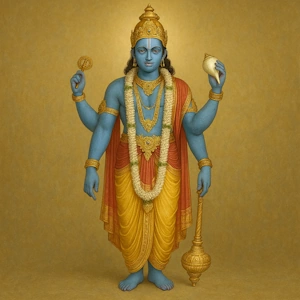
The Padma Purana, in its Swarga Khanda, gives us a beautiful vision of Lord Vishnu. It says:
एकं पुराणं रूपं वै तत्र पाद्मं परं महत् । ब्राह्मं मूर्धा हरेरेव हृदयं पद्मसंज्ञकम् ॥ वैष्णवं दक्षिणो बाहुः शैवं वामो महेशितुः । ऊरू भागवतं प्रोक्तं नाभिः स्यान्नारदीयकम् ॥ मार्कण्डेयं च दाशाङ्घ्रिर्वामो ह्याग्नेयमुच्यते । भविष्यं दक्षिणो जानुर्विष्णोरेव महात्मनः ॥ ब्रह्मवैवर्तसंज्ञं तु वामजानुरुदाहृतः । लैङ्गं तु गुल्फकं दक्षं वाराहं वामगुल्फकम् ॥ स्कान्दं पुराणं लोमानि त्वगस्य वामनं स्मृतम् । कौर्मं पृष्ठं समाख्यातं मात्स्यं मेदः प्रकीर्त्यते ॥ मज्जा तु गारुडं प्रोक्तं ब्रह्माण्डमस्थि गीयते । एवमेवाभवद्विष्णुः पुराणावयवो हरिः ॥
Every single Purana is a part of Vishnu’s divine body. They are not just texts — they are limbs of the Lord.
- Brahma Purana – his head
- Padma Purana – his heart
- Vishnu Purana – his right hand
- Shiva Purana – his left hand
- Bhagavata Purana – his thighs
- Narada Purana – his navel
- Markandeya Purana – his right foot
- Agni Purana – his left foot
- Bhavishya Purana – his right knee
- Brahmavaivarta Purana – his left knee
- Linga Purana – his right ankle
- Varaha Purana – his left ankle
- Skanda Purana – his body hair
- Vamana Purana – his skin
- Kurma Purana – his back
- Matsya Purana – his fat/flesh
- Garuda Purana – his bone marrow
- Brahmanda Purana – his bones
Vishnu is not just the preserver of the universe. He is the living essence of all scriptural wisdom. When you read a Purana, you're not just reading words — you’re touching a part of Vishnu himself.
- What profound theological shift occurs when one views the Puranas not merely as historical or mythological texts but as the physical manifestation of Lord Vishnu?
Viewing the Puranas as the physical manifestation of Lord Vishnu transforms the act of reading from a mere intellectual pursuit into a deeply spiritual communion. The scriptures cease to be ordinary words and become the living, breathing essence of the divine, meaning that engaging with the text is equivalent to touching the supreme deity himself. - Why is the Padma Purana specifically identified as the heart of the supreme deity, and what does this suggest about its core spiritual message?
The heart represents the center of devotion, compassion, and divine love. By designating the Padma Purana as the heart, the text implies that this specific scripture holds the central, pulsating life force of devotional wisdom, radiating grace and profound spiritual emotion to the rest of the scriptural body. - How does the mapping of the Vishnu Purana to the right hand and the Shiva Purana to the left hand of the Lord symbolize the unity of seemingly distinct cosmic functions?
The hands are instruments of action and interaction in the universe. Assigning the Vishnu Purana and Shiva Purana to the right and left hands respectively reveals a hidden, mysterious truth that preservation and dissolution are not opposing forces, but complementary actions perfectly coordinated by the same supreme divine consciousness. - What is the hidden significance of the Bhagavata Purana being described as the thighs of the Lord, considering its status among devotees?
The thighs are the major weight-bearing pillars that support the entire structure of the human body. Describing the deeply revered Bhagavata Purana as the thighs indicates that the supreme devotion and divine pastimes chronicled within it form the foundational support upon which the entire spiritual structure of a devotee rests. - What cosmic and spiritual connection is established by identifying the Narada Purana as the navel of the supreme being?
The navel is universally recognized as the source of birth, connection, and cosmic origination, famously from where the creator Brahma emerged. Identifying the Narada Purana as the navel suggests it acts as the vital umbilical link connecting the seeker to profound divine knowledge and the very source of cosmic creation. - In what way do the Markandeya and Agni Puranas function as the grounding forces of spiritual progression, given their identification as the feet?
The feet represent the foundation that touches the earth, grounding the divine form in the material realm. As the right and left feet, the Markandeya and Agni Puranas provide the essential grounding knowledge, ritualistic foundations, and earthly dharma upon which a seeker must stand before ascending to higher spiritual realizations. - What mysterious aspect of spiritual anatomy is revealed by assigning the Garuda, Matsya, and Brahmanda Puranas to internal elements like marrow, flesh, and bones?
These associations reveal that scriptural wisdom permeates beyond the visible surface into the deepest, invisible core of existence. Marrow, flesh, and bones provide internal structure, nourishment, and vitality, implying that these specific texts offer the hidden esoteric framework and inner sustenance required for the soul to thrive. - How do the Vamana Purana and Skanda Purana, representing the skin and body hair respectively, serve a protective and sensory role in the scriptural body?
The skin is the protective outer boundary that defines a form, while hair serves as a sensory extension. The Vamana Purana as the skin suggests it envelops and protects the vast body of Vedic knowledge, while the Skanda Purana as body hair implies an expansive, detailed network that extends the divine presence outward into the world. - Why is the Brahma Purana placed at the highest point as the head of the deity, and what does this signify about its content?
The head is the seat of consciousness, intelligence, and the highest perception. Placing the Brahma Purana as the head signifies that it contains the primary, overarching cosmic intelligence and the ultimate cognitive framework regarding the creation and structure of the universe, guiding all other faculties. - How does this grand anatomical metaphor redefine the way a seeker should approach the study of the various Puranas?
This metaphor teaches that approaching the scriptures with a fragmented mindset is flawed. Just as a body cannot function or be understood by isolating its parts, a seeker must realize that every Purana, regardless of its specific focus or deity, is an interconnected, indispensable limb of a single, unified supreme reality.





English
Purana Stories
Click on any topic to open
7
30
Astrology
Bhagavad Gita
Bhagavatam
Bharat Matha
Devi
Devi Mahatmyam
Ganapathy
Garuda Puranam
Glory of Venkatesha
Hanuman
Kathopanishad
Mahabharatam
Mantra Shastra
Mystique
Practical Wisdom
Purana Stories
Radhe Radhe
Ramayana
Rare Topics
Rigveda Explained
Rituals
Sages and Saints
Shiva
Spiritual books
Sri Suktam
Story of Sri Yantra
Temples
Vedas
Vishnu Sahasranama
Yoga Vasishta
26
17
10
0


