Krishna gets Blessings of Shiva
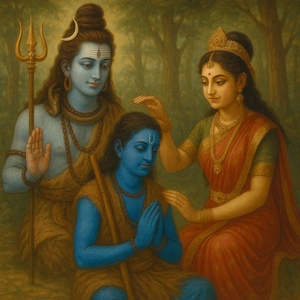
Bhagavan Krishna had eight main wives. Among them, Jambavati had no children. One day, she said to Krishna,
'Rukmini got eight sons because of your worship of Shiva. Won’t you do the same for me too?'
Hearing this, Krishna climbed on Garuda and went straight to the Himalayas. There, in a beautiful ashrama, many munis were doing intense tapas. Krishna joined them and took deeksha from a muni named Upamanyu.
He shaved his head, wore tree bark as clothes, installed a Shiva Linga, and began his daily worship. His tapas was very intense. He stood on one leg, raised both hands, and chanted the Panchakshara Mantra non-stop for five months.
- First month – he ate only fruits
- Second month – only water
- Next three months – no food at all
One day, while Krishna was deep in meditation after Shiva puja, Bhagavan Shiva appeared in front of him along with Parvati Devi. Krishna praised him with devotion. Pleased, Shiva told Krishna to ask for eight boons.
Krishna said:
- May my mind always stay firm in dharma
- May I always win over enemies in battle
- May I be able to perform more and more yajnas
- May I have unmatched strength
- May I stay interested in yoga shastra.
- May I always have deep devotion at your feet
- May your presence always stay with me
- May I have a thousand children
Then Parvati Devi smiled and said, 'Krishna, now ask me for eight boons too.'
Krishna said:
- May I never get angry at Brahmanas
- May my ancestors be pleased with me
- May I have a hundred sons
- May I enjoy all comforts of life
- May there never be fights within my kula.
- May women always be happy
- May everyone find peace
- May I have equal love for all my wives
Shiva and Parvati blessed him saying 'tathastu' and returned to Kailasa.
Krishna did tapas just for the sake of Jambavati’s wish for a child. See what all Shiva gave him.
नास्ति शर्वसमो देवो नास्ति शर्वसमा गतिः।
नास्ति शर्वसमो दाने नास्ति शर्वसमो रणे।।
There is no god like Shiva. There is no ashraya like Shiva. No one gives like Shiva. No warrior matches Shiva in battle.
- Why did Krishna, who is himself considered a Supreme Being, need to perform severe penance to Lord Shiva to fulfill Jambavati's wish?
This act highlights the profound principle that even divine incarnations abide by the cosmic laws of karma, tapas, and protocol. Krishna demonstrates that true power is attained through discipline, humility, and seeking the grace of the appropriate deity. It establishes the ultimate unity and mutual reverence between Hari and Hara, showing that the divine does not bypass the rules of the universe but perfectly embodies them. - What is the hidden significance of Krishna taking deeksha from Sage Upamanyu and living as an ascetic, despite being a powerful king?
It reveals the strict necessity of a Guru in any spiritual endeavor. By shaving his head, wearing tree bark, and surrendering to a sage, Krishna deliberately dismantles the ego of kingship. It teaches the overlooked principle that approaching the highest divine truths requires stripping away worldly identities, titles, and pride, approaching instead with utter simplicity and submission. - In the boons requested from Lord Shiva, Krishna asks for a thousand children last. What does the order of his requests reveal about his priorities?
Krishna first asks for a mind firm in dharma, victory over enemies, the ability to perform yajnas, strength, interest in yoga, and deep devotion. This progression emphasizes that righteous character, spiritual wisdom, and devotion must always precede material or familial desires. The worldly goal that initiated the penance is rendered secondary to the maintenance of cosmic order and spiritual elevation. - Why does Goddess Parvati grant Krishna a separate set of eight boons, and how do her boons differ philosophically from Lord Shiva's?
Parvati represents the Divine Mother and the energy of the material and familial world. While Shiva's boons focus heavily on cosmic duties, inner spiritual strength, and yogic pursuits, Parvati's boons center on family harmony, social peace, the happiness of women, and domestic prosperity. Together, their boons represent the perfect, necessary balance of the spiritual and material realms for a complete life. - Krishna asks Parvati that he may never get angry at Brahmanas. What underlying societal principle does this specific request protect?
Brahmanas were the custodians of sacred knowledge, spiritual rites, and dharma. Anger towards them from a powerful ruler could easily disrupt the spiritual and social fabric of society. By asking for this boon, Krishna ensures that his immense temporal power and authority are always tempered with respect for wisdom, learning, and those who dedicate their lives to the divine. - How does Krishna's request that women always be happy and that there be no fights within his kula reflect a deeper understanding of societal stability?
Krishna understood the foundational truth that a prosperous and stable society begins at home. The happiness of women and the absence of internal family conflict are the absolute bedrock of peace. The eventual self-destruction of the Yadava clan makes this boon mysterious and poignant, suggesting he sought divine grace to mitigate or delay the inevitable, tragic destiny of his lineage. - Krishna asks Parvati for equal love for all his wives. What psychological and emotional truth does this reveal about his character?
Despite his divine status, this request acknowledges the complex human dynamics and heavy emotional responsibilities of maintaining a large household. It highlights his deep desire to be fundamentally fair and to prevent feelings of neglect or jealousy among his wives, emphasizing that true divine love is impartial and equally distributed. - What is the esoteric significance of the Panchakshara Mantra in this context, and why did Krishna chant it non-stop for five months?
The Panchakshara Mantra represents the five elements of nature and the core vibration of Lord Shiva. Chanting it continuously for five months while progressively eliminating food and water signifies complete mastery over the physical senses and the five earthly elements. It purifies the mind and the surrounding environment, turning the practitioner into a perfect vessel capable of holding immense divine grace. - The story concludes by stating there is no god, refuge, giver, or warrior like Shiva. How does this supreme praise fit into the broader narrative of Krishna's own greatness?
This praise completely dismantles the superficial rivalry often constructed by followers of different deities. Krishna, who is himself the ultimate warrior and giver in the Mahabharata, openly acknowledging Shiva as the unmatched supreme teaches humanity that divinity is non-dual. True greatness lies in recognizing and elevating the greatness of the other, reflecting absolute spiritual maturity. - Krishna's tapas was initiated solely for Jambavati’s wish for a child, yet he ultimately asked for universal boons like everyone finding peace. What does this teach about the nature of a true seeker's consciousness?
It reveals the mystery of expanded consciousness through austerity. While a spiritual practice might begin with a narrow, personal desire, the sheer intensity of authentic tapas elevates the soul. By the time the divine actually appears, the seeker's consciousness has expanded to encompass the entire universe, naturally transforming a personal, domestic request into a grand prayer for global harmony and spiritual welfare.





English
Purana Stories
Click on any topic to open
7
30
Astrology
Bhagavad Gita
Bhagavatam
Bharat Matha
Devi
Devi Mahatmyam
Ganapathy
Garuda Puranam
Glory of Venkatesha
Hanuman
Kathopanishad
Mahabharatam
Mantra Shastra
Mystique
Practical Wisdom
Purana Stories
Radhe Radhe
Ramayana
Rare Topics
Rigveda Explained
Rituals
Sages and Saints
Shiva
Spiritual books
Sri Suktam
Story of Sri Yantra
Temples
Vedas
Vishnu Sahasranama
Yoga Vasishta
26
17
10
0


