Vilwamangalam: From Worldly Temptations to Divine Enlightenment
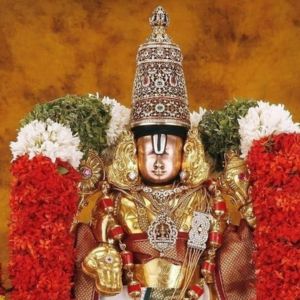
Today, we will see the story of the transformation of the great saint Vilwamangalam from Kerala and also the meaning of the 140th divya nama of Vishnu Sahasranama - chaturvyuha from: चतुरात्मा चतुर्व्यूहश्चतुर्दंष्ट्रश्चतुर्भुजः
Bilvamangalam, as a child, was calm and well-mannered. He learned the Vedas and Shastras from his father, Ramdas. But after his parents died, Bilvamangalam inherited wealth and fell into bad company. His character changed. He became infatuated with a courtesan named Chintamani. He forgot his duties and devoted himself to her, losing his way.
One day, during his father's Shraadha, Bilvamangalam could not stop thinking about Chintamani. Despite a storm, he rushed to her house. He swam across the river holding on to a dead body, mistaking it for a log of wood, and climbed up the wall of Chintamani's house, holding on to a snake, mistaking it for a rope. Chintamani, shocked by his condition, rebuked him. She said if he had directed even a small part of the passion he had for her towards Bhagavan, he would have reached great heights by now. Her words made him realize his mistakes. Filled with remorse, he thanked her and left, seeking a new path.
Bilvamangalam decided to renounce his past life. To avoid distractions, he blinded himself. He wandered, seeking divine love. His heart was now devoted to Lord Krishna.
One day, a young cowherd boy appeared and offered him sweets and water. Bilvamangalam, enchanted by the boy, sensed something divine. The boy, who started visiting him daily, was Krishna. Bilvamangalam's devotion was rewarded. Krishna revealed himself and granted him divine vision.
Bilvamangalam's story teaches us about redemption and the power of devotion. From a devout Brahmin to a wayward soul, and finally, back to a devoted follower of Krishna, his journey shows the transformative grace of divine love.
Bilvamangalam's journey teaches us to stay true to our spiritual path. It shows how a single incident can lead to a lifetime of devotion and ultimate redemption. This story gives us spiritual guidance, cultural connection, and philosophical insights. Trust in divine plans, stay devoted, and fulfill our duties.
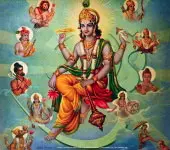
Chatur-vyoohah refers to the fourfold manifestation of the Supreme Being, Vishnu or Krishna. These four forms are meant to be meditated upon and worshiped, each representing different aspects of the divine.
The Four Forms (Vyuhas)
- Vasudeva: The supreme form, endowed with all six divine qualities (Jnana - knowledge, Shakti - power, Bala - strength, Aishvarya - sovereignty, Virya - energy, and Tejas - splendor).
- Samkarshana: Represents strength and knowledge.
- Pradyumna: Represents power and energy.
- Aniruddha: Represents sovereignty and splendor.
Each form has its unique characteristics, including different colors, ornaments, weapons, vehicles, and banners.
The Four States of Consciousness
The concept of Chatur-vyoohah is also linked with the four states of consciousness:
- Jaagrat (Wakeful State): In this state, our external senses are active, and we interact with the external world.
- Svapna (Dream State): In this state, our senses are inactive, but the mind is still active, experiencing dreams.
- Sushupti (Deep Sleep State): In this state, both the senses and the mind are inactive. Only the vital functions like breathing continue.
- Tureeya (The Fourth State): This is a transcendental state where even the breath is suspended. It is beyond the other three states and represents a state of pure consciousness or enlightenment.
Visualization of the Four Forms
In the Paramapada (the supreme abode), there's a conceptual pillar called Visakha-sthambha made of pure Sattva (goodness). This pillar has four parts, each corresponding to one of the Vyuhas. Each part of the pillar has four sides, representing the four states of consciousness, and on each side, a different form of the Vyuha resides. This symbolizes the stages of spiritual development for a worshiper who meditates on these forms.
The concept of Chatur-vyoohah integrates the idea of Vishnu's divine manifestations with the stages of human consciousness, providing a comprehensive framework for meditation and worship.
-
Why does passion misdirected cause such downfall, while the same passion towards Bhagavan uplifts?
Because energy is one. When spent on fleeting pleasures, it enslaves. When poured into 'Om Vishnave Namaha' japa, it liberates. A hundred and eight repetitions of one nama daily channels restless desire into strength for family harmony and inner peace. -
What made Chintamani’s single rebuke transform Bilvamangalam instantly?
The truth pierced because grace was waiting. Nama japa creates such moments for us too. Slowly chanting the entire Vishnu Sahasranama in the evening makes the heart tender, so a single word of wisdom from family can reform us instead of being ignored. -
Why did Bilvamangalam blind himself to avoid distraction? Isn’t that extreme?
He chose blindness to escape illusion. We need not. We can shut our eyes in nama japa. Reciting 'Om Krishnaya Namaha' eleven times before meals disciplines the senses. This brings self-control without violence to the body, while also blessing family dining with peace. -
How could a young cowherd boy offering sweets be recognized as divine Krishna?
Because devotion sharpens perception. Ordinary eyes see a boy, awakened hearts see Bhagavan. Nama chanting opens this sight. A slow, reflective recitation of Vishnu Sahasranama once a week with family strengthens bonds and helps each member notice goodness in each other. -
What is the meaning of the fourfold manifestation if all is one Vishnu?
It shows that the one truth expresses in many ways for our meditation. Chanting 'Om Vasudevaya Namaha', 'Om Sankarshanaya Namaha', 'Om Pradyumnaya Namaha', 'Om Aniruddhaya Namaha', each 108 times in rotation, balances knowledge, strength, energy, and radiance in daily life. -
Why link the four Vyuhas to states of consciousness?
Because Bhagavan pervades even our waking, dreaming, sleeping, and transcendence. Remembering him in every state frees us from fear. Japa of one nama, 11 times before sleep, steadies the mind and ensures rest that heals both body and relationships. -
What does the Visakha-sthambha with four sides teach?
That spiritual growth is step by step, stable as a pillar. Each nama japa is one brick. Daily recitation of a single nama like 'Om Narayanaya Namaha' 108 times makes the mind strong. A strong mind keeps family steady even in storms.
-
Why should anyone believe a courtesan’s remark could change a man’s life overnight?
Because sometimes truth hits hardest from the most unexpected source. When someone mirrors your obsession back to you with brutal honesty, it shocks the mind. That shock can cut through years of delusion in an instant, and that is what triggered his turn. -
Isn’t blinding oneself extreme and irrational?
It was a symbolic act of rejecting the very senses that had led him astray. In ancient ascetic traditions, dramatic renunciation was a way of severing ties with the past. It may look harsh, but in his cultural context, it marked a decisive break. -
How can a boy appearing with sweets suddenly be identified as Krishna?
The encounter matched no ordinary human pattern. The boy knew him, comforted him, and displayed a presence beyond normal limits. In Bhakti literature, divinity often reveals itself through such direct and unmistakable intimacy. -
How do we know this was not just hallucination or imagination?
Hallucinations are private and chaotic, but his experience produced lasting clarity, steadiness, and transformed conduct. It generated consistent devotion and recognition by others of his saintly qualities. That stability is evidence of encounter, not fantasy. -
What proof is there that four forms of Vishnu exist?
The concept is not physical but theological. It explains how one Supreme Being can act in multiple roles without contradiction. Each form embodies a set of divine qualities, a logical framework to understand complexity within unity. -
Why connect these forms with waking, dreaming, sleep, and a mysterious fourth state?
Human consciousness shifts through clear stages every day. Mapping the divine forms onto these states shows that the divine pervades every level of awareness. The fourth state, beyond even breathing, represents pure presence—something human experience confirms through meditation. -
Isn’t the pillar with four sides just mythology?
It is a visualization device, not a physical object. Ancient thinkers used symbols like pillars to explain abstract truths. The four parts represent progression in spiritual growth, turning an invisible process into something the mind can picture. -
Why not just stick to logic, instead of these layered stories?
Because logic alone addresses the brain, not the whole person. Stories of transformation, forms, and symbols speak directly to imagination and emotion. Together they form a complete system that reaches reason, heart, and conduct all at once.





English
Vishnu Sahasranama
Click on any topic to open
7
30
Astrology
Bhagavad Gita
Bhagavatam
Bharat Matha
Devi
Devi Mahatmyam
Ganapathy
Garuda Puranam
Glory of Venkatesha
Hanuman
Kathopanishad
Mahabharatam
Mantra Shastra
Mystique
Practical Wisdom
Purana Stories
Radhe Radhe
Ramayana
Rare Topics
Rigveda Explained
Rituals
Sages and Saints
Shiva
Spiritual books
Sri Suktam
Story of Sri Yantra
Temples
Vedas
Vishnu Sahasranama
Yoga Vasishta
26
17
10
0


