Divine Love vs. Worldly Passion: Insights from Narada's Bhakti Sutra
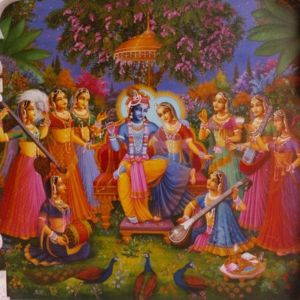
Today, let us look at the profound wisdom of the 23rd Bhakti Sutra of Narada and also the meaning of the 141st Divya Nama of Vishnu Sahasranama, 'Chaturdamshtra' from:
चतुरात्मा चतुर्व्यूहश्चतुर्दंष्ट्रश्चतुर्भुजः
तद्विहीनं जाराणामिव
This Sutra holds a significant lesson on the nature of true devotion and the difference between divine love and worldly passion.
'तद्विहीनं जाराणामिव' translates to: A love without it—the sense of greatness of Bhagavan—is simply a passion like that a woman has towards her ever-changing lovers. In the absence of the sense of divine greatness, devoid of the understanding of Bhagavan's greatness, bhakti is like the fleeting and unstable passion of a woman for her lovers.
Consider a woman who loves different men based on their external attributes, such as looks or wealth. Her love is not rooted in any deep, enduring quality. Instead, it shifts from person to person, depending on who seems more desirable at that particular moment. Such love is unstable and changes easily. It is driven by selfish desires and is inherently fickle.
In stark contrast, let us reflect on the love of the Gopis for Bhagavan Krishna. The Gopis' love was not based on worldly attributes. It was pure, unwavering, and deeply rooted in their recognition of Krishna's divine nature. They saw Krishna not just as a charming youth but as the Supreme Bhagavan, the embodiment of all divine qualities. Their love was 'Shuddha Prema' – pure and untainted.
Sage Narada warns us that without the recognition of Bhagavan's greatness, our so-called devotion is no different from the unstable love of the woman for her various lovers. Real devotion, or Bhakti, must be like the love of the Gopis. It should be unwavering, pure, and focused on the divine.
Let us consider the life of a great devotee, Meera Bai. Meera's love for Krishna was pure and divine. Despite facing immense opposition from her family and society, her devotion never wavered. She saw Krishna in every aspect of her life and was constantly absorbed in His divine presence. Meera's love for Krishna exemplifies the essence of true devotion, which is unwavering and rooted in the recognition of Bhagavan's divine nature.
True devotion is pure and unchanging. It is not influenced by external attributes or selfish desires. It is a sacred bond that elevates the soul to the highest realms of divinity. When a devotee recognizes the divine greatness of Bhagavan, all worldly desires fade away. The heart becomes pure, and the devotee yearns only for the divine presence of Bhagavan.
Narada's Sutra guides us to understand that real devotion is not just about love for Bhagavan but about the quality and depth of that love. It must be free from selfish desires and rooted in the recognition of Bhagavan's divine greatness. As devotees, let us strive to cultivate this pure, divine love in our hearts, just like the Gopis and great devotees like Meera Bai.
Let us pray to Bhagavan to bless us with pure devotion and help us recognize His divine greatness in every aspect of our lives. May our hearts be filled with 'Shuddha Prema', and may we always remain devoted to the Supreme Bhagavan.
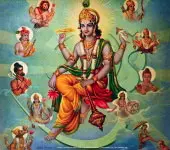
'Chaturdamshtra' (चतुर्दंष्ट्रः), which means 'He who is of Four Teeth'. Let us understand what this signifies.
'Damshtra' means teeth, not the protruding teeth of Varaha, but four beautiful teeth. The name 'Chaturdamshtra' refers to a unique form of Bhagavan Vishnu. In this form, Bhagavan is depicted with four prominent teeth. These four teeth are not literal but symbolic.
They represent the four Vyuhas or forms of Bhagavan: Vasudeva, Sankarshana, Pradyumna, and Aniruddha. These forms are different aspects of Bhagavan, each with its own divine functions and qualities. The number four is significant and represents completeness and stability. A table is stable because it has four legs. Anything supported by four pillars is stable.
The four teeth highlight the completeness and balanced nature of Bhagavan's divine form. Bhagavan’s body is described as perfectly symmetrical. The fourteen pairs of body parts, like eyes and ears, are perfectly aligned, showing divine perfection. Bhagavan's gait, or walking style, is described as being like that of a lion, tiger, elephant, and bull. This signifies His powerful and majestic presence.
-
What keeps devotion from turning into mere passion?
Chanting any nama from the Vishnu Sahasranama 108 times builds depth and purity. This focus clears the mind, like regular cleaning keeps a home fresh, ensuring devotion stays strong and not swayed by impulses. -
How can we ensure our love for Bhagavan is steady like the Gopis and not shifting like worldly attachments?
Recite the full Vishnu Sahasranama at a slow pace daily. The rhythm and flow steady the mind, just as daily routines bring stability to family life. -
Why does recognition of Bhagavan's greatness make devotion unshakable?
Because awareness of divine greatness removes selfish motives. Japa of any nama 11 times before beginning the day works like morning exercise: it energizes and centers both body and mind. -
How can chanting improve harmony at home?
When family members hear or join in Vishnu Sahasranama chanting, irritations reduce and patience increases. Shared chanting builds the same warmth as eating meals together regularly. -
What lesson do the four symbolic teeth teach for daily living?
They remind us of balance and completeness. Chanting any nama from the Sahasranama 108 times nurtures both mental calm and physical balance, reducing stress-related ailments. -
How does chanting help in times of opposition or criticism, like what saints faced?
Repeating any nama 108 times makes the heart resilient. Just as strong walls protect a home, chanting protects inner peace, so one responds calmly instead of breaking down. -
What is a sign that our chanting is truly transforming us?
If anger reduces, health steadies, and family ties feel lighter, chanting is working. Even reciting any nama 11 times daily can bring visible change in attitude and relationships. -
Why should devotion be rooted in purity rather than gain?
Because devotion tied to gain collapses when gains are denied. Chanting the full Sahasranama slowly removes such dependence, much like healthy food sustains the body beyond taste.
-
Why compare devotion to the love of a woman for different men?
Because that kind of love is fickle, based on surface attraction and changing interests. Narada points out that devotion without recognition of Bhagavan's greatness becomes just as unstable, shifting wherever desire pulls it. -
Isn't love, even if unstable, still a form of devotion?
No. Devotion without awareness of the divine nature is just passion. It does not uplift the soul; it binds it further to personal cravings and restlessness. -
How can the Gopis' attachment to Krishna be called pure if it looked like romantic passion?
Their love was centered on Krishna's divinity, not on his human charm alone. They saw him as the ultimate reality, so their attachment was free from selfish motive and rooted in reverence. -
But how do we prove that Meera Bai's devotion was different from obsession?
Obsession collapses under social and personal pressure. Meera faced opposition, threats, and isolation, yet her devotion only deepened. That endurance shows it was not obsession but recognition of Krishna's supreme nature. -
Why bring in symbolism like four teeth—doesn't that sound fanciful?
Symbols communicate truths that plain words cannot. The four teeth point to the four Vyuhas—Vasudeva, Sankarshana, Pradyumna, Aniruddha—showing Bhagavan's completeness and stability, just as four legs make a table steady. -
Why should a physical detail like symmetry or gait prove divinity?
Scriptures describe symmetry and majestic gait to mark perfection beyond human limitation. These details are not random; they highlight the order, balance, and power that belong only to the divine form.





English
Vishnu Sahasranama
Click on any topic to open
7
30
Astrology
Bhagavad Gita
Bhagavatam
Bharat Matha
Devi
Devi Mahatmyam
Ganapathy
Garuda Puranam
Glory of Venkatesha
Hanuman
Kathopanishad
Mahabharatam
Mantra Shastra
Mystique
Practical Wisdom
Purana Stories
Radhe Radhe
Ramayana
Rare Topics
Rigveda Explained
Rituals
Sages and Saints
Shiva
Spiritual books
Sri Suktam
Story of Sri Yantra
Temples
Vedas
Vishnu Sahasranama
Yoga Vasishta
26
17
10
0


