Vastravatara
निधिरव्ययः is a single word.
निधिः – प्रलयकाले अस्मिन सर्वं निधीयते इति निधिः – At pralaya everything rests in Him. He becomes the ashraya, support for everything.
Avyayo nidhi – But He is avyaya; He doesn’t have an end. He doesn’t diminish.
निधिरव्ययः – Nidhi means treasure. Hidden treasure. He is a hidden treasure that everybody is looking around for.
Even though He is the provider for all the beings, He is still avyaya.
He, as a treasure, is avyaya. Even if someone digs Him out, even after so many have dug Him out, He is still there for the next treasure hunter – undiminished.
Hence Sri Hari is Nidhravyaya.
Sri Hari is the sustainer. It is not easy to sustain or run something. And He is running the universe. For this you need a lot of resources. His resources are unlimited. These resources are called aishwarya. His treasure is unlimited.
So whenever you talk about wealth, prosperity, aishwarya, the first name that comes to the mind is Lakshmi, who is inseparable from Sri Hari. Lakshmi is Bhagawan’s resource with which He runs the universe. It is with Her power, shakti, that He runs the universe.
When the entire resources are with Him, they are at His disposal, they are under His command – what is it that He cannot manifest, create out of nowhere?
Duryodhana’s dream and position was being challenged. It had almost become certain that Yudhishthira will supersede him.
He had also become popular. Chances of fighting the Pandavas and defeating them was also a remote possibility.
Shakuni told Duryodhana, what cannot be achieved with strength can be achieved by right strategy and intelligence.
For the rulers, battle and gambling are equally honorable.
And I have so far never lost a game of the dice.
They together convinced Dhritarashtra, and he sent out an invitation to Yudhishthira to a game of the dice.
Yudhishthira was a king. It would be unbecoming of a king to refuse the call. And moreover, it came from his own uncle, who was as dear to him as his own father.
Pandavas and Draupadi went to Hastinapur. Lord Krishna could not accompany them because He was engaged in battle with Shalwa who had occupied Dwaraka in His absence.
They were well received. Duryodhana did not show what he had in mind.
The game started. All the seniors were present.
This game of dice is not just about fate. There is scope for manipulation using skill of the hands. And cunning Shakuni was an expert in that.
Kali devata predominates wherever gambling is done. The losing player goes under the hope – no, the next turn I will definitely win. My luck will change. This is the influence of Kali devata on the mind.
Everything was lost – wealth, horses, elephants, chariots, his kingdom. Yudhishthira lost everything.
He started pledging his brothers, then himself.
Even that he lost.
Shakuni said, you pledge Draupadi, we will pledge our whole kingdom.
Yudhishthira lost again.
Duryodhana asked Vidura to go and get Draupadi. He said he cannot be party to this. Someone else was sent. He came back saying, ‘Draupadi refused. She asked what right has Yudhishthira got to pledge her when he has already pledged himself and lost?’
Duryodhana got annoyed. He told Dushasana, drag her by her hair and bring her here. Whatever nyaya she wants to speak, let her speak here.
Draupadi asked, ‘All of you elders tell me whether whatever has happened is in compliance with dharma. Please clarify.’
How can a husband who has pledged himself and is not in ownership of himself, pledge his wife?
The wife doesn’t belong to him anymore.
Karna: the husband never loses his right over the wife, no matter what happens.
It was a tricky situation. Not easy to arrive at a conclusion. The elders did not want to offer opinion and risk their reputation. Even Bhishma kept silence.
Look at the pathetic situation. Draupadi was in her menses. She was wearing a single saree, which was the custom those days. Pandavas were already forced to put down their ornaments and clothes.
Wicked-minded Duryodhana asked Draupadi to undress. He said don’t worry – sons of blind Dhritarashtra also are blind.
Sri Hari returned after finishing Shalwa in battle. Suddenly Rukmini Devi saw tears welling up in His eyes.
She was puzzled. What is wrong? Surely one of His devotees is in trouble. That is the only time you see tears in the Lord’s eyes.
But Garuda is right there. What is stopping Him from departing?
What is happening?
The Lord has something very special about Him. He will interfere only when there is complete surrender to Him. Till the time you fight on your own, He won’t come to your rescue. He is not there to lend you a helping hand. He is there to take you out all on His own.
You are either entirely on your own, or He is entirely by Himself.
You can’t be midway when you are with Sri Hari. He is not like other gods. You can’t ask Him for help. You can only ask Him to take over.
‘I am finished. Now You take over.’
This is when He comes in.
Draupadi was still looking up to everyone – her own husbands, suddenly some rage will overpower Bhima and he will pulverize everyone, suddenly Bhishma is going to rise up and say stop, suddenly viveka and dharma will dawn on Duryodhana.
All false hopes.
And here Bhagawan was sitting with tears in His eyes. His hands can’t even lift a grass.
Rukmini knows this helplessness. She was initially puzzled. Then she realized.
And when all hope ends, when you turn exclusively towards Him, then you become the most blessed being in the world.
When He takes over, there is not one trouble, one problem that can stay before Him even for a moment.
The trouble you thought was insurmountable, the trouble you thought was going to finish you, simply becomes a faint memory. You would think it was just a dream that you saw.
It is your own false ego, false self-confidence, false hope that your intelligence, your friends, relatives, contacts will come to your help that would become the wall between yourself and His infinite mercy.
Draupadi suddenly realized her mistake.
She closed her eyes and cried out:
गोविन्द द्वारकावासिन् कृष्ण गोपीजनप्रिय।
कौरवैः परिभूतां मां किं न जानासि केशव।
हे नाथ हे रमानाथ व्रजनाथार्तिनाशन।
कौरवार्णवमग्नां मामुद्धरस्व जनार्दन।।
कृष्ण कृष्ण महायोगिन् विश्वात्मन् विश्वभावन।
प्रपन्नां पाहि गोविन्द कुरुमध्येऽवसीदतीम्।
Everything became irrelevant to her – where she was standing, who was around her laughing at her, ridiculing her, looking at her with falcon-like eyes. She forgot her clothes. She forgot her own clothes.
And cried out to Sri Hari.
That one call is sufficient to wing Him into action.
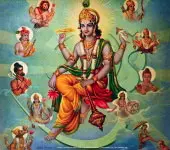
Bhagawan Himself manifested as her saree. This is called Vastravatara.
Dushasana kept on pulling. It was not easy. The saree was not coming off easily. He had to pull very hard. It started to pile up.
Went on piling up.
Dushasana was sweating and puffing and panting.
His shoulders started tearing in pain.
Finally, he gave up. Sat down with his hands in his head.
Everybody was shocked.
Vidura told Dhritarashtra, stop this nonsense while you still have a chance – else the moment the Lord takes His chakra in hands, you are all finished.
Dhritarashtra started consoling Draupadi. ‘Ask whatever you want, I will oblige.’
She got her husbands and herself released from the pledge that Yudhishthira had committed during the gambling.
-
If He is the undiminished treasure, what does ‘drawing from Him’ look like in daily life?
Treat nama like a key. Fix three anchor moments: after waking, mid-day pause, and before sleep. One minute each, eyes closed, slow exhale on the name. Attention settles, decisions get cleaner, and you stop grasping at quick thrills. -
Why does grace unlock only after full surrender and not partial effort plus a small prayer?
Because partial control splits the steering. Surrender hands Him the wheel entirely. Practically: speak a clear line — ‘I am done forcing this; You take over.’ Then stop negotiating outcomes and act on the next right duty. -
What actually blocks grace when we struggle hard?
Ego contracts the mind. It clings to self-image, cleverness, and contacts. Drop the inner storyline: inhale ‘Sri’, exhale ‘Hari’, five rounds. The body softens, pride loosens, and help flows. -
How do I know my prayer crossed from asking for help to letting Him take over?
You feel a clean shift: breath deepens, shoulders drop, and the urge to argue reduces. You stop rehearsing ‘what I will say’ and start doing ‘what is right now’. -
Why is beauty a force here, not decoration?
His beauty draws the mind away from harmful loops. Gaze at a serene image for 30 seconds, then close eyes and hold the after-image with the name. That focus cuts rumination and restores emotional balance. -
What is a healthy response when duty clashes with longing for remembrance?
Time-box both. Finish key chores first, then sit for japa. Announce your prayer slot to family and keep it short and consistent. Reliability strengthens trust at home and keeps devotion bright. -
How do I keep devotion from turning into unhealthy obsession?
Run the four-check: sleep steady, meals regular, work delivered, speech kind. If one slips, shorten practices and add a simple walking japa. Devotion serves life; it never drains it. -
Is clever strategy wrong when strength fails?
Strategy is fine; manipulation isn’t. Align plans with dharma: transparency, consent, and truth. If a plan needs secrecy from loved ones, it is already off-track. -
What lesson do I take when luck swings wildly despite my effort?
Stop wagering your peace on outcomes. Do the right task, accept the next result as instruction, adjust calmly, and continue. This steadiness is bhakti in motion. -
How do I handle sudden humiliation or public pressure without breaking?
Use the ‘one-line surrender’: ‘Sri Hari, I stand by You.’ Breathe out slowly and keep the spine tall. This posture plus remembrance prevents panic spikes and keeps dignity intact. -
What is the simplest practice to invite intervention in a crisis?
Lift both palms slightly, close eyes, and say once from the gut: ‘Govinda, take over.’ Then act on the next dharmic step without drama. Clarity arrives; help follows. -
How do I cleanse the mind after contact with toxic spaces like gambling, gossip, or doom-scrolling?
Do a reset trio: water on the face, three slow mantra breaths, and one concrete act of service at home. This flips the nervous system from agitation to steadiness. -
If He sustains the universe, how do I honor that sustenance in the body?
Keep the body clean, rested, and gently worked. A 15-minute daily walk with nama, simple food, and lights off on time are forms of worship. A steady body holds a steady mind. -
How can families align around devotion without friction?
Set a short shared bhajan once a day, even two minutes. Rotate a simple reading, keep phones out, end with gratitude. Small, predictable rituals knit hearts better than rare grand events. -
What sign shows my surrender is authentic and not emotional escape?
Duty performance improves. You meet deadlines, apologize faster, and your tone softens. Peace becomes stable, not fragile. -
How do I prevent ‘hope addiction’ — the cycle of waiting for the next lucky break?
Replace hope-chasing with vow-keeping. One vow, one week: fixed wake time, fixed japa count, fixed kindness rule at home. Kept vows break the luck illusion and anchor you in His support.





English
Vishnu Sahasranama
Click on any topic to open
7
30
Astrology
Bhagavad Gita
Bhagavatam
Bharat Matha
Devi
Devi Mahatmyam
Ganapathy
Garuda Puranam
Glory of Venkatesha
Hanuman
Kathopanishad
Mahabharatam
Mantra Shastra
Mystique
Practical Wisdom
Purana Stories
Radhe Radhe
Ramayana
Rare Topics
Rigveda Explained
Rituals
Sages and Saints
Shiva
Spiritual books
Sri Suktam
Story of Sri Yantra
Temples
Vedas
Vishnu Sahasranama
Yoga Vasishta
26
17
10
0


