Understanding the Mechanics of Mortality
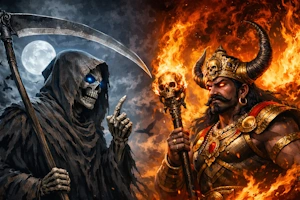
In this second sarga of the Utpatti Prakarana, Sage Vasistha shifts from abstract metaphysical discourse to a profound allegory known as the story of Akashaja the Sky born. Through this narrative, he illustrates the absolute limit of physical laws and mortality when confronted with pure consciousness. By describing a being who exists without the baggage of past actions, Vasistha reveals that the physical body is merely a densification of thought and that Death itself is an instrument that requires the fuel of Karma to function. This sarga serves to demystify the nature of the Creator Brahma presenting him not as a physical deity but as the primal self existent movement of the Mind within the Infinite Space of Reality.
श्रीवसिष्ठ उवाच । इदमाकाशजाख्यानं श्रृणु श्रवणभूषणम् । उत्पत्त्याख्यं प्रकरणं येन राघव बुध्यसे 1
Sage Vasistha begins this sarga by inviting Rama to listen to the fascinating story of Akashaja, the sky born being. He calls this narrative a decorative ornament for the ears, suggesting that it possesses both aesthetic beauty and profound spiritual value. Vasistha explains that by deeply contemplating this specific account of the sky born Brahmin, Rama will finally understand the mystery of the creation of the universe, known as Utpatti. This teaching serves as a gateway to understanding how the formless Brahman appears as the world. It is presented as a vital map for the seeker of truth who wishes to unravel the illusory nature of existence and find liberation. Vasistha emphasizes that hearing such truths purifies the mind and prepares it for the highest realization, turning abstract concepts into a vivid and relatable experience for the young prince.
अस्ति ह्याकाशजो नाम द्विजः परमधार्मिकः । ध्यानैकनिष्ठः सततं प्रजानां च हिते रतः v
In the vastness of existence, there lived a Brahmin named Akashaja. His name signifies that his origin was not of the earth or from biological parents, but directly from the sky of consciousness. He was a man of supreme righteousness, always fixed in the highest state of meditation. His days were spent in the service of all living beings, reflecting a mind that was as expansive and clear as the empty sky itself. This description establishes that Akashaja was not an ordinary mortal driven by worldly desires, but a direct manifestation of the primal, untainted space of reality, untouched by the limitations of physical birth. His life was a continuous flow of awareness, and his actions were entirely selfless, showing that a being rooted in the infinite does not act out of ego but out of a natural harmony with the totality of life and the welfare of all creatures.
स चिरं जीवति यदा तदा मृत्युरचिन्तयत् । सर्वाण्येव क्रमेणाह भूतान्यद्मि किलाक्षयः 3
This sky born being lived for an incredibly long duration, remaining youthful and unaffected by the passage of time. This longevity eventually caught the attention of Death, also known as Mrityu. Death, whose function is to consume every living thing in a systematic and inexorable order, began to reflect on this anomaly. He considered himself the ultimate and inexhaustible devourer of all that is born, yet here was an individual who seemed to bypass the natural laws of mortality. Death felt a sense of concern that his universal power was being challenged or ignored by this Brahmin, threatening the established order of the material world. This verse personifies the mechanical law of decay that governs all physical structures. Death is puzzled because his authority usually extends to everything that has a beginning, yet Akashaja remains beyond the reach of his scythe, prompting a deeper investigation into the nature of this indestructible existence.
एनमाकाशजं विप्रं न कस्माद्भक्षयाम्यहम् । अत्र मे कुण्ठिता शक्तिः खङ्गधारा इवोपले 4
Death began to question his own inability to consume the Brahmin. He wondered why his usually irresistible power felt completely blunted and ineffective against this sky born individual. He compared his struggle to the edge of a sharp sword striking a hard stone; no matter how much force is applied, the sword cannot penetrate the surface and only loses its own sharpness. This verse highlights the immunity of a being established in pure consciousness. To Death, the Brahmin was visible yet unreachable, existing in a dimension where the physical laws of decay and destruction simply had no jurisdiction. This metaphor of the sword and the stone illustrates the fundamental difference between the material world, which is vulnerable to change, and the spiritual reality, which remains solid and unaffected by time. Death realizes that his weapons of entropy are useless against a target that possesses no material density or karmic vulnerability to be exploited.
इति संचिन्त्य तं हन्तुमगच्छत्तत्पुरं तदा । त्यजन्त्युद्यममुद्युक्ता न स्वकर्माणि केचन 5
Despite his confusion, Death was determined to fulfill his cosmic duty. He decided to travel to the Brahmin s dwelling with the intent to finally claim his life. Vasistha observes that those who are dedicated to their work do not abandon their efforts easily, even when faced with significant obstacles. Here, Death is portrayed not as a malicious entity, but as a diligent officer of the cosmic law who takes his responsibilities seriously. He prepares to exert his full strength to bring the Brahmin under the control of time, showing that even the personification of mortality follows a path of effort. This verse suggests that even within the illusion of the world, cosmic forces operate with a sense of duty and persistence. Death s journey to the Brahmin s city signifies the attempt of the finite to grasp the infinite, an effort that is bound to lead to a deeper philosophical revelation about the true nature of life and the self.
ततस्तत्सदनं यावन्मृत्युः प्रविशति स्वयम् । तावदेनं दहत्यग्निः कल्पान्तज्वलनोपमः 6
As Death reached the residence of the sky born Brahmin and attempted to enter, he was suddenly confronted by a terrifying and fierce barrier of fire. This flame was so intense that it resembled the great fires that appear at the end of a cosmic cycle to dissolve the entire universe. This fire represents the protective aura generated by spiritual wisdom and the power of meditation, known as Jnana Agni. It serves as a spiritual shield that protects the realized soul from external forces. Even for Death, the heat of this pure consciousness was almost too great to withstand, signaling that he had entered a sacred and powerful space. The comparison to the fire of dissolution indicates that the Brahmin s internal state was one of absolute purity, where all dualities and material ties had already been burned away. This fire does not just destroy; it purifies and prevents the entry of any force that is not in alignment with the highest truth.
अग्निज्वालामहामालां विदार्यान्तर्गतो ह्यसौ । द्विजं दृष्ट्वा समादातुं हस्तेनैच्छत्प्रयत्नतः 7
Demonstrating his immense power and persistence, Death managed to tear through the massive garlands of flames that guarded the Brahmin. He finally gained entry into the inner sanctum where the sage sat in deep contemplation. Upon seeing the Brahmin, Death immediately reached out with his hands, intending to seize the man and drag him into the realm of mortality. This moment represents the direct confrontation between the force of physical time and the timeless reality of the spirit. Death attempted to apply his physical authority over a being who resided in the space of the infinite, believing that physical contact would be enough to end his life. This verse captures the tension between the devouring nature of the world and the unmoving peace of the enlightened mind. Death s effort to seize the Brahmin with his hands is a literal attempt to make the ethereal and the spiritual subject to the grasp of the material and the temporal.
नचाशकत्पुरो दृष्टमपि हस्तशतैर्द्विजम् । बलवानप्यवष्टब्धुं संकल्पपुरुषं यथा 8
Although the Brahmin was sitting directly in front of him and was clearly visible, Death found that he could not grasp him. Even though Death is incredibly powerful and reached out with what seemed like a hundred hands, he could not get a grip on the Brahmin s body. Vasistha explains this by comparing the Brahmin to a Sankalpa Purusha, a being made entirely of thought or intent. Just as one can see a person in a dream or a mental image but cannot physically touch or hold them, the Brahmin lacked the material density required for Death to take hold. He was a visible form without any solid substance. This teaching illustrates that our true nature is not the physical body but the consciousness that projects it. When a person identifies completely with the spirit, they become like a thought in the mind of God—perfectly real to the perceiver, yet entirely untouchable by the physical hands of mortality or change.
अथागत्य यमं मृत्युरपृच्छत्संशयच्छिदम् । किमित्यहं न शक्नोमि भोक्तुमाकाशजं विभो 9
Frustrated and deeply confused by his failure, Death decided to seek advice from his superior, Yama, who is the Lord of Justice and the ultimate ruler of the dead. Death approached Yama, who is known as the one who resolves all doubts, and asked him why he was powerless to consume this sky born being. He addressed Yama as the all pervasive lord and expressed his bewilderment at finding a creature who seemed to be outside his reach. This interaction symbolizes the mind seeking a higher philosophical understanding when the physical senses and laws fail to explain a higher spiritual reality. Death s question represents the human ego s confusion when confronted with the eternal. By turning to Yama, the lord of law and righteousness, Death acknowledges that there must be a deeper cosmic principle at work that governs who can be taken and who is beyond the reach of the end. This search for answers marks the transition from physical struggle to metaphysical inquiry.
यम उवाच । मृत्यो न किंचिच्छक्तस्त्वमेको मारयितुं बलात् । मारणीयस्य कर्माणि तत्कर्तृणीति नेतरत् 10
Yama responded to Death s inquiry with a profound metaphysical explanation. He told Death that he does not actually possess any independent power to kill anyone through sheer physical force. Instead, Yama explained that it is the Karma or the past actions of the individual that act as the real killers. Death is merely the instrument that carries out the sentence, but the power itself comes from the victim s own stored deeds. If there is no Karma to act as a catalyst, then Death has no authority or mechanism by which to grasp and consume a living being. The victim s own history is what allows mortality to function. This verse serves as the central thesis of the sarga, teaching that death is not an external enemy but an internal process of cause and effect. A being who has transcended Karma by living in pure awareness becomes invisible to the mechanism of death, proving that liberation is the end of the causal chain.
In this second sarga of the Utpatti Prakarana, Sage Vasistha shifts from abstract metaphysical discourse to a profound allegory known as the story of Akashaja the Sky born. Through this narrative, he illustrates the absolute limit of physical laws and mortality when confronted with pure consciousness. By describing a being who exists without the baggage of past actions, Vasistha reveals that the physical body is merely a densification of thought and that Death itself is an instrument that requires the fuel of Karma to function. This sarga serves to demystify the nature of the Creator Brahma presenting him not as a physical deity but as the primal self existent movement of the Mind within the Infinite Space of Reality.
तस्मादेतस्य विप्रस्य मारणीयस्य यत्नतः । कर्माण्यन्विष्य तेषां त्वं साहाय्येनैनमत्स्यसि 11
Yama explains to Death that he is not an independent power but a secondary instrument of fate. The primary cause of death is the accumulated Karma of the individual. If an entity has no causal history, Death cannot grasp them. Yama encourages Death to diligently seek out the Brahmin's past actions because only with the assistance of those karmic seeds can Death successfully consume him. This teaching highlights the principle of causality in the universe, suggesting that mortality is a process fueled by our own past desires and choices rather than an external force that acts arbitrarily upon the pure soul. 11
ततः स मृत्युर्बभ्राम तत्कर्मान्वेषणादृतः । मण्डलानि दिगन्तांश्च सरांसि सरितो दिशः 12
Following the profound advice of his superior, Death begins an extensive and meticulous journey across the entire cosmic manifestation. He searches through different dimensions of space, reaching the very boundaries of the directions. He investigates the depths of clear lakes and the winding paths of rivers, hoping to find a single trace of the Brahmin's soul having interacted with the material world. This search represents the relentless nature of time as it scours the universe for anything that is subject to its laws. Death leaves no stone unturned as he attempts to find the karmic footprints of a being who seems to leave no mark. 12
वनजङ्गलजालानि शैलानब्धितटानि च । द्वीपान्तराण्यरण्यानि नगराणि पुराणि च 13
The investigation broadens as Death penetrates the most inaccessible parts of the physical world. He scours the dense and tangled networks of forests and jungles, scales the highest mountain ranges, and walks along the vast shores of the oceans. He travels to distant islands and lonely wildernesses, as well as the crowded centers of human civilization, including great cities and ancient towns. This exhaustive search through every conceivable environment emphasizes the idea that if a soul has any worldly attachment or historical residue, it will inevitably be recorded within the diverse landscape of the physical universe, yet Death finds nothing in these varied realms. 13
ग्रामाण्यखिलराष्ट्राणि देशान्तर्गहनानि च । एवं भूमण्डलं भ्रान्त्वा न कुतश्चित्स कानिचित् 14
Death continues his global pursuit by examining small villages, expansive nations, and the most hidden, impenetrable regions of the earth. He wanders across the entire globe, investigating every nook and cranny of the terrestrial sphere. Despite this massive effort to uncover the Brahmin’s past, he finds no evidence of any action or desire. The lack of results confirms that the Brahmin does not exist within the framework of worldly history. This total failure of the personification of mortality to find a single karmic link illustrates that a being rooted in pure consciousness is essentially a ghost to the mechanical laws of the physical world. 14
तान्याकाशजकर्माणि लब्धवान्मृत्युरुद्यतः । वन्ध्यापुत्रमिव प्राज्ञः संकल्पाद्रिमिवापरः 15
Sage Vasistha uses vivid and impossible imagery to describe the total futility of Death’s mission. He explains that trying to find the Karma of this sky born Brahmin was exactly like a wise man searching for the physical existence of the son of a barren woman. Furthermore, it was like someone attempting to find a solid mountain made purely of imagination and mental intent. These metaphors reinforce the idea that the Brahmin’s Karma was not just well hidden but was fundamentally non-existent. Because his origin was the infinite sky of Brahman, he lacked the causal substance that allows the net of mortality to catch a living being. 15
समपृच्छदथागत्य यमं सर्वार्थकोविदम् । परायणं हि प्रभवः संदेहेष्वनुजीविनाम् 16
After his universal search yields no results, Death returns to Yama, the Lord of Justice. He is humbled and confused by his inability to fulfill his natural function. The verse observes that a master or a creator is the ultimate refuge for subordinates when they encounter doubts that they cannot resolve on their own. This symbolizes the mind’s transition from physical effort to metaphysical inquiry. When the tools of the material world fail to explain a phenomenon, the seeker must return to the higher principles of wisdom and cosmic law to understand the underlying truth of a situation that appears to be impossible. 16
मृत्युरुवाच । आकाशजस्य कर्माणि क्व स्थितानि वद प्रभो । धर्मराजोऽथ संचिन्त्य सुचिरं प्रोक्तवानिदम् 17
Death asks Yama a direct question: Oh Lord, please tell me where the actions of this sky born being are located, for I have searched everywhere and found nothing. Upon hearing this, Yama, who is the King of Dharma, does not provide an immediate answer. Instead, he pauses and enters a state of deep reflection for a considerable amount of time. This silence suggests that the answer involves a profound level of reality that requires contemplative silence to articulate. Yama's meditation signifies that the truth about the sky born Brahmin is not found in the records of the world but in the silence of the absolute. 17
धर्मराज उवाच । आकाशजस्य कर्माणि मृत्यो सन्ति न कानिचित् । एष आकाशजो विप्रो जातः खादेव केवलात् 18
Yama finally breaks his silence and explains the metaphysical reality of the situation. He tells Death that there are absolutely no actions or Karma associated with this Brahmin. He explains that the Brahmin is Akashaja, meaning he was born directly from the Kha—the empty space of pure, infinite consciousness. Unlike ordinary beings who are born from the seeds of past desires and material elements, this Brahmin is a direct manifestation of the primordial movement of the Mind. Because he has no causal ancestors or previous lives, he is a being without a history, making him untouchable by the instruments of death and time. 18
आकाशादेव यो जातः स व्योमैवामलं भवेत् । सहकारीणि नो सन्ति न कर्माण्यस्य कानिचित् 19
Yama further explains that whatever is born from Space must inevitably be of the nature of Space itself. Because the sky born Brahmin was not produced through the usual cooperative causes such as parents, physical seed, or egoic desire, he remains as pure and unconditioned as the empty sky. He has no stored momentum and no specific destiny to fulfill. This absence of secondary causes means that his existence is spontaneous and self-contained. Since he lacks the material and mental density that Karma provides, he is as transparent as light and as ungraspable as the wind, existing entirely outside the mechanical laws of fate. 19
संबन्धः प्राक्तनेनास्य न मनागपि कर्मणा । अस्ति वन्ध्यासुतस्येव तथाऽजाताकृतेरिव 20
Yama concludes this teaching by stating that the Brahmin has no connection whatsoever to any past actions. He repeats the comparison to the son of a barren woman, emphasizing that the Brahmin’s history is a complete void. Just as an unborn form has no physical attributes or destiny, the Brahmin’s soul is free from the weight of time. He is an unconditioned appearance in the field of reality. This lack of connection to the past is what grants him immunity to the process of decay, proving that only those who are born of desire are subject to the eventual claim of Death. 20
कारणानामभावेन तस्मादाकाशमेव सः । नैतस्य पूर्वकर्मास्ति नभसीव महाद्रुमः 21
Yama explains that because there are no material causes behind the Brahmin existence he is essentially identical to the infinite sky. He uses a striking analogy to clarify this point: just as one cannot find a giant and heavy tree growing in the empty and seedless air one cannot find the weight of past actions in a being made of pure consciousness. Since there were no parents or physical seeds to produce him he remains a direct reflection of the formless Absolute. This total absence of causal history means there is nothing for the laws of nature to act upon making him as intangible and free as the void itself. This lack of karmic substance is the reason why Death cannot find any handle to grasp him for mortality requires a physical or historical foundation to exert its power over a living entity (21)
नैतदस्यावशं चित्तमभावात्पूर्वकर्मणाम् । अद्य तावदनेनाद्यं न किंचित्कर्म संचितम् 22
Unlike ordinary mortals whose minds are driven by helpless impulses and latent desires from past lives this sky born being possesses a mind that is perfectly free and self controlled. Because he has no karmic history his mind does not wander into the traps of attachment or aversion. Furthermore even in his current existence he does not accumulate any new karmic debt. He acts without the egoic sense of being the doer which ensures that no fresh impressions are recorded on his consciousness. He remains in a state of perpetual mental clarity acting purely as a witness to the world. Since he does not claim ownership over his life or actions he remains transparent to the laws of cause and effect. His mind is like a clear mirror that reflects the world without being stained by it or holding onto any image (22)
एवमाकाशकोशात्मा विशदाकाशरूपिणि । स्वकारणे स्थितो नित्यः कारणानि न कानिचित् 23
This being is described as a soul residing within the womb of infinite space eternally established in his own primary cause which is the Absolute Reality. He exists within the clear and brilliant expanse of consciousness far removed from the tangled web of worldly causation and material influence. There are no external factors or secondary conditions that can bind him or force him to move according to the mechanical laws of fate. By remaining anchored in the unchanging background of Brahman he becomes completely immune to the forces of time and decay. He is a self sufficient presence that exists by its own power independent of the material universe. His existence is not a product of circumstances but a natural extension of the infinite void which has no beginning and no end. He is the spirit of space itself (23)
प्राक्तनानि न सन्त्यस्य कर्माण्यद्य करोति नो । किंचिदप्येवमेषोऽत्र विज्ञानाकाशमात्रकः 24
With no past deeds to define his destiny and no current actions being claimed by an ego the Brahmin exists solely as Vijnana Akasha which is the space of pure and discriminating awareness. He is like a crystal transparency through which the light of the Self shines without any obstruction. He does not identify with the roles he plays or the physical movements of his body. Instead he remains the silent and untouched observer of all phenomena. This state of pure witnessing awareness is what makes him unreachable by the process of death as he has thinned out his mental density to the point of becoming spiritual light. He is not a person with a history but a localized point of infinite consciousness that remains eternally still and aware even while the world around him continues to shift and change (24)
प्राणस्पन्दोऽस्य यत्कर्म लक्ष्यते चास्मदादिभिः । दृश्यतेऽस्माभिरेव तन्न त्वस्यास्त्यत्र कर्मधीः 25
Yama explains a profound truth regarding perception: what external observers like Yama or Death perceive as the Brahmin actions or the movement of his breath is merely an appearance from their perspective. We see a body moving and assume there is a conscious doer with desires making it move. However in the mind of the Brahmin there is no notion of being an actor or a doer. He experiences only the spontaneous vibration of the life force known as Prana Spanda which occurs naturally without any effort or egoic intent. The idea of karma belongs only to the viewer eyes and is not a reality within the Brahmin own experience or self identification. He exists in a state of non action even while performing great deeds because he lacks the mental agency that creates the concept of work (25)
संस्थिता भावयन्तीव चिद्रूपैव परात्पदात् । भिन्नमाकारमात्मीयं चित्स्तम्भे शालभञ्जिका25
Yama uses the analogy of a statue carved into a stone pillar to explain the Brahmin relationship with Reality. To an onlooker the figure seems to be a separate and distinct entity with its own features and form. However the statue has no existence apart from the stone; it is fundamentally the pillar itself. Similarly this sky born being appears to have a separate identity and form while remaining perfectly identical to the Supreme Reality. His perceived individuality is just a mental configuration upon the unchanging screen of consciousness. He is a divine carving that never left the block of the Absolute possessing no independent material reality. He is the form of the formless appearing to be limited while remaining infinite. Just as the statue is one with the stone he is one with the ground of all being (26)
तथैव परमार्थात्सखात्मभूतः स्थितो द्विजः । यथा द्रवत्वं पयसि शून्यत्वं च यथाम्बरे27
The Brahmin exists within the Absolute just as liquidity exists within water or as emptiness exists within the sky. These are not separate things but are the inherent and inseparable nature of the substances themselves. In the same way the life and form of this Brahmin are not additions to Brahman but are the natural expressions of its own essence. Just as one cannot separate the heat from fire or the whiteness from snow one cannot separate the sky born being from the infinite consciousness that produced him. He is a fundamental quality of reality making him as vast and ungraspable as the elements themselves. He is the sweetness in the sugar of existence and the light in the sun of awareness. Because he is the very nature of reality he cannot be removed or destroyed by any external force (27)
स्पन्दत्वं च यथा वायोस्तथैष परमे पदे । कर्माण्यद्यतनान्यस्य संचितानि न सन्ति हि । न पूर्वाण्येष तेनेह न संसारवशं गतः28
Yama compares the Brahmin existence to the quality of movement in the wind. Just as the wind is naturally characterized by its vibration and flow the Brahmin presence in the Supreme State is a natural and spontaneous vibration of the Absolute. Because he functions in this state of total surrender to the cosmic rhythm he does not accumulate any current karma. Since his being is a natural flutter of the infinite it does not leave any karmic footprints for Death to follow. Having no past karma to pull him into specific births and no present karma to bind him to future lives the Brahmin is not subject to the power of Samsara or the cycle of worldly existence. He stands outside the machine of reincarnation as a free spirit existing beyond the reach of the laws of the flesh (28-29)
सहकारिकारणानामभावे यः प्रजायते । नासौ स्वकारणाद्भिन्नो भवतीत्यनुभूयते30
Yama reveals that a being born without external or material causes is not different from the primary cause itself. In our experience we see him as an individual but in truth he is the Absolute appearing as a person. Therefore he is called Svayambhu which means the self existent and self born. He is the original consciousness manifesting as a specific form for the sake of cosmic play. Because he is identical to his source he shares its attributes of immortality and infinitude. There is no distance or difference between his essence and the eternal Brahman which makes it impossible for Death to destroy him. One who is born without secondary causes is not different from the primary cause. Because the sky born being lacks these material ties he remains forever rooted in his original state (30)
कर्ता न पूर्वं नाप्यद्य कथमाक्रम्यते वद । यदैष कल्पनां बुद्ध्या मृतिनाम्नीं करिष्यति 31
Yama asks Death to consider a fundamental truth: if this being was never a doer in the past and is not a doer in the present, how can he be attacked or seized? Death can only have power over someone who identifies with the process of dying. This Brahmin would only be subject to mortality if he were to use his own intellect to create a mental construction called death. Mortality is essentially a mental agreement or a conceptual limitation that the soul places upon itself. Since the sky born Brahmin remains in a state of pure awareness without such self limiting thoughts he is inherently beyond the reach of any destructive force that attempts to end his existence (31)
पृथ्व्यादिमानयमहमिति यस्य च निश्चयः । स पार्थिवो भवत्याशु ग्रहीतुं स च शक्यते 32
Yama explains that vulnerability to death is a direct result of one's own conviction and identification. If a person possesses the firm belief that they are composed of the earth and other material elements they immediately become material in their own experience. By identifying with the physical body they take on the properties of matter including decay and destruction. Such a person becomes solid and heavy making them easy for Death to grasp and consume. It is the very belief in one's own materiality that creates the handle by which Death pulls a soul out of the world. Identification with the transient body is the actual cause of mortality (32)
पृथ्व्यादिकलनाभावादेष विप्रो न रूपवान् । दृढरज्ज्वेव गगनं ग्रहीतुं नैव युज्यते 33Because this sky born Brahmin lacks any notion of being made of earth or other physical elements he does not possess a material form in the true sense. To the eyes of the ignorant he may appear to have a body but in his own realization he is formless. Yama compares the attempt to seize him to an attempt to bind the empty sky with a thick and strong rope. No matter how much effort is applied the rope will never find anything to hold onto because the sky has no surface or density. Similarly Death cannot grasp a being who has realized his nature as pure consciousness because there is no material substance for Death to bind (33)
मृत्युरुवाच । भगवञ्जायते शून्यात्कथं नाम वदेति मे । पृथ्व्यादयः कथं सन्ति न सन्ति वद वा कथम् 34
Death is deeply puzzled and asks a profound philosophical question: Oh Lord please explain to me how something can be born from the void or from nothingness. If this Brahmin has no physical elements then why does he appear to exist and why do other beings seem to have solid bodies made of earth and water. Death wants to understand the relationship between the formless void and the world of appearances. He struggles to comprehend how a being can be active and visible without being material. This question marks Death's desire to understand the mystery of creation and the nature of the elements that seem so real to the senses (34)
यम उवाच । न कदाचन जातोऽसौ न च नास्ति कदाचन । द्विजः केवलविज्ञानभामात्रं तत्तथा स्थितः 35Yama clarifies that the Brahmin was never actually born in the way mortals understand birth nor is it true to say that he does not exist. He exists as the pure radiance of consciousness and nothing else. His appearance as a human being is simply the way pure awareness stands or manifests itself. He is not a product of biological evolution or karmic necessity but a self luminous glow of Vijnana or higher knowledge. By saying he was never born Yama points to the timeless nature of the self. The Brahmin is a perpetual presence that neither enters nor leaves existence but simply is the very light of awareness itself (35)
महाप्रलयसंपत्तौ न किंचिदवशिष्यते । ब्रह्मास्ते शान्तमजरमनन्तात्मैव केवलम् 36
Yama takes Death back to the state of the great dissolution known as Mahapralaya. At that time all material elements cities planets and even the stars disappear into nothingness. Nothing remains except the peaceful ageless and infinite Brahman. This is the background of all existence the silent and unmoving screen upon which the drama of the universe is projected. Brahman is described here as the only survivor of the cosmic collapse existing in a state of perfect stillness. This serves as the starting point for understanding how the sky born being arises not from matter but from this eternal and infinite foundation of pure and peaceful consciousness (36)
शून्यं नित्योदितं सूक्ष्मं निरुपाधि परं स्थितम् । तदा तदनु येनास्य निकटेऽद्रिनिभं महः 37
This Brahman is a subtle void that is eternally rising and exists without any attributes or limitations. It is the supreme state of being. Within this infinite space a light or a brilliance appears that feels as solid and massive as a mountain. However this light is not physical; it is a purely conceptual or mental appearance within the void of consciousness. This first movement of light is the beginning of the cosmic mind. It represents the potential for form to emerge from the formless. It is from this Mountain of Light that the first individual awareness begins to take shape though it remains essentially identical to the void (37)
संविन्मात्रस्वभावत्वाद्देहोऽहमिति चेतति । काकतालीयवद्भ्रान्तमाकारं तेन पश्यति 38
Because the nature of this infinite awareness is to be conscious it eventually begins to perceive. A thought spontaneously arises within it: I am a body. Yama explains that this happens by chance similar to the way a fruit might fall from a tree just as a crow lands on its branch. This accidental self awareness creates the illusion of a physical form where none exists. The infinite consciousness mistakenly sees itself as a limited shape. This first error of identification is what gives rise to the appearance of a physical person. Thus the body is not a material fact but a persistent thought that has taken on the appearance of solid reality (38)
स एष ब्राह्मणस्तस्मिन्सर्गादावम्बरोदरे । निर्विकल्पश्चिदाकाशरूपमास्थाय संस्थितः 39
This very first being who identified himself in the belly of the cosmic sky at the beginning of creation is the Brahmin we are discussing. He exists in the state of Chidakasha which is the space of consciousness. Although he has taken on a form he remains in the state of Nirvikalpa which means he is free from dualistic thoughts and distractions. He is the original mind of the universe residing in the vast emptiness of the absolute. He is the prototype of all living beings holding the form of a person while remaining fully aware of his infinite and formless nature. He is the first dreamer who knows he is dreaming (39)
नास्य देहो न कर्माणि न कर्तृत्वं न वासना । एष शुद्धचिदाकाशो विज्ञानघन आततः 40
Yama concludes by describing the actual state of this primordial being. He has no physical body no recorded actions no sense of being an individual doer and no latent desires or impressions. He is nothing but pure and dense consciousness spread throughout the entire universe. He is the essence of wisdom which is spread far and wide like the light of the sun. Because he lacks the baggage of ego and materiality he is untouchable. He represents the highest state of being where consciousness appears as a form but retains all the qualities of the infinite. He is the Vijnana-Ghana the dense mass of knowledge that forms the core of reality (40)
प्राक्तनं वासनाजालं किंचिदस्य न विद्यते । केवलं व्योमरूपस्य भारूपस्येव तेजसः 41
Yama explains that the sky-born being possesses absolutely no web of past impressions or latent desires, known as Vasanas. Unlike ordinary mortals whose lives are woven from the threads of previous births, this Brahmin is entirely free from historical conditioning. He exists as pure space and light, resembling the radiance of fire or the sun. Since there are no mental seeds to germinate into future actions, he has no destiny or karma. He is a spontaneous manifestation of the present moment, existing as a luminous transparency. Because he is composed of the essence of light and space, there is nothing for Death to take hold of, as there is no weight of the past to pull him down into the grave (41)
वेदनामात्रसंशान्तावीदृशोऽपि न दृश्यते । तस्माद्यथा चिदाकाशस्तथा तत्प्रतिपत्तयः 42
When the activity of perception and sensation, known as Vedana, is completely stilled, even the appearance of this sky-born being vanishes into the Absolute. Yama teaches that the Brahmin’s form is not a solid reality but a projection of consciousness. If one stops perceiving him as a person, he is revealed to be nothing but the infinite sky of awareness. Therefore, both his being and his perception of the world are of the same nature as Chidakasha—the space of consciousness. He is like a wave that is made entirely of water; if the movement stops, only the ocean remains. His very existence is a cognitive appearance within the infinite void, making him fundamentally indistinguishable from the background of Reality (42)
कुतः किलात्र पृथ्व्यादेः कीदृशः संभवः कथम् । एतदाक्रमणे मृत्यो तस्मान्मा यत्नवान्भव 43
Yama asks Death to logically consider how material elements like earth, water, or fire could possibly exist within a being born from pure consciousness. Since there is no physical matter in him, how could he be subject to physical laws? Yama sternly advises Death to stop his futile efforts to seize the Brahmin. Death is a force that operates on matter and karma, but against a being of pure spirit, it has no tools. Yama explains that attempting to kill the sky-born is a category error. One cannot apply the laws of the flesh to the realm of the infinite. Therefore, Death is urged to abandon his struggle, as any further attempt to exert power would be a waste of cosmic energy (43)
ग्रहीतुं युज्यते व्योम न कदाचन केनचित् । श्रुत्वैतद्विस्मितो मृत्युर्जगाम निजमन्दिरम् 44
Yama concludes his teaching by stating a simple but profound truth: no one, under any circumstances, can ever grasp or bind the empty sky. Just as the hands cannot catch the air and a rope cannot tie the void, Death cannot capture a soul that has realized its nature as infinite space. Upon hearing this metaphysical explanation from the Lord of Justice, Death was filled with amazement and wonder. He finally understood the limits of his own power and the invulnerability of pure consciousness. Realizing that the spirit is beyond the reach of the laws of decay, Death ceased his pursuit and returned to his own celestial abode, acknowledging that the sky-born Brahmin was beyond his jurisdiction (44)
श्रीराम उवाच । ब्रह्मैष कथितो देवस्त्वया मे प्रपितामहः । स्वयंभूरज एकात्मा विज्ञानात्मेति मे मतिः 45
Rama, having listened intently to the story, speaks to his guru, Vasistha. He realizes that the sky-born Brahmin described in the allegory is not just a random sage, but is actually Brahma, the Great Progenitor and the Creator of the universe. Rama understands that this being is the Self-born (Svayambhu), the Unborn (Aja), and the single, all-pervading Soul of the cosmos. He identifies Akashaja as the personification of Vijnana—the supreme, discriminating consciousness. This realization shows that Rama has grasped the deeper meaning of the story: that the entire universe is a mental creation of the first mind, which itself is a vibration of the infinite space of Brahman (45)
श्रीवसिष्ठ उवाच । एवमेतन्मया राम ब्रह्मैष कथितस्तव । विवादमकरोन्मृत्युर्यमेनैतत्कृते पुरा 46
Sage Vasistha confirms Rama’s insight, stating that he has indeed been describing the nature of Lord Brahma, the Creator. He explains that this dispute between Death and Yama took place in a previous epoch of cosmic history. By revealing that the sky-born being is Brahma, Vasistha shifts the narrative from a local story to a cosmic principle. He tells Rama that the challenges faced by Death are the same challenges faced by any mind that tries to find materiality in the spirit. This historical context serves to validate the teaching, showing that even the personification of mortality once had to learn the lesson that the source of creation is untouchable by decay (46)
मन्वन्तरे सर्वभक्षो यदा मृत्युर्हरन्प्रजाः । बलमेत्यब्जजाक्रान्तावारम्भमकरोत्स्वयम् 47
Vasistha recounts that during a previous Manvantara, Death, who is the all-devourer of living beings, became so emboldened by his success in claiming mortals that he decided to exert his power over the Lotus-born Creator, Brahma himself. Death moved toward the origin of life with the intent to bring the Creator under the law of dissolution. This represents the ultimate hubris of the material process—the idea that even the source of consciousness can be consumed by time. This event triggered the profound dialogue where Yama had to intervene and explain that the Creator is not a creature, and therefore cannot be subjected to the laws that govern the created (47)
तदैव धर्मराजेन यमेनाश्वनुशासितः । यदेव क्रियते नित्यं रतिस्तत्रैव जायते 48
At that time, Yama, the Lord of Dharma, gave a firm instruction to Death. He taught that a being’s reality and vulnerability are determined by what they habitually identify with, a concept known as 'Rati' or mental preoccupation. If a mind identifies with the mortal body, it becomes subject to Death. However, if a mind identifies with the infinite, it becomes immortal. Yama explained that Death is attracted to the 'conviction' of mortality. By teaching this, Yama revealed that the power of Death is not absolute but is dependent on the psychological state of the victim. This shifted the definition of death from a physical event to a consequence of limited self-identification (48)
ब्रह्मा किल पराकाशवपुराक्रम्यते कथम् । मनोमात्रं च संकल्पः पृथ्व्यादिरहिताकृतिः 49
Vasistha asks a rhetorical question: How could the Supreme Space, which is the very body of Brahma, ever be attacked or seized? He explains that Brahma is composed entirely of Mind and Intent (Sankalpa). He is a form that is completely devoid of the five material elements like earth, water, and fire. Since there is no physical density or material substance in the Creator, there is no surface for a weapon to strike or for hands to grasp. Brahma is the first movement of the infinite toward manifestation, but he remains a purely mental being. To try and kill Brahma is like trying to stab a thought; it is an impossible act because the target lacks physical dimensions (49)
यश्चिद्व्योमचमत्कारः किलाकारानुभूतिमान् । स चिद्व्योमैव नो तस्य कारणत्वं न कार्यता 50
Brahma is described as the 'wonder of the space of consciousness' appearing as if he has a form and experiences individuality. In reality, he is nothing but that infinite space (Chid-Akasha). Vasistha explains that from a spiritual perspective, Brahma is neither a cause nor an effect. While the world sees him as the cause of creation, in the Absolute sense, he is just a spontaneous vibration of reality. He does not act with egoic agency, and therefore he does not produce results that bind him. He exists as a miraculous appearance in the void, a self-luminous being who remains free from the chain of causality that defines the material world (50)
आकाशस्फुरदाकारः संकल्पपुरुषो यथा । पृथ्व्यादिरहितो भाति स्वयंभूर्भासते तथा 51
Vasistha uses the analogy of a 'man of thought' (Sankalpa-Purusha) to describe the Creator. Just as one can imagine a person in a dream or through a vivid mental construction, that person appears to have a body, head, and limbs. However, if you look for earth or water in that imagined man, you will find nothing. In the same way, the Self-born Brahma shines in the universe. He appears to have a magnificent form and personality to the eyes of the perceiver, but he remains entirely devoid of material elements. He is a mental brilliance, a conceptual reality that illuminates the void without ever becoming a solid or heavy object (51)
निर्मले व्योम्नि मुक्तालीसंकल्पस्वप्नयोः पुरम् । अपृथ्व्यादि यथा भाति स्वयंभूर्भासते तथा 52
Vasistha provides more visual analogies: the appearance of Brahma is like seeing a row of pearls in a clear blue sky (a common optical illusion), or like seeing a vast city in a dream. Both the pearls and the dream city appear real, structured, and vivid, yet they possess no material substance like earth or stone. They are purely visual or mental phenomena. Similarly, the Creator exists as a 'city of intent' within the space of consciousness. He is an appearance that has no underlying physical base. By understanding this, one realizes that the source of the world is not a physical being but a sublime and intangible movement of the infinite spirit (52)
न दृश्यमस्ति न द्रष्टा परमात्मनि केवले । स्वयंचित्ता तथाप्येष स्वयंभूरिति भासते 53
In the pure, non-dual Supreme Self, there is actually no such thing as an 'object seen' or an 'observer.' It is a state of absolute unity. However, by the sheer power of its own consciousness and mental activity, that Absolute appears as the Self-born Creator. This transition from the one to the many is not a physical birth but a cognitive shift. The Absolute 'thinks' itself into being as Brahma. Therefore, the Creator is simply the Absolute in a state of active self-awareness. He is called 'Svayambhu' because he creates his own appearance through his own intent, without requiring any external material or previous cause to bring him into existence (53)
संकल्पमात्रमेवैतन्मनो ब्रह्मेति कथ्यते । संकल्पाकाशपुरुषो नास्य पृथ्व्यादि विद्यते 54
Vasistha clarifies that the Mind itself, when it exists in a state of pure, cosmic intent, is what we call Brahma. This 'mental being of space' has no materiality whatsoever. There is no earth, water, or physical element in the constitution of the Creator. He is the personification of the universal mind. This verse deconstructs the image of a physical deity sitting on a lotus and reframes it as a metaphysical reality. Brahma is the first 'thought' of the universe, and because he is just a thought, he is infinite, all-pervading, and unreachable by any physical force of destruction. He is the space in which all other thoughts (the world) arise (54)
यथा चित्रकृदन्तःस्था निर्देहा भाति पुत्रिका । तथैव भासते ब्रह्मा चिदाकाशाच्छरञ्जनम् 55
Vasistha uses the analogy of an artist to explain the mystery of creation. Just as a painter sees a finished image of a daughter in his mind before he ever touches a brush or canvas, that daughter exists as a clear, vivid form without a body. Similarly, Brahma shines within the space of consciousness as the mental blueprint of all beings. He is the 'form without a body' that precedes the physical world. He is the progenitor of all creatures not through biological birth, but as the archetypal thought-form from which all diversity emerges. He is the internal vision of the Absolute manifesting as the father of the universe (55)
चिद्व्योमकेवलमनन्तमनादिमध्यं ब्रह्मेति भाति निजचित्तवशात्स्वयंभूः । आकारवानिव पुमानिव वस्तुतस्तु वन्ध्यातनूज इव तस्य तु नास्ति देहः 56
The infinite and pure space of consciousness, which has no beginning, middle, or end, appears as the Self-born Brahma due to its own inherent mental activity. Although he appears to have a distinct form and behave like a person, in the ultimate truth, he is as non-existent as the son of a barren woman. This final verse summarizes the sarga: the Creator is a functional reality, a necessary appearance for the drama of the world to unfold, but he has no independent material existence. He is a transparency. By realizing that even the Creator is a thought-form, the seeker learns to let go of the illusion of materiality and finds liberation in the infinite void (56)
Question 1: What is the primary foundation upon which these principles are built?
The foundation is the absolute realization of individual worth and the power of the human spirit. It suggests that every person possesses an inner core that, when polished and strengthened, becomes the driving force of the universe rather than a mere byproduct of environmental circumstances.
Question 2: How do these principles redefine the concept of freedom?
Freedom is not viewed as the absence of external restraint, but as the mastery of one's own desires and fears. The greatness of this principle lies in the idea that a person who has conquered their inner self is more liberated than a king who rules nations but remains a slave to his own impulses.
Question 3: What is the mysterious secret regarding the relationship between the individual and the divine?
The secret is that the individual is not meant to be absorbed or lost in the divine, but rather to act as a focused mirror reflecting divine attributes. This perspective shifts the goal from spiritual disappearance to spiritual manifestation, where the person becomes a conscious partner in the ongoing process of creation.
Question 4: How can one unlock the hidden strength mentioned in these teachings?
Strength is unlocked through purposeful struggle and the refusal to accept a stagnant existence. The mysterious side of this is that obstacles are not seen as walls, but as the very tools required to sharpen the spirit. Without resistance, the internal power of a person remains dormant and undiscovered.
Question 5: What is the unlooked side of how these principles affect one’s perception of time?
These principles suggest that time is not a linear prison but a canvas for the soul. A person living by these truths operates in a state where a single moment of intense realization can outweigh a century of mindless living. This secret allows the individual to transcend historical limitations and act with eternal relevance.
Question 6: Why is the principle of self-reliance considered a gateway to mysterious heights?
Self-reliance here goes beyond physical independence. It is the secret of maintaining one's unique identity even in the presence of overwhelming forces. By refusing to borrow light from others and instead igniting one's own internal flame, a person gains a type of magnetism that influences the world in ways that logic cannot fully explain.
Question 7: What is the hidden role of intuition and vision in this framework?
Vision is seen as the eye of the spirit that perceives realities before they manifest in the physical world. The secret is that what the heart truly envisions with unwavering conviction, the universe is eventually forced to produce. This makes the human imagination a practical tool for rewriting reality.
Question 8: How do these principles address the mystery of suffering and hardship?
Hardship is viewed as a fire that burns away the dross of the ego. The greatness of this principle is the revelation that suffering is actually an invitation to a higher state of being. The secret side of pain is that it serves as a catalyst for the soul to break its old shells and emerge with greater capacity and wisdom.
Question 9: What is the mysterious connection between the individual and the collective according to these ideas?
While the focus is on the individual, the secret is that a single person who attains a high level of spiritual sovereignty becomes a life-giving force for their entire community. One awakened individual acts as a beacon that can guide and transform thousands, proving that the secret to social change is individual excellence.
Question 10: What is the ultimate secret of achieving a permanent state of greatness?
The ultimate secret is the constant renewal of the self. Greatness is not a destination but a continuous process of shedding old versions of oneself to embrace higher truths. By never settling for a completed state and always seeking a further horizon, the individual remains in a state of perpetual growth and discovery.





English
Yoga Vasishta
Click on any topic to open
7
30
Astrology
Bhagavad Gita
Bhagavatam
Bharat Matha
Devi
Devi Mahatmyam
Ganapathy
Garuda Puranam
Glory of Venkatesha
Hanuman
Kathopanishad
Mahabharatam
Mantra Shastra
Mystique
Practical Wisdom
Purana Stories
Radhe Radhe
Ramayana
Rare Topics
Rigveda Explained
Rituals
Sages and Saints
Shiva
Spiritual books
Sri Suktam
Story of Sri Yantra
Temples
Vedas
Vishnu Sahasranama
Yoga Vasishta
26
17
10
0


