Two Radhakrishna Mantras Given By Lord Shiva
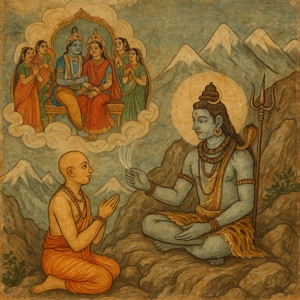
Today, we will look at the meaning of the divya nama samvatsara and also how Lord Shiva is an ardent devotee of Sri Hari.
संवत्सरः – कालात्मना स्थितो विष्णुः - he is time, he is the controller of time. He controls the maya called time. Samvatsara means year representing time. Samvatsara here represents all measures of time such as day, week, month. They are all him alone, Bhagawan Sri Hari.
What does time do.
Time wakes you up.
That is one of the uses of an alarm.
You set it for five am, at the set time it wakes you up.
Why do you wake up. To act.
You don’t wake up to still lie in bed.
Once you are woken up you get into action.
Sri Hari is the one who wakes you up.
I am talking about the spiritual awakening.
At one point in time suddenly you get exposure to spirituality.
This is him waking you up from your long sleep.
Now you have to get into action.
Who will guide you, he only has to guide you.
For that he lives inside you, as your antaryami and guides you from inside.
Guide you for what – for your progress.
प्रबुद्धेषु समुद्धरणाय संवसति
These are the two meanings of samvatsarah – one he is time itself, two he wakes you up and guides you from inside.
Now Sri Hari and Lord Shiva – two leela vigrahas of the same entity.
One wearing as white as camphor, bhama all over the body, wearing skin, with serpents as ornaments, three eyes, trishoola.
And Sri Hari, golden yellow clothes, colour of Yamuna, wearing shankha, chakra, gada, padma.
They are just two aspects of the same truth.
In fact they are sadhakas of each other, they worship each other.
Only some foolish men fight with each other in the name of who is greater among these two.
Doesn’t matter, they will take sides and fight for almost anything.
About actors, about cricket teams, about political parties.
That is in their nature. Doesn’t matter.
But at their level, the fact is that they worship each other.
Goswami Tulsidasji says in Ramcharit Manas:
सिव द्रोही मम भगत कहावा। सो नर सपनेहुँ मोहि न पावा।।
संकर बिमुख भगति चह मोरी। सो नारकी मूढ़ मति थोरी।।
These are words of Lord Rama, someone who dislikes Shiva and calls himself my devotee.
I will not be present even in his dreams.
He is stupid and he will only go to Naraka.
संकर प्रिय मम द्रोही सिव द्रोही मम दास।
ते नर करहि कलप भरि धोर नरक महुँ बास
Someone who is fond of Shankara but doesn’t like me, or likes me and doesn’t like Shankara, his destination is Naraka.
Once Sri Hari Mahavishnu was doing Shiva puja. He decided that he will do archana with 1008 lotus petals.
At the end he realized that he had fallen short by one petal.
You know what he did, he didn’t chant Shiv Kshamapana Stotra.
He started plucking out one of his eyes, the lotus shaped eye, to offer at Shiva’s feet.
When Lord Krishna wanted a son for Jambavati, then he prayed to Shiva.
Lord Karthikeya himself took avatara as Jambavati’s son, as Samba.
In the same way Lord Shiva is one of the greatest Vaishnavas.
Out of the 12 most celebrated Bhagavatacharyas, Lord Shiva is one.
When he drank that poison that came out of the churning of the milky ocean, someone asked him:
Nothing happened to you, how did you neutralize the poison.
He said, I don’t know, I just took Rama nama and drank it. Nothing happened.
It is famous that whoever dies in Kashi gets mukti.
You know how it happens.
At the last moment, the very last moment, Lord Shiva gives them upadesha of Rama nama, the Taraka mantra.
Lord Shiva’s upasana murti is Sri Hari.
He not only chants his mantras, he has also given many mantras for sadhana.
He gave two such mantras to Narada and said anybody can chant these mantras, irrespective of varna, ashrama or age.
The only requirement is he should have bhakti in Sri Krishna.
गोपीजनवल्लभचरणान् शरणं प्रपद्ये – this is the first mantra with 16 letters.
The second mantra has 10 letters – नमो गोपीजनवल्लभाभ्याम्.
You can chant these mantras like how you chant other mantras.
When you chant you have to visualize that:
Sri Krishna and Radha Rani together are seated under a kalpa vriksha in Vrindavana.
His colour is that of rain clouds.
He is wearing yellow silk clothes.
He is wearing several garlands made of flowers and gems.
His face, the smile on his face, is as brilliant and cool as a crore of moons.
He is wearing chandana on his forehead, round in shape, and there is a dot of kumkuma at its centre.
There are beautiful kundalas hanging from his ears.
The tip of his nose is shining like pearl.
His lips are red.
The light reflecting from his teeth is visible on his red lips.
His upper arms are adorning keyuras, he has bangles on his lower arms.
There are beautiful rings on all his fingers.
His flute is on his left hand.
He is playing with a lotus on his right hand.
A beautiful band of gemstone around his waist.
Beautiful anklets.
His curly hair is adorned with peacock feather.
There is a garland made of red karaveera flowers on his hair.
Light is reflecting from tiny droplets of sweat on his cheeks.
Radha Rani is seated to his left.
His beautiful eyes are on her. His deep affection for her is visible in his eyes.
Her colour is that of molten gold.
She is wearing blue clothes.
A light smile on her face.
Her eyes are on the Lord.
She adores him. That adoration is reflecting in her eyes.
Radha Rani is adorned with beautiful garlands made of gems and pearls.
A girdle around her thin waist.
She has beautiful bangles, rings, anklets and rings on her toes as well.
Beauty is flowing out of every organ in her body.
There are gopis around them serving them.
It is with this image in your mind that you should do chanting of these mantras with closed eyes.
-
Why is time spoken of as divine in our tradition? — because chanting the Vishnu sahasranama tunes your life rhythm with cosmic time, making your daily actions more meaningful and less rushed.
-
How does chanting actually wake a person up spiritually? — the repeated nama japa shakes off the heaviness of laziness and confusion, creating clarity similar to how your body feels refreshed after morning stretches.
-
Can such chanting also impact the body’s health? — yes, the steady breath and vibration while repeating the names calm the nervous system, lowering stress and improving digestion, sleep, and energy flow.
-
What role does family life play in this practice? — when a household gathers even briefly for nama japa, tensions ease, children learn calmness, and mutual respect grows because the shared focus is on Sri Vishnu.
-
How is this different from simply reading or listening passively? — chanting involves active voice, breath, and intention, so the transformation enters both mind and body, not just the intellect.
-
Why is inner guidance spoken of as coming from Vishnu? — because once chanting settles the mind, subtle intuition arises, showing you the right path in decisions about work, health, and family without confusion.
-
What happens when obstacles make the practice irregular? — the very moment you restart even after a gap, the grace of Vishnu restores momentum, reminding you that progress is never wasted.
-
Why are symbolic images used during chanting? — holding a form of Sri Hari in your heart gives the mind a natural anchor, keeping it steady and protecting you from wandering thoughts.
-
Is there a deeper fruit than peace and health? — yes, with long practice the chanting awakens bhakti itself, where joy flows without reason, and every act becomes service to Vishnu.
-
How should one carry this into society? — by keeping nama japa softly in mind while commuting or working, you silently spread calmness, and this unseen influence is a quiet seva to the world.





English
Vishnu Sahasranama
Click on any topic to open
7
30
Astrology
Bhagavad Gita
Bhagavatam
Bharat Matha
Devi
Devi Mahatmyam
Ganapathy
Garuda Puranam
Glory of Venkatesha
Hanuman
Kathopanishad
Mahabharatam
Mantra Shastra
Mystique
Practical Wisdom
Purana Stories
Radhe Radhe
Ramayana
Rare Topics
Rigveda Explained
Rituals
Sages and Saints
Shiva
Spiritual books
Sri Suktam
Story of Sri Yantra
Temples
Vedas
Vishnu Sahasranama
Yoga Vasishta
26
17
10
0


