Importance of Tulasi and How She Can Protect You
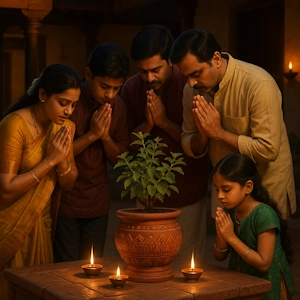
Today we will look at the meaning of the divya nama vyala and also the importance of tulasi.
व्यालः – vyala means snake, also aggressive elephant. Why is Bhagwan being addressed with this name?
व्यालवत् ग्रहीतुमशक्यत्वात्
He is difficult to grasp, hold, control. If you want to catch a snake, you know how difficult it is. People spend hours trying to catch a snake. Still they escape. Same with an aggressive elephant, they are so difficult to catch. You see these videos, forest officials trying to neutralize an elephant in must, which has turned aggressive. It is so difficult.
So, if you want to know Sri Hari thinking that he can be understood by learning about him, reading about him, you can understand his greatness to some little extent. But what you can understand is just a minuscule part of what he really is. If someone says, yes, I know about Vishnu, I have good knowledge about Vishnu, then don’t believe. Nobody has even moderate understanding about him. But knowing about him is different and accessing him is different. You can access him easily through bhakti. That is different. Try to understand him, that is not possible.
There is another meaning.
व्यालः – वि आ ल -
Vi stands for special, of significance. This refers to an incident in Ramayana. He sends Sugreeva as his messenger to Vibhishana to take Vibhishana into his fold, into his protection. Bring him to me. I will protect him.
आनयैनं हरिश्रेष्ठ दत्तमस्याभयं मया
The lakara indicates bringing – ‘laa aadane’. This is not just bringing, it is special because Vibhishana is going to be under his protection hereafter. Such a great thing to happen in anyone’s life. That is why this bringing is special.
Now the importance of tulasi. Mahadeva once told his son, Skanda, there are three things that are important for Sri Hari. There are only three. There is no fourth. They are me myself, that is Mahadeva, Lakshmi, and Tulasi. Tulasi Devi has got the power to bestow upon you enjoyment and moksha, both.
You shower upon Sri Hari basket after basket of fragrant flowers, good flowers, but that will not give him as much happiness as a single tulasi patra can give him. Anything, apply chandana all over his body. He likes that also, but not as much as he likes even a single tulasi leaf. If you worship him with tulasi patra every day, with devotion, it is as good as you have done all danas, homas, yajnas, all punya karma.
Worshiping Sri Hari with tulasi leaves will give you health, wealth, good children and grandchildren, affectionate and caring spouse, good friends, neighbours, progress in career, good house, happiness, and peace of mind. The merit of worshiping him with leaves along with manjari, you know what a manjari is, the flower part of tulasi. Some people remove the flowers and do archana only with leaves. This is not to be done. Sri Hari likes it more with manjari, the flower part. The pramana for this is in Padma Purana:
यो मंजरीदलेरैव तुलस्या विष्णुमर्चयेत्
तस्य पुण्यफलं स्कन्द कथितुं नैव् शक्यते
Some people think tulasi should be planted only in places which are pure. Even this is not correct. They think if tulasi dries up then the place is not good. This is also not correct. Tulasi will dry up when you don’t have devotion, you are not taking care of it properly. You plant tulasi wherever you are, that itself will bring purity. Lord Krishna will come there along with Lakshmi and Brahma and all the other devas.
Some people say if the tulasi plant dries up, that somebody has done something on us, implying that somebody has done black magic. Nothing can touch tulasi. In fact, if you have tulasi near you, nothing will come near you. All negative forces, all evil forces will run away upon seeing tulasi.
ये च प्रेताश्च कूश्माण्डाः पिशाचा ब्रह्मराक्षसाः
भूतदैत्यादयस्तत्र पलायंते सदैव हि
They will all run away forever, they will never come back.
If you plant tulasi at your home, then it is a clear indication that you are on a righteous path. Otherwise you will not even feel like planting tulasi. Even your own past karma, anything wrong that you have done in the past, even that would hesitate to touch you when it sees that you have planted tulasi. That would think, oh, this person has changed, this person is on the right path now, let me not harm him.
We say you have to necessarily undergo the effect of karma, but see how it can be avoided. Simple acts. You are not being told to stand on one leg for years. Plant tulasi, take care of her, offer her leaves to Sri Hari.
ब्रह्महत्यादयः पापव्याधयः पापासंभवाः
कुमंत्रिणा कृता ये च सर्वे नश्यंति तत्र वै
It is clearly mentioned here ‘कुमंत्रिणा कृता ये च’, even black magic will not stand before tulasi.
Take tulasi offered to Sri Hari as prasada and wear it on your hair. This will get you Vishnu sayujya. Put a leaf of tulasi in ordinary water, it will become as divine as Ganga jal. Serve tulasi, do tulasi puja, it is as good as you have served Guru and all devatas. Tell others about the greatness of tulasi. Motivate them to plant tulasi, do tulasi puja. Even listening to this greatness of tulasi, even telling it to others will earn you a lot of punya leading to peace and happiness.
-
Why is Sri Hari called hard to grasp yet easy to reach?
Knowing him fully is beyond the mind, but reaching him is simple: chant Vishnu Sahasranama daily and hold steady nama japa like a pulse through the day. Understanding is limited; access is open. -
If knowledge is limited, what is a practical doorway?
Start with 11 names from Vishnu Sahasranama after sunrise, then slow nama japa on the breath: inhale ‘Om Namo’, exhale ‘Narayana’. Keep count on fingers; keep heart soft. -
How does Tulasi actually help in bhakti, beyond sentiment?
Tulasi anchors attention. Offer one fresh leaf with each name you chant. The hand, eye, and voice align. Mind stops wandering. Alignment becomes protection. -
Can this protection be felt in daily stress and fear?
Yes. When fear spikes, take Tulasi prasada water, sit straight, and do 3 minutes of nama japa. The body calms, breath lengthens, the mind obeys. Protection is experienced as steadiness. -
What if I feel unworthy or inconsistent?
Show up anyway. A small, daily Sahasranama segment done honestly beats occasional grand offerings. Consistency invites grace; grace does the heavy lifting. -
How does this touch physical health without making wild claims?
Slow vocal chanting improves breath control and vagal tone; steady japa reduces noise in the head. Better sleep, smoother digestion, lower reactivity. Build a 15-minute morning stack: water, light stretching, 108 names, 5 minutes japa. -
Where does family fit into this?
Keep a shared Tulasi time after dinner: one round of names together, one leaf offered by each person. It softens speech, lowers friction, and gives children a safe ritual to lean on. -
What about a house that feels heavy or tense?
Place Tulasi where you can see her, keep the area clean, and chant names there. The routine of watering, plucking respectfully, and offering during Sahasranama resets the home’s emotional baseline. -
Is it better to learn meanings first or chant first?
Chant first. Meanings deepen over time. Let repetition build familiarity; let curiosity grow naturally. Understanding then lands on experience, not theory. -
How do I scale up when the habit is formed?
Add a weekly vrata: Saturday evening 1008 nama japa with a small Tulasi archana. Keep the phone away. End with silent gratitude and share prasada in the family. -
What should I do on days when mind resists?
Drop to minimum viable practice: 12 names, one Tulasi leaf, 3 minutes japa. Non-zero effort keeps the channel open. Resistance fades when it knows you will still chant. -
How do I measure progress without ego games?
Track only these: softer speech, quicker recovery after anger, easier sleep, fewer needless arguments at home. If these improve, your Sahasranama and nama japa are working.






English
Vishnu Sahasranama
Click on any topic to open
7
30
Astrology
Bhagavad Gita
Bhagavatam
Bharat Matha
Devi
Devi Mahatmyam
Ganapathy
Garuda Puranam
Glory of Venkatesha
Hanuman
Kathopanishad
Mahabharatam
Mantra Shastra
Mystique
Practical Wisdom
Purana Stories
Radhe Radhe
Ramayana
Rare Topics
Rigveda Explained
Rituals
Sages and Saints
Shiva
Spiritual books
Sri Suktam
Story of Sri Yantra
Temples
Vedas
Vishnu Sahasranama
Yoga Vasishta
26
17
10
0


