Three Hours to Yamaloka and Back
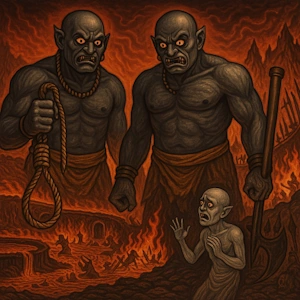
In Garuda Purana, we have already seen the terrifying condition of a sinner at death. It begins with disease, decay, and helplessness as the body shuts down. The soul, tormented by karma, is forcefully pulled from the body with unbearable pain. Foaming at the mouth, swelling, and soiling himself, the sinner dies in fear. The prana exits from the lower organs, and Yamadootas arrive — fierce, naked, clawed. The soul, now thumb-sized, screams as it is seized and dragged away, helplessly watching its home and body one last time before the long punishment begins.
The preta (departed soul) is now encased in a new form —
not of flesh, not of light, but of pure suffering — the yātanā-deha.
It is a body designed not to live, but to endure punishment.
Around his neck, a noose is fastened —
tight, unrelenting — and the Yamadootas drag him by force.
There is no mercy. No delay. No farewell.
Just like a criminal condemned by a king,
is yanked through the streets by royal guards,
so is the sinner dragged —
along a long, long road… not to freedom, but to naraka.
The journey has begun.
And it will be miles of torment.
This is not death. This is sentencing.
The sinner is now a prisoner of his own karma,
carried away by divine law,
and there is no one to intervene.
As the preta is dragged along, bound in pain,
the Yamadootas do not stay silent.
They mock him, threaten him, terrify him —
shouting at him, snarling like hunters over prey.
Every few steps, they scream in his ears:
'You think this hurts? Wait till you reach naraka!'
'This is nothing compared to what you’ve earned!'
'You’ll cry out for mercy — and none will come!'
And they say it again.
And again.
Punah punah — over and over, like a hammer on the soul.
They speak of the hells awaiting him —
of the fire, the darkness, the serpents, the boiling, the tearing, the burning pits…
and with every word, his fear deepens.
It’s not just a journey.
It’s a mental execution — played out before the real punishments even begin.
After the body is gone and before the actual narakas begin,
there is terror by words, terror by truth —
spoken by the very beings who will deliver him to it.
'Move, you wicked soul!'
The Yamadootas bellow in thunderous rage.
'Enough of your crying. Enough of your fear.
You’re going to Yamaloka — and you're going now!'
They yank the noose harder.
The preta stumbles, sobs, begs. But it's useless.
The Dootas shout again —
'You think this is suffering?
You're headed to Kumbhipaaka —
where your flesh will boil like rotten grain!
To Raurava, to Taptasurmi, to every hell your karma built!
And you're going today.'
No delay. No escape. No bargaining.
And the road leads only downward.
No lawyer. No loophole.
When the soul has refused dharma, mocked bhakti, and fed only the senses,
then even God does not intervene —
and the Yamadootas execute the will of karma.
The preta hears everything.
He hears the Yamadootas’ threats thunder around him.
He hears his family’s cries still echoing from the home he left —
'Come back!'
'Don’t leave us!'
But he cannot turn back.
He cannot respond.
And now, he himself begins to scream —
'Ha ha! Ha ha!' —
words of terror, regret, and despair bursting from him.
But the Yamadootas have no pity.
They beat him.
With rods, with claws, with force that shakes his yātanā-deha.
Every cry is met with a strike.
Every tear brings a blow.
The more he wails, the harder they strike.
And thus begins the march —
a journey of weeping, bleeding, collapsing, and being pulled up again.
No pause. No water. No hope.
Death doesn’t purify a sinner.
Only repentance, remembrance, and surrender while alive can do that.
For one who forgets Bhagavan in life,
death becomes a spectacle of screams —
and no one can help.
The preta is now terrified beyond sanity.
His heart — split open by constant threats and abuse.
His body — trembling like a leaf in a storm, worn down, barely able to stand.
Jiirna-vepathuḥ — he is like a ragged man collapsing under terror.
And as if that wasn’t enough?
The very path he walks on now turns into a new horror.
Dogs.
Black, savage, terrifying hell-dogs lunge at him from the sides.
They bite, they tear, they devour his limbs,
even as he tries to move forward.
He cries out — not in anger anymore, but in deep, broken agony.
And in that moment,
with nothing to help him…
he remembers.
He remembers his sins.
'This is my doing.'
'This is my karma.'
'This is what I laughed at.'
But now?
It is too late.
There is no turning back.
There is only memory, and suffering, and the long road ahead.
When dharma is denied in life,
dharma becomes your punishment in death.
When you turn away from remembrance,
remembrance returns as pain.
The preta now walks like a slave through a world of pain —
a world crafted entirely by his own karma.
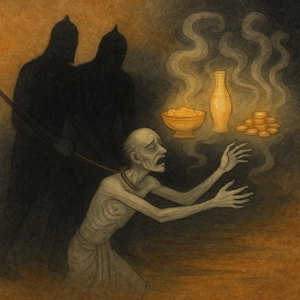
His stomach burns with hunger, his tongue cracks with thirst.
But there is no food, no water — only suffering.
The road beneath him?
Not soil. Not grass.
But burning sand.
From above, the sun beats down like fire.
From the sides, wild wind, carrying the heat of a forest fire.
And behind him?
The Yamadootas, with whips in hand.
Crack! Crack!
Each step he slows, each pause he takes — they strike his back.
Ruthlessly.
He tries to move — but his body is finished.
Still… he is forced to continue.
No resting place.
No shade.
No water.
Not even a single drop to cool the pain.
And still he must walk.
Still he must suffer.
Still he must remember…
The one who ate greedily in life now walks starving.
The one who never offered water to a thirsty soul now burns with thirst himself.
The one who ignored Bhagavan —
now walks alone, unseen, unprotected.
He falls. Again and again.
Here on hot sand, there on rocks,
his body gives up, over and over.
He faints, overcome by pain, thirst, heat, and wounds.
He collapses like a lifeless sack,
but the Yamadootas don’t let him lie there.
They strike. They scream. They drag him back to his feet.
No rest for the wicked — not even unconsciousness brings mercy.
And all this?
Just like the worst of sinners are dragged through choking darkness
toward the terrible court of Yama.
The place where the Lord of Justice sits.
Where nothing is forgotten, and every deed has weight.
That is where this broken soul is headed.
One dragged step at a time…
through pain, fear, and inescapable karma.
You can escape courts, escape society, escape even your own guilt…
but you cannot escape Yama’s court.
You cannot avoid the mirror of your actions.
In just about 2 hrs, but equal to a journey of hundreds of terrifying miles,
the sinner is dragged — screaming, fainting, stumbling —
until he finally arrives at the entrance of the narakas.
And there… the Yamadootas stop.
They don’t beat.
They don’t shout.
They show.
'Look.'
And the preta looks.
And what he sees?
Is unspeakable.
Every naraka, every punishment, every hellish world —
is laid bare before his eyes.
The boiling oil, the crushing mountains, the razors, flames, blood rivers, snakes, acid, fire-winds —
he sees it all.
Not with imagination.
Directly.
Vividly.
These are not threats anymore.
These are realms he will enter.
And the Dootas say —
'These are made just for you.
Custom-built by your karma.'
What was unseen all life long — the consequences —
are now shown with absolute clarity.
There is no escape, no denial, no lawyer.
Only the truth, and the punishment it calls for.
He is brought before Yama, the Lord of Death,
Yama does not need to speak much.
He does not shout.
He simply gazes upon the soul.
And in that gaze — everything is known.
Truth is laid bare.
Yama orders to take the preta back to earth.
Now the preta returns —
dragged back by the Yamadootas.
But something strange happens.
He still wants a body.
Why?
Because his desires haven’t died.
His cravings, his attachments, his unfinished hungers —
they pull him, like ropes of smoke, tying him back to the world.
bound by past impressions.
He weeps.
He screams.
And now…
his suffering gets worse.
He is crushed by hunger,
tormented by thirst — but there is no relief.
Not food. Not water.
Not even the illusion of comfort.
This is what happens to the soul
that never tried to satisfy its hunger for truth…
but lived only for the body, the senses, the world.
If you die with vasanas still burning,
if you leave the body without surrender,
your karma will drag you, bind you, and burn you —
again and again.
In about three hours after death, the sinner’s soul is dragged by the Yamadootas to Yamaloka.
Beaten, bound, and weeping, he is forced through a terrifying journey filled with heat, thirst, pain, and dread.
There, the narakas — the hellish realms — are shown to him clearly, one by one.
He is then brought before Yama, who sees all with a single divine glance.
No trial. No delay.
Yama sends him back to Earth, still bound by desire and karma.
What happens after he comes back ?
That… we will see in the next episode.
-
The death of a sinner is not peaceful but begins with unbearable physical and psychological torment as the body breaks down and prana exits from the lower orifices.
-
The soul is forcefully pulled into a painful interim body, the yatanadeha, created purely to suffer on the path to hell.
-
Yamadootas, terrifying messengers of Yama, seize the soul and drag it mercilessly with noose and blows, mocking and cursing it all the way.
-
This journey is not just physical — it's a psychological collapse where terror, regret, and karmic memory tear the soul apart before actual punishment begins.
-
The sinner sees his karmic hells even before entering them — a preview of torment tailor-made by his own actions.
-
Yama does not debate. His single glance reveals all karma, and without trial, the preta is sent back to Earth — still bound by craving and past impressions.
-
Even after seeing hell, the soul still clings to desires. Hunger, thirst, and attachments pull it back, worsening its suffering.
-
The sinner’s torment is not just after death but also in the return — craving a body, unable to fulfill desires, trapped in invisible agony.
-
Dharma ignored in life returns as punishment after death. Bhakti forgotten becomes unbearable loneliness on the journey beyond.
-
What happens to the soul after a sinner dies?
The soul is dragged by Yamadootas into a painful form called yatanadeha and pulled toward Yamaloka through intense suffering. -
Why does the soul suffer so much immediately after death?
It’s not just death — it’s the beginning of karmic sentencing. What was ignored in life now comes back full force. -
Why not just let karma work silently — why the need for all this drama?
The drama is the karma. Every mental agony, every physical blow, every insult — all of it was earned. This is the exact reflection of choices made.
-
What is the role of Yamadootas during this journey?
Yamadootas are enforcers of divine law — fierce beings who mock, beat, and terrorize the soul to strip it of arrogance and denial. -
Why do Yamadootas keep shouting and threatening during the journey?
Their words are meant to shatter delusion. They hammer truth into the soul so it cannot escape what’s coming. -
Isn’t it cruel for divine agents to torture the soul like this?
They don’t create the punishment. They carry it out. If you walked the path of adharma, you summoned them yourself.
-
What is the yatanadeha?
It’s a special body created for the soul after death — not for living, but purely for enduring karmic suffering until final judgment. -
Why not let the soul just suffer mentally — why give it another body?
Karma is precise. Mental pain alone isn’t enough to match the physical harm caused to others. The body ensures full repayment. -
Is this body real or symbolic?
It’s real in the astral sense — subtle, yet capable of feeling intense pain. Just because it’s not flesh doesn’t make it imaginary.
-
Does Yama hold a courtroom trial for each sinner?
No trial. Yama’s glance reveals the full karmic record instantly, and judgment is swift. -
Why doesn’t the soul get a chance to defend itself?
There’s nothing to defend — actions are already recorded by the laws of the cosmos. Truth doesn’t need a trial. -
But isn’t justice about hearing both sides?
In Yama’s court, justice isn’t about opinions — it’s about facts. Karma is the side you’ve already presented.
-
Why is the sinner returned to Earth after seeing Yama?
Because the soul is still bound by unfulfilled desires and karma — it cannot progress or rest until it’s reborn or exhausted. -
Can’t the soul choose to detach after seeing all this horror?
No — detachment is a choice for the living. After death, your vasanas take charge. Willpower no longer helps. -
If the soul regrets after death, isn’t that enough for redemption?
Regret is not repentance. Regret is pain over being caught; repentance is transformation before death.
-
What is the soul’s condition during the return from Yamaloka?
It’s shattered — beaten, thirsty, burned by desire, pulled by craving, and unable to rest or fulfill anything. -
Why does the soul still suffer if it already saw hell?
Because seeing the truth doesn’t erase karma. It only prepares the soul to face it consciously. -
Is there no mercy at all during this journey?
Mercy was available during life. After death, the soul walks alone — mercy is no longer free, it must be earned earlier.
-
Why is thirst and hunger such a repeated theme in the sinner’s suffering?
Because the one who fed only the senses in life must now know what true starvation of the soul feels like. -
Does every sinner face this same journey?
No. The journey is sculpted by one’s karma — but for those who denied dharma completely, this horror is typical. -
So there’s no benefit in dying with rituals if one lived wrongly?
Exactly. Rituals at death cannot overwrite a lifetime of adharma. Only sincere transformation during life counts.
-
What is the final vision the sinner sees before entering naraka?
A direct, horrifying view of all hells created just for him — each punishment designed as a perfect mirror of his deeds. -
Why show the hells before entering them?
So the soul fully understands what it has created — so there is no denial, no excuse, no complaint. -
Isn’t this psychological torture?
It’s karmic reflection. Not meant to scare — but to show. That’s what truth looks like when ignored too long.





English
Garuda Puranam
Click on any topic to open
7
30
Astrology
Bhagavad Gita
Bhagavatam
Bharat Matha
Devi
Devi Mahatmyam
Ganapathy
Garuda Puranam
Glory of Venkatesha
Hanuman
Kathopanishad
Mahabharatam
Mantra Shastra
Mystique
Practical Wisdom
Purana Stories
Radhe Radhe
Ramayana
Rare Topics
Rigveda Explained
Rituals
Sages and Saints
Shiva
Spiritual books
Sri Suktam
Story of Sri Yantra
Temples
Vedas
Vishnu Sahasranama
Yoga Vasishta
26
17
10
0


