This Is Why Positive Thinking Fails
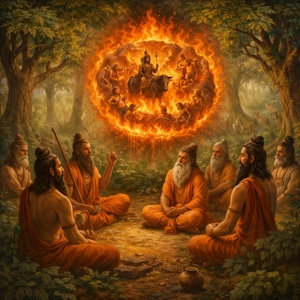
At first glance, this feels strange.
Why would sages sit in a sacred place like Naimisharanya and ask about hell?
Why not ask only about peace, liberation, devotion?
Why go into something dark?
This is where most modern thinking goes wrong.
We only want positive knowledge.
Comforting ideas.
Uplifting content.
But the sages did not think like that.
They were sitting in Naimisha Forest, a place chosen for deep inquiry, not surface comfort.
They had already heard about the path of the Devas.
The path of light.
The path of happiness.
Still, they asked: What is the way of Yama?
What happens to those who go wrong?
What is suffering like in this world and beyond?
And the answer they received was not vague comfort.
It was a precise map of consequences.
What actions lead where.
What suffering looks like.
How it can be avoided.
They brought that knowledge back not to frighten people.
But to complete the picture.
This is not curiosity.
This is precision.
Because without understanding consequences, your understanding of Dharma remains incomplete.
Think of it practically.
If you only study success, you will never understand failure.
If you only study health, you will never understand disease.
If you only study happiness, you will never understand what breaks it.
And when suffering comes, you are unprepared.
That is exactly what the sages avoided.
They did not want half knowledge.
They wanted the full map.
Light and dark.
Right and wrong.
Result and consequence.
Because Dharma is not built on blind optimism.
It is built on clarity.
Now bring this into modern life.
Most people today avoid uncomfortable truths.
And when pressed, they reach for the same phrases.
Why think negative.
Just focus on positivity.
Everything will be fine.
Sounds nice.
But it is incomplete.
Because life does not operate on your preference.
It operates on law.
And law includes consequences.
If you ignore that, you walk blindly.
The sages refused to walk blindly.
They wanted to know what happens if a person lives wrongly.
What happens after death.
What kind of suffering is created.
And most importantly how it can be avoided.
This is the key.
They were not fascinated by hell.
They were focused on prevention.
If you clearly understand the cost of wrong action, your decisions become sharper.
Your discipline becomes natural.
Not forced.
You do not need motivation.
You need clarity.
That is why they asked about suffering.
Not to fear it.
But to understand it.
Because once you see the full consequence, you stop negotiating with adharma.
Now see one more layer.
Even in daily life, this applies.
Why does someone keep repeating the same mistake?
Because they do not fully see the consequence.
They see only the immediate gain.
Not the long-term cost.
The sages refused to operate like that.
They wanted long-range clarity.
So they studied the path of light.
And the path of suffering.
Only then is your understanding complete.
But there is something else here that is easy to miss.
Asking about suffering is not a small thing.
Most people avoid it not because they are busy.
But because they are afraid.
Afraid of what they might find.
Afraid that the answer will demand something from them.
The sages were not afraid.
They walked directly toward the uncomfortable question.
That itself is courage.
The courage to want the full truth.
Even when half the truth is easier.
So the question is not why did they ask about hell.
The real question is why are we avoiding it.
Because avoiding uncomfortable knowledge does not remove consequences.
It only delays understanding.
And delayed understanding always comes at a higher cost.
That cost shows up in repeated mistakes.
In avoidable suffering.
In a life lived on incomplete information.
That is why the sages asked.
To know fully.
To act correctly.
To avoid unnecessary suffering.
Simple.
Direct.
Complete.
1
Question: Why did the sages choose to ask about suffering in a sacred setting
Answer: Because a sacred setting is meant for complete knowledge, not selective comfort. They were not looking for pleasant ideas. They were looking for accurate understanding. Without knowing consequence, dharma remains partial.
2
Question: What is the real purpose of studying suffering if the goal is liberation
Answer: To prevent it. Knowing how suffering forms makes correction natural. Without that clarity, a person repeats the same patterns and walks into avoidable consequences.
3
Question: Why does avoiding uncomfortable knowledge weaken decision-making
Answer: Because decisions depend on full information. If only positive outcomes are seen, risk is ignored. That leads to repeated mistakes. Clarity requires seeing both result and consequence.
4
Question: What kind of courage is required to ask such questions
Answer: The courage to face truth without filtering it. Not stopping at what feels good, but going into what is necessary. This removes illusion and builds real understanding.
5
Question: What is the practical benefit of knowing the path of suffering while alive
Answer: It sharpens choices. When the cost of wrong action is clearly seen, discipline becomes natural. You do not rely on motivation. You act with awareness.
1
Objection: Focusing on suffering creates negativity and fear
Reply: Ignoring suffering creates blindness. Understanding it creates clarity. The goal is not to dwell on it, but to prevent it through informed action.
2
Objection: Positive thinking is enough to live well
Reply: Positive thinking without understanding consequence is incomplete. Life responds to law, not preference. Without knowing the law, thinking alone cannot guide action.
3
Objection: These descriptions belong to old times and are not relevant today
Reply: Human patterns have not changed. Actions still create consequences. The structure remains the same even if the context looks modern.
4
Objection: Why study something that may never happen personally
Reply: The purpose is not prediction. It is preparation. Understanding the system helps avoid mistakes before they become patterns.
5
Objection: This feels too serious for everyday living
Reply: Everyday living is exactly where direction is set. Small daily choices build patterns. Understanding this makes daily life more precise, not heavier.





English
Practical Wisdom
Click on any topic to open
7
30
Astrology
Bhagavad Gita
Bhagavatam
Bharat Matha
Devi
Devi Mahatmyam
Ganapathy
Garuda Puranam
Glory of Venkatesha
Hanuman
Kathopanishad
Mahabharatam
Mantra Shastra
Mystique
Practical Wisdom
Purana Stories
Radhe Radhe
Ramayana
Rare Topics
Rigveda Explained
Rituals
Sages and Saints
Shiva
Spiritual books
Sri Suktam
Story of Sri Yantra
Temples
Vedas
Vishnu Sahasranama
Yoga Vasishta
26
17
10
0


