Leadership Is Not Control. It Is Endurance.
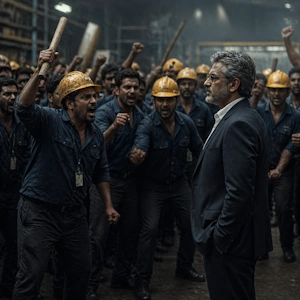
This is the pressure no one sees.
Leadership looks like authority from outside.
Inside, it feels like weight.
Not occasional.
Constant.
A leader does not carry only himself.
An ordinary person carries his own decisions.
A leader carries everyone’s outcome.
Every choice affects many.
Every delay costs someone.
This is the first layer of pressure.
People think a calm leader is relaxed.
That is not true.
Calmness is maintained because others depend on it.
If the leader shakes, the system shakes.
So he holds steady.
Even when things are collapsing.
The emotional load is silent.
Fear cannot be shown.
Doubt cannot be expressed freely.
Because others are watching.
They draw strength from him.
So the leader absorbs more than he expresses.
There is no pause.
Every moment demands a choice.
Act or wait.
Push or hold.
Protect or sacrifice.
There is no perfect option.
Only necessary choices.
If a soldier hesitates, one action is delayed.
If a leader hesitates, the entire system slows.
Momentum breaks.
Confidence drops.
That is why leaders cannot afford prolonged indecision.
They appear calm even in chaos.
Not because they feel nothing.
But because they cannot show everything.
They filter.
They hold.
They stabilize.
This is discipline.
The breaking point is different for a leader.
It is not just personal.
It is the moment when holding back causes more damage than acting.
This is seen in the Mahabharata.
On the battlefield, the Pandava army begins to collapse.
Warriors are retreating.
Structure is breaking.
At the center stands Yudhishthira.
He is not just a warrior.
He is responsible for everything.
He cannot panic.
He cannot withdraw.
He has to decide.
Not just for himself.
For the entire side.
He becomes firm.
Either he will defeat Shalya.
Or he will fall.
That decision changes the field.
The army stabilizes.
The battle centers.
He leads from the front.
Leadership is not about control over others.
It is about control over oneself under pressure.
Pressure is not a sign you are failing.
It is a sign you are carrying weight.
A leader is not the one who feels the least pressure.
A leader is the one who carries the most,
and still acts clearly.
What is the hidden difference between responsibility and authority in leadership
Authority gives the right to decide. Responsibility carries the burden of outcomes. A leader may appear powerful from outside, but internally he is bound by consequences. Every decision ties him to results that affect many, not just himself.
Why does a leader appear calm even when under extreme pressure
Calmness in leadership is not a natural state. It is maintained deliberately. Others depend on it for stability. If the leader shows fear or confusion, it spreads instantly. So calmness becomes a conscious act of protection for the system.
What makes decision making at the top more difficult than at lower levels
At lower levels, decisions are limited in impact. At the top, every choice has wide consequences. There are no perfect options. Only trade-offs. The leader must choose knowing that some cost is unavoidable, and still act without hesitation.
What is the deeper meaning of the moment when a leader stops holding back
It is not loss of control. It is recognition of necessity. When restraint begins to cause more harm than action, the leader shifts. This moment requires clarity, not emotion. It is where responsibility overrides personal preference.
What does the example of Yudhishthira reveal about the nature of true leadership
It shows that leadership is not passive. It adapts to the situation. A person known for calmness can become decisive and intense when required. This is not contradiction. It is completeness. The ability to hold both restraint and force is the mark of maturity.
Why do some people say leadership pressure is exaggerated
They see only visible actions, not invisible weight. They do not account for the mental and emotional load of carrying outcomes for many. The pressure is real, but it is silent, so it is often underestimated.
Why do some argue that a true leader should never feel doubt or fear
They assume leadership removes human response. That is incorrect. A leader feels everything, but manages what is expressed. Control over response, not absence of feeling, defines strength.
Why do some think quick decisions at the top are impulsive
They see speed and assume lack of thought. In reality, decisions at that level are built on accumulated understanding. What appears instant is backed by deep processing done over time.
Why do some believe that staying calm is enough in all situations
Calmness alone cannot resolve every situation. There are moments where action is required. Holding calm beyond the right point can allow damage to grow. The skill lies in knowing when to shift.
Why do some dismiss such examples as only relevant to war
The setting is a battlefield, but the principles are universal. Pressure, responsibility, restraint, and decisive action exist in every domain. The outer context changes, but the inner mechanics remain the same.





English
Practical Wisdom
Click on any topic to open
7
30
Astrology
Bhagavad Gita
Bhagavatam
Bharat Matha
Devi
Devi Mahatmyam
Ganapathy
Garuda Puranam
Glory of Venkatesha
Hanuman
Kathopanishad
Mahabharatam
Mantra Shastra
Mystique
Practical Wisdom
Purana Stories
Radhe Radhe
Ramayana
Rare Topics
Rigveda Explained
Rituals
Sages and Saints
Shiva
Spiritual books
Sri Suktam
Story of Sri Yantra
Temples
Vedas
Vishnu Sahasranama
Yoga Vasishta
26
17
10
0


