Third Boon Of Nachiketas
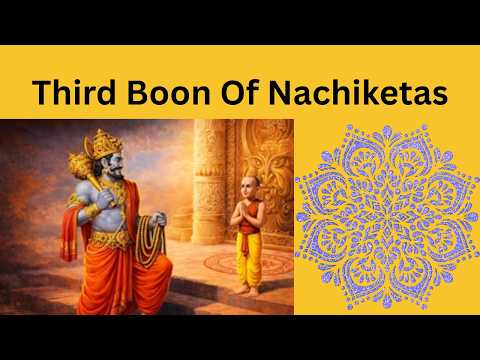
We are going to look at the meaning of the 18th and 19th Mantras of the first adhyaya of the Prathama valli of Kathopanishad.
त्रिणाचिकेतस्त्रयमेतद्विदित्वा
य एवं विद्वाँश्चिनुते नाचिकेतम् ।
स मृत्युपाशान् पुरतः प्रणोद्य
शोकातिगो मोदते स्वर्गलोके ॥ १८॥
As the second boon to Nachiketas, Yamaraja taught him the Swargya Agni vidya, the Chayana vidya through which one goes beyond the mortal worlds.
I this mantra, Yamaraja is just reiterating that someone who knows the Trinachiketa, he cuts the ropes of death ahead of him, goes beyond all sorrows and enjoys in Swargaloka.
Basically, he goes beyond the cycle of births and deaths.
There will not be any rebirth for him.
We have seen in detail about this Agni vidya or going beyong the mortal worlds by means of performing yajas in the previous mantras.
Now, the 19th mantra -
एष तेऽग्निर्नचिकेतः स्वर्ग्यो
यमवृणीथा द्वितीयेन वरेण ।
एतमग्निं तवैव प्रवक्ष्यन्ति जनासः
तृतीयं वरं नचिकेतो वृणीष्व ॥ १९॥
Yamaraja is telling Nachiketas - I have told you about the Agni Vidya as the second boon.
As an additional boon, as a fourth boon, I also named this vidya after you, the Trinachiketagni vidya.
Now, you ask for the third boon which I had promised you.
Nachiketas said -
This is the 20th mantra -
येयं प्रेते विचिकित्सा मनुष्ये-
ऽस्तीत्येके नायमस्तीति चैके ।
एतद्विद्यामनुशिष्टस्त्वयाऽहं
वराणामेष वरस्तृतीयः ॥ २०॥
Some say that body and atma are separate. After dying the atma goes to another world to undergo the results of its karma.
Some say that there is no atma different from the body. When the body perishes, atma also perishes.
This dispute and debate have been going on ever since creation.
A mortal being can not answer this question.
As my third boon, please settle this debate for ever and give me a clear answer.
Here, one thing is clear.
Nachiketas went to Yamaloka not after dying.
He had only fainted.
Otherwise, he himself would have known the answer to this.
Now, you know these terms, Astika and Nastika, beleivers and non-believers.
In the mantra,
अस्तीत्येके नायमस्तीति चैके
Some say Asti and some say Nasti.
Asti means - yes, it is there.
What is there?
Atma.
Nasti - No, it is not there, Atma is not there.
This is where these terms have come from.
It could be Ishwara also - Ishwara is there, Ishwara is not there.
So this is the most important question - is there something other than the body?
This is what Yamaraja is going to clarify.
This is the third boon to Nachiketas.
- What does it mean to ‘know’ Trinachiketa rather than merely perform it?
Knowing tTrinachiketa means understanding the inner truth behind the ritual. The outer fire is symbolic. The real fire is knowledge that burns ignorance. When a person realizes the Self is different from the body and mind, bondage ends. This is true knowing. - Why does Yamaraja say the knower cuts the ropes of death ahead of time?
Death binds through fear and attachment. These exist while living itself. When knowledge arises, these inner chains break immediately. The person becomes free while alive. Physical death loses its power to create fear or rebirth. - Why are the ropes of death described as something that can be cut?
Ropes represent bondage created by ignorance. They are not permanent. They exist only because of false identification. Knowledge removes ignorance instantly. The Self was never truly bound. - Why is freedom from sorrow mentioned as a direct result of this knowledge?
Sorrow arises from attachment to temporary things. When a person knows the Self is permanent, loss and change no longer disturb inner peace. Freedom from sorrow is the natural result of correct understanding. - Why is fire used as the symbol of this knowledge?
Fire transforms everything it touches. It removes impurity and reveals essence. Knowledge works the same way. It destroys ignorance and reveals the true nature of the Self. - Why did Yaamaraja name this agni vidya after Nachiketas?
This shows that truth reveals itself fully only to a qualified seeker. Nachiketas approached without fear or selfish desire. His sincerity made him worthy. Knowledge became permanently associated with him. - Why did Nachiketas ask about the Self instead of asking for pleasure or power?
He understood that all pleasures and powers are temporary. Even heaven ends. He wanted permanent freedom. This shows deep discrimination between the eternal and the temporary. - What is the deeper meaning of asti and nasti in this mantra?
Asti means the Self exists beyond the body. Nasti means denying this truth. This determines whether a person lives in knowledge or ignorance. This is the root of spiritual inquiry. - Why is this question about the Self considered the most important question?
Every other question concerns temporary matters. This question concerns ultimate reality. Knowing this removes fear, sorrow, and confusion completely. - What makes Nachiketas qualified to receive this highest knowledge?
His fearlessness, sincerity, and clarity made him qualified. He did not seek comfort. He sought truth. This qualification attracts true knowledge naturally.





English
Kathopanishad
Click on any topic to open
7
30
Astrology
Bhagavad Gita
Bhagavatam
Bharat Matha
Devi
Devi Mahatmyam
Ganapathy
Garuda Puranam
Glory of Venkatesha
Hanuman
Kathopanishad
Mahabharatam
Mantra Shastra
Mystique
Practical Wisdom
Purana Stories
Radhe Radhe
Ramayana
Rare Topics
Rigveda Explained
Rituals
Sages and Saints
Shiva
Spiritual books
Sri Suktam
Story of Sri Yantra
Temples
Vedas
Vishnu Sahasranama
Yoga Vasishta
26
17
10
0


