They Came from Apes — We Came from Rishis
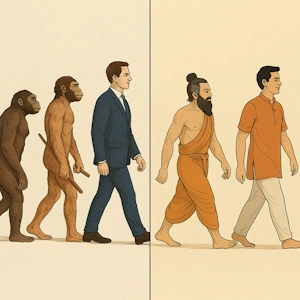
- If Darwin’s theory was rooted in truth, why did it spread like a fashion trend — not through rigorous debate, but through cultural obsession with 'newness'?
- Why were we so quick to abandon centuries of spiritual knowledge — Vedas, Yoga, Upanishads — in favor of a theory barely 150 years old, promoted by people who had never even heard of Yogic wisdom?
- How can a civilization that never understood prana, atma, or moksha claim to explain the origin of man?
- If Darwin’s theory is so flawless, why did it need blind imitation and mass propaganda to survive — instead of inner conviction and proof through lived spiritual experience?
- What made us assume that 'evolution' was always upward, when our own rishis and shastras have spoken for millennia about kaliyuga and decline?
- Why was anything that didn’t fit Darwin’s theory — no matter how ancient, sacred, or experientially validated — instantly branded as ‘myth’? Isn’t that dogma, not science?
- If history must be viewed through the lens of evolution alone, what do we do with all the yogis, sages, and seers who could stop their heartbeat at will and live without food for days? Were they ‘primitive’? Or were they evolved in ways modern science can’t comprehend?
- Why did Indian intellectuals start parroting Western evolutionary views, even when they contradicted everything in their own sacred texts and inherited wisdom? Was it honesty — or colonial hangover?
- Can a theory that ignores consciousness, spiritual force, and the soul truly explain the nature and origin of life — or is it just another materialist fantasy pretending to be fact?
- Have we traded truth for trend — exchanging the lived, tested, divine knowledge of our ancestors for a fragile hypothesis born from microscopes and guesswork?
- Who decided that finding a stone tool in one village proves the entire world was in the Stone Age at that time? Isn’t that a giant leap based on a tiny clue?
- If even today, in 2025, there are people using stones and clay in remote corners of the world — would future archaeologists call our time the Stone Age too?
- Have we mistaken poverty for primitiveness? Just because a society uses simple tools, does that mean they are backward — or just living differently?
- Why does evolution theory assume that every culture across the globe must have followed the same path — from stone to metal to modernity — when even today, the world is full of parallel realities?
- Is it honest to build an entire theory of human progress by digging up broken tools, without knowing who used them, why they used them, or what spiritual knowledge they carried?
- If someone discovers a worn-out village that uses mud huts and firewood in 2025, will they declare this was a prehistoric tribe? Or will they look deeper into the social, economic, and spiritual context?
- What if the so-called primitive tribes had inner peace, spiritual mastery, and connection to nature far beyond what ‘modern man’ has? Who’s truly evolved then?
- Have we been tricked into equating ‘metal tools’ with intelligence — while ignoring the fact that ancient Indian rishis, without any machines, knew the stars, time, and soul better than today’s scientists?
- Why do we think history only goes forward? Don’t civilizations rise and fall? Don’t great cultures disappear while inferior ones remain?
- Is our faith in a straight-line human evolution just a comforting myth — created by scholars who were too impatient to understand ancient wisdom?
- If two animals look alike, does that automatically mean one came from the other — or could they simply share a common design by choice or function?
- When a potter makes two pots with similar shapes, do we say one pot came from the other — or that the same intelligence shaped them both? Why don’t we think the same about nature?
- Darwin saw similarity and jumped to ancestry. Would that pass as proof in any serious philosophical debate or legal trial?
- If cows and horses look similar in some ways — but cannot reproduce together — doesn't that prove that similarity does not equal sameness?
- Isn’t it strange that Darwin never gave a solid reason (hetu) for his claims — only a collection of superficial comparisons (drishtanta)?
- Why do we ignore the deeper cause behind similar body designs? Couldn’t prakriti-vikriti (variation within a divine blueprint) or simply divine will explain what Darwin rushed to call evolution?
- What makes reproductive compatibility a more reliable marker of species than just appearance — and why did Darwin completely overlook this?
- If evolution was so obvious, why do its ‘proofs’ need to be explained with diagrams, speculation, and centuries of adjustment? Wouldn’t truth reveal itself more directly?
- Have we allowed Darwin’s charm and Western authority to replace the need for actual logic? Have we stopped asking: Where’s the hetu? (Where’s the cause?)
- Is Darwin’s theory of evolution based more on imagination than evidence — and are we afraid to say it out loud just because ‘everyone believes it’?
- If humans and apes can’t produce offspring together, how exactly did one species evolve into the other? Isn’t reproductive separation the biological definition of distinct species?
- Wouldn’t it be more scientific to accept what we can observe — that man has always been man — instead of spinning a tale based on bones, gaps, and guesses?
- If your ancestors were divine beings, seers, and rishis — not jungle-dwelling primates — who are you really dishonoring by accepting Darwin’s story without question?
- Why are we so eager to call our forefathers ‘primitive’, when even today we can’t match their wisdom, memory, ethics, or spiritual discipline?
- If truth, strength, lifespan, and dharma are all declining — as even modern reports confirm — can we still say we’re ‘evolving’? Or are we simply decorating our fall with technology?
- Why does every sacred Indian text speak of a cycle — from Satya Yuga to Kali Yuga — a decline, not a rise? Are we arrogant enough to say they were all wrong, and Darwin was right?
- Is ‘progress’ just a story we tell ourselves to avoid facing the uncomfortable truth — that we are living in a time of spiritual and moral collapse?
- Have we confused complexity for growth? Does a smartphone in your hand prove you are more evolved than someone who could recite 10,000 verses from memory and live on air and silence?
- If the Sun itself is shrinking and the Earth’s fertility is falling, why are we still repeating the outdated fairytale that everything is getting better?
- Do you really believe Darwin understood life — when he never even touched the knowledge of atman, prana, karma, or dharma — which our rishis mapped thousands of years ago without a microscope?
Sanatana Dharma on the Origin and Condition of Man: Decline, Not Evolution
Sanatana Dharma does not teach that man evolved from a lower state into a higher one. In fact, it teaches the exact opposite — that man started at his highest, and has been declining ever since. This isn’t a theory or belief — it’s a consistent record preserved through scriptures, lived tradition, and rishi-prampara.
Let’s explore this perspective through the voices of the great rishis:
1. Bhrigu: Human Lifespan and Vitality Decline with Each Yuga
From Bhṛgu Moksha Samhita:
- In Satya Yuga, man was full of health (arogya), strength, clarity, and purpose — and lived up to 400 years.
- In Treta, lifespan dropped to 300 years.
- In Dvapara, it went to 200.
- In Kali Yuga, it’s 100 — and often far less in quality.
Each Yuga causes a 25% loss in strength, dharma, and consciousness.
This isn't poetic nostalgia — this was documented by rishis who measured time through cosmic and spiritual events.
2. Narada: The Birth of Government Marks the Death of Inner Dharma
- In Satyuga, there was no king, no police, no courts — because people were governed by internal Dharma.
- Only when Dharma weakened, and people lost their inner compass, did kings, laws, and punishment systems arise.
Sanatana Dharma sees law enforcement not as progress, but as a symptom of spiritual collapse.
3. Brihaspati: Austerity and Wisdom Faded Into Shallow Charity
As quoted in Apararka’s Tika:
- In Satya and Treta Yugas, people practiced tapas (austerity) and were rooted in divine knowledge.
- In Dvapara and Kali, people’s minds, bodies, and even their charity became weak and superficial.
The real fall wasn’t in technology — it was in discipline, intellect, and integrity.
4. Yajnavalkya: Even in Dvapara, the Decline Was Already Visible
From Shatapatha Brahmana, preserved by Madhyandina:
- As early as 5100 years ago, Rishi Yajnavalkya was recording the fall of human brilliance and inner clarity.
- His student Madhyandina passed these truths down with care.
This was not guesswork. This was observed reality.
Final Vision: Decline Is Not Pessimism — It’s Patterned Truth
Each of these rishis — Bhrigu, Narada, Brihaspati, Yajnavalkya — speak in one voice:
Mankind is not on a steady climb from barbarism to brilliance.
Mankind is in gradual spiritual decay, moving from Satya to Kali — from truth to confusion.
This isn’t fatalism. It’s not depression. It’s the wisdom of watching thousands of years unfold.
What Does Sanatana Dharma Really Say About Man?
- Man was created divine, not as a primitive animal.
- Man had clarity of mind, purity of heart, and mastery over self.
- With time, man lost touch with that inner fire, layer by layer.
- What we call modernity is often just better packaging of weaker content.
Sanatana Dharma doesn’t deny change. But it calls out false progress.
What matters is not what tools you hold in your hand — but what kind of fire burns in your soul.
The rishis never said 'man is evolving.' They said:
Man is forgetting who he once was.
Darwin’s theory tells us:
'Man was once an ape — and over time, he evolved into a sophisticated, intelligent being.'
But Sanatana Dharma says:
'Man began as divine — radiant, truthful, and powerful. What you see today is not evolution. It is decline.'
Acharya Harisvami — Even Yajnavalkya Looked Back with Reverence
Acharya Harisvami (638 CE) wrote that:
Even the great sage Yajnavalkya, a blazing light of wisdom, admitted that the sages before him were even more brilliant.
Insight:
Spiritual power is not increasing — it has been fading with each generation.
This isn’t nostalgia. It’s a testimony from within the tradition — an honest recognition of spiritual entropy.
Yaska Muni — The Departure of the Seers
In Nirukta 13.11, Yaska notes:
As rishis began leaving for higher lokas, ordinary men started taking their place — but without that divine vision.
Insight:
There was once a time when humanity was led by those with direct access to truth.
Now, humans debate with opinions, not realization. Even Yaska — barely a generation after the Mahabharata — witnessed this shift.
Vyasa — Yuga by Yuga, Man Declines
In Mahabharata Parva 188.11, Vyasa declares:
From one yuga to the next, lifespan, patience, memory, strength, and radiance all decline.
Insight:
Vyasa — 5000 years ago — already outlined a clear downward spiral in human capacity.
It’s not progress, it’s systematic loss, Yuga after Yuga.
Charaka — From Divine Bodies to Dull Flesh
In Charaka Samhita, Vimanasthana 3, it’s written:
In the earliest age, humans were godlike — brilliant, long-lived, with direct vision of Dharma and Devas.
In Treta Yuga, one leg of Dharma disappeared. Humans became slightly weaker.
This pattern of loss continued, Yuga after Yuga.
Insight:
Even Ayurveda, which deals with the physical body, confirms: man did not evolve from animals — he fell from greatness.
Apastamba — Rishis Will Stop Appearing
In Dharmasutra 1.2.5.4, Apastamba declares:
Rishis will no longer be born in later times, because tapas, discipline, and purity will be broken.
Insight:
Not only is spiritual decline acknowledged — it’s seen as inevitable, unless humanity returns to rigorous inner discipline.
These rishis — from Vedanta, Ayurveda, Linguistics, and Dharmashastra — all agree on one point:
Humanity is in decline.
What modern science calls 'evolution' is actually involution, degradation, forgetting, and loss.
The Illusion of Progress: How the West Got It Wrong
- In 19th-century Europe and America, people did not know the ancient world deeply.
- Those who had glimpses of it often dismissed it due to arrogance or bias.
- So they spread a belief:
'Ancient man was primitive. We have progressed through science and intellect.' - Then came colonialism and English education — and many Indians blindly adopted this false story, discarding their own heritage in the process.
What the modern world calls myth, the rishis recorded as history.
They were not being romantic. They were telling the truth of time.
The laws of nature are not linear. They are cyclical.
Civilizations rise and fall. Dharma fades.
Humanity started at the top — and is now sliding downward, through the ages.
And so, Sanatana Dharma doesn’t ask you to believe you are the product of apes.
It reminds you:
You are the descendant of rishis.
You were born radiant.
And if you choose tapas, truth, and inner discipline — you can reclaim that lost light.
The West Got It Wrong — Because It Missed the Yogic Key
The modern Western idea, shaped by Darwin, tells us:
'Man rose from the mud. Life came from blind mutation. Civilizations have steadily improved.'
Sanatana Dharma says:
'Man fell from the sky. Life came from yogic energy. Civilizations have steadily declined.'
The Vedic view holds that time itself declines, moving from Satya Yuga to Kali Yuga, and mankind's spiritual, mental, and even physical capacities decay with it.
The belief in decline is not just Indian — it is global, ancient, and rooted in deep truth.
Darwinism Replaced Wisdom with Arrogance
- When Darwin’s ideas gained fame, Western scholars became intoxicated with the illusion of progress.
- They began mocking the rishis, dismissing ancient truths, and rewriting history in their own image.
But even Western thinkers like Ferguson and Gordon Childe admitted:
- 'Progress is not continuous.'
- 'It moves like waves.'
- 'There are gaps and regressions.'
So if even their own historians doubted evolution’s neat timeline — why did they ignore the spiritual truths that had lasted for millennia?
What the Rishis Knew — The Real Origin of Man
Sanatana Dharma declares:
Man was never an animal. Man was always a conscious soul.
The first beings were created not by mating, but through Yoga-born energy — Yogaja Shariras.
These were not metaphors. These were literal truths, stated by sages who had:
- Mastered prana,
- Controlled mind and matter,
- And accessed the subtle fabric of creation.
This truth was not 'discovered' — it was remembered and passed down with sacred precision.
Why Yoga Is the Missing Science of the West
- Yoga isn’t gymnastics. It is the science of creation itself.
- It requires:
- Tapas (austerity)
- Satya (truth)
- Vairagya (detachment)
- Shuddhi (purity)
- Shraddha (faith through experience)
Just as a chemist must master chemicals, only a yogi can grasp Yoga.
India still holds such beings — hidden, luminous, powerful — who preserve the unseen source-code of life.
Modern science has no vocabulary for spiritual mastery, so it ignores it.
But Sanatana Dharma sees what they cannot:
- That the creator is not evolution.
- The mechanism is not mutation.
- The process is not accident — but divine will and yogic vision.
The True History of Man — What Was Erased
The West, under Darwin’s spell, erased real history:
- It told the world that the rishis were myths,
- That Vedic time cycles were symbolic nonsense,
- That material growth = human progress.
They buried truth under charts, bones, and guesses.
But now, the call is rising to resurrect what was lost.
This very work — the one you’re reading or writing — is part of that recovery effort.
To restore the timeline.
To revive the Yogic origin of man.
To reawaken the memory of what we truly are.
Darwin said: 'We came from apes.'
Rishis said: 'You came from light.'
Darwin said: 'You are climbing upward.'
Rishis said: 'You are falling downward — unless you turn inward.'
Sanatana Dharma is not trying to glorify the past.
It’s trying to warn us about the cost of forgetting our inner divinity.
The world is not evolving. It is devolving.
And Yoga is the only path that leads us back —
Not to the forests of the past — but to the light we left behind.





English
Bharat Matha
Click on any topic to open
7
30
Astrology
Bhagavad Gita
Bhagavatam
Bharat Matha
Devi
Devi Mahatmyam
Ganapathy
Garuda Puranam
Glory of Venkatesha
Hanuman
Kathopanishad
Mahabharatam
Mantra Shastra
Mystique
Practical Wisdom
Purana Stories
Radhe Radhe
Ramayana
Rare Topics
Rigveda Explained
Rituals
Sages and Saints
Shiva
Spiritual books
Sri Suktam
Story of Sri Yantra
Temples
Vedas
Vishnu Sahasranama
Yoga Vasishta
26
17
10
0


