There Is Brahmaloka and Vishnuloka on the Surface of Earth Also
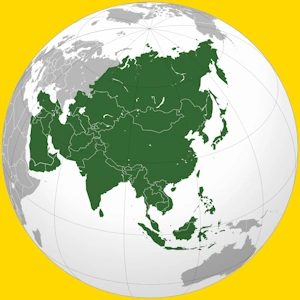
We have already seen this concept:
Just as the three lokas—Bhumi, Antariksha, and Swarga—exist one around the other or one above the other, they exist on the surface of the earth as well, essentially within Asia.
From the Indian Ocean to the Himalayas is Bhuloka.
From the Himalayas to Mongolia is Antariksha Loka.
Above that, up to the North Sea, is Swarga Loka.
The Bhuloka consists of Hindustan at the eastern end and Iran at the western end.
The Antariksha Loka consists of China at the eastern end and Tatarstan at the western end. Tatarstan is now a part of the Russian Federation.
The Dyuloka or Swarga Loka corresponds to Russia on the surface of the earth. Russia, in this context, primarily refers to Siberia, which constitutes about 75% of Russia.
When you visualize this, you can see:
- At the bottom, from Iran to India horizontally and from the Indian Ocean to the Himalayas vertically, is Bhuloka.
- Above that, up to Mongolia, with China on the eastern end and Tatarstan on the western side, is Antariksha Loka.
- Above that is Siberia, which represents Swarga Loka.
There is a reason for explaining this.
We do not know much about the history of ancient India. To understand it, we need to refer to the Vedas. In the Vedas, it is not mentioned as Hindustan or Siberia; it is mentioned as Bhuloka, Antariksha, and Dyuloka.
We must connect these terms to the geographies on the surface of the earth. For this, we need to know the associated regions. This is the key to understanding our ancient history.
This is based on the macrocosm-microcosm concept.
Whatever happens in the Divya Triad has to happen in the earthly triad, and it has to happen within the human body.
So, when the Veda says that Indra killed Vritrasura, at the earthly level, this battle must have actually occurred somewhere in Asia—a real battle.
This battle must also occur within man, where a positive power conquers a negative power.
This is the key to understanding our ancient history as revealed in the Vedas.
In the Antariksha Loka, starting from Asia Minor in the west (Asia Minor is part of Turkey, also called Anatolia) to China in the east, this region belonged to Brahma.
From Romania in the west to western Russia in the east, this is Vishnu Loka.
Siberia is the Swarga Loka.
Do not think this is some fancy visualization. As we unfold these secrets, there is much to learn.
Do not think, 'How can Siberia be Swarga? It is one of the most uninhabitable parts of the world. People go to Swarga to enjoy. In Siberia, you will freeze to death.'
That is today. It was different then. We are talking about history as found in the Vedas, not the present time.
There is the Sringi Mountain in central Nepal, which is part of the Himalayas. The land above this is called Uttara Kuru Desha.
Broadly speaking, the people below this are manushyas, under the control of Agni Deva. The people above this are devas, under the control of Indra.
Be clear here—this is not today. I am not suggesting that Russians are devas. Not today.
This is history. These were regions occupied by manushyas and devas in the past.
Many transmigrations have occurred since then. This is not the present situation.





English
Bharat Matha
Click on any topic to open
7
30
Astrology
Bhagavad Gita
Bhagavatam
Bharat Matha
Devi
Devi Mahatmyam
Ganapathy
Garuda Puranam
Glory of Venkatesha
Hanuman
Kathopanishad
Mahabharatam
Mantra Shastra
Mystique
Practical Wisdom
Purana Stories
Radhe Radhe
Ramayana
Rare Topics
Rigveda Explained
Rituals
Sages and Saints
Shiva
Spiritual books
Sri Suktam
Story of Sri Yantra
Temples
Vedas
Vishnu Sahasranama
Yoga Vasishta
26
17
10
0


