The Twenty-Two Sacred Marks of Lord Rama’s Lotus Feet
प्रजापतिः – ईश्वरत्वेन सर्वासां प्रजानां पतिः प्रजापतिः – since he is the lord of all praja, beings, he is called prajapati.
बद्धात् उत्कृष्टतॊ यॆ च जायन्तॆ सूरयः प्रजाः |
तॆषां यॊ नित्यसूरीणां पतिः स स्यात् प्रजापतिः
Praja means the suris, the liberated beings. Their pati, lord. Prajapati.
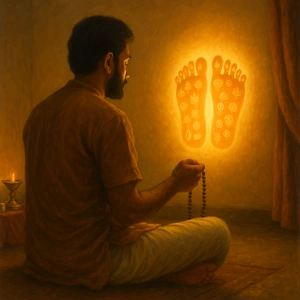
Do you know that there are 22 marks on Lord Rama’s feet, the soles of his feet. Each one has significance. Looking at these signs you can make predictions about the nature of the person, about the person’s life. This is part of samdrika shastra.
First mark – ankusha. Goad. A stick with a hook at the end. This is used to control elephants. By wearing this on his sole, Bhagawan is telling us that the mind is like a mad elephant. If you take refuge at his feet, he will control that mad elephant with this ankusha.
The second mark is that of clothes. Man becomes cold after some time. He doesn’t want to progress. He doesn’t want anything anymore. He becomes complacent. This is like when the weather is cold, you don’t want to venture out. By wearing the ambara chihna, the sign of clothes, he is telling us that if you take refuge at his feet, he will protect us from this cold. Energy and enthusiasm will come back if you take refuge at his feet. Optimism will come back. Hope will come back.
The third mark is that of vajra, vajrayudha, thunderbolt, which can even break mountains. Papas are like mountains, apparently difficult to move. Even big, big papas which are like mountains, they will be pulverized as if struck by lightning if you take refuge at his feet.
The fourth mark is that of lotus. Like how a lotus is always aligned with the sun, blossoms whenever sun appears, when he comes into your life, your life blossoms, and he would come into your life when you take refuge at his feet.
The fifth mark is that of yava, that is grain of barley. Grains are symbolic of food, nutrition, health, both physical and mental health, intelligence, abundance. When you take refuge at his feet, you get all these.
The sixth mark is that of dhwaja, a flag. Where do you see a flag? On the chariot of a king, at power centres like a palace, at places of authority. By adorning the sign of a flag upon his soles, the Lord is telling us that I will give you protection. Don’t worry. Don’t fear anything, anyone. I am there for you.
The seventh mark is called gopada, the mark of the hoof of a cow, the print that the hoof of a cow leaves behind on the ground. What does it indicate? We know samsara is a sagara which is very difficult to cross. If his mercy is there, then this huge ocean becomes a small puddle, like a small pool of water that accumulates in the footprint of a cow.
The eighth mark is that of shankha, the conch shell. The moment you hear shankha what comes to the mind is panchajanya. When Bhagawan blows his shankha, evil is destroyed. When you take refuge at his feet, with the mark of shankha upon them, then evil cannot touch you.
The next, the ninth mark is that of chakra, the lethal chakra that can destroy enemies both external and internal, internal enemies such as greed, lust, jealousy.
The tenth mark is swastika. Swastika is symbolic of swasti, auspiciousness, goodness. After taking refuge at his feet, the devotee’s life becomes auspicious.
The eleventh mark is that of jambuphala, the jamun fruit, saying fruits of all your actions are decided by me, given by me.
The twelfth and thirteenth marks are that of amrita kalasha and amrita kunda, both indicating immortality attained through moksha, amaratva attained through bhakti, which are there for you when you take refuge at his feet.
The fourteenth is ardha chandra, the crescent. The cool crescent. For those suffering from the three kinds of heat, the tapa traya, adhyatmika, adhibhautika and adhidaivika, his feet become the cool moonlight emanating crescent.
The next three are signs of trikona, shatkona and ashtakona, the signs that you see on yantras, offering protection, protection both from inside and outside.
The eighteenth and nineteenth are signs of a fish and a bindu, a dot, both as per tantra shastra indicate control. When you take refuge at his feet, he assumes complete control of your life thereafter, you don’t have to worry anymore about anything.
The twentieth mark is that of straight line, vertical line, a bridge that opens for you when you take refuge at his feet, a bridge that can take you across the samsara sagara.
The twenty first mark is that of a rainbow, his bow that is famous, which destroyed Ravana, with which he will protect you both from evil outside and evil inside.
And the twenty second is a purusha chihna, mark of a man, figure of a man, showing that the position of the true devotee is at his feet. That is how you attain him.
-
Why do symbols on Rama’s feet matter for my inner life today?
They point to qualities you can cultivate through nama japa. Chanting anchors the mind, and those qualities begin to show up in speech, choices, and relationships. -
How does nama japa actually tame my restless mind?
Use breath-linked japa: inhale ‘Om Namo’, exhale ‘Narayanaya’ for one bead. Do 108 beads. Restlessness drops because rhythm replaces rumination. -
What should I do when thoughts feel like a mad elephant charging around?
Hold the bead and repeat a fierce name like ‘Narasimha’ 21 times. The surge passes. Then continue the mala at a steady pace. -
I feel stuck and complacent. How do I restart momentum?
Morning micro-set: 11 names aloud, clear voice, standing posture. Write one tiny action that matches a name, then do it before breakfast. -
Guilt feels like a mountain. How do I shatter it without collapsing?
Pick three names linked to protection and compassion. Do 3 malas: first for acceptance of the past, second for restitution action, third for gratitude. Guilt loses mass when it meets responsibility. -
How do I keep my mind oriented to light like a lotus to the sun?
Face east at sunrise. Chant one page of Vishnu sahasranama softly. End with 60 seconds of silence. Orientation becomes habit. -
Can chanting improve physical health in a real way?
Yes. Slow cadence recitation extends exhale, improves heart rate variability, reduces blood pressure spikes, and deepens sleep. Track breath length and sleep onset time weekly. -
What is the most sustainable day plan that busy families can follow?
Morning: 7 minutes sahasranama. Commute or walk: 108 japa on beads. Night: 5 names together as a family with one lamp. Keep it short and consistent. -
How can we bring children in without turning it into a lecture?
Give roles: one lights the lamp, one reads 5 names, one tells one-line meaning, one offers water. Praise the effort, not the performance. -
How do I use the names to make cleaner decisions at work and home?
Before a decision, chant ‘Om Namo Narayanaya’ 12 times. Ask: does this action protect, preserve, and reduce harm. If not, revise the choice. -
What should I do on crisis days when routine breaks?
Pocket practice: every hour, 9 repetitions of a single name. At night, one verse aloud and 2 minutes of silence. Crisis gets punctuated by calm. -
How do I turn chanting into real courage, not just comfort?
Alternate modes: morning firm voice for resolve, night soft voice for surrender. Courage comes when steadiness and softness coexist. -
Can japa help my temper and sharp tongue?
Yes. Do one mala only on the exhale. Speak only after finishing that mala. The breath slows, anger dissolves, speech turns measured. -
How do I connect japa to service at home?
After chanting, do one action that reduces another’s burden: wash dishes, call a relative, help with homework. Names turn into hands. -
I forget to chant. What is a simple anchor that never fails?
Tie it to existing cues: lamp lighting, morning tea, locking the door. Keep a visible mala near each cue. Habit rides on anchors. -
How do I measure progress without ego taking over?
Monthly check: fewer outbursts, quicker recovery from setbacks, better sleep, kinder words noted by others. If pride shows up, offer that day’s merit back through 108 silent japa. -
What if I feel no devotion while chanting?
Keep the tongue moving and breath even. Note one small benefit in a notebook daily. Bhava follows discipline, like fragrance follows sandalwood.





English
Vishnu Sahasranama
Click on any topic to open
19


