The Weightless Lotus: Rama’s Readiness for Jnana
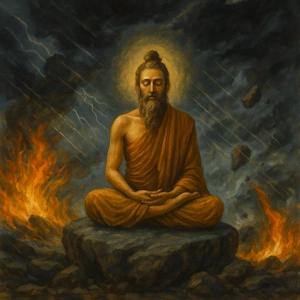
The 11th Sarga of Mumukshu Vyavahara Prakarana marks a turning point. After narrating the descent of knowledge in Sarga 10, Sage Vasishta now explains how vairagya and viveka prepare a seeker for true liberation. He praises Rama’s rare, causeless dispassion — a sign of inner ripeness and divine grace. The sarga then becomes a powerful guide on choosing the right teacher, cultivating discernment, and anchoring the mind through wisdom. With poetic clarity, it also lays out the four gatekeepers of moksha: shama, santosha, viveka, and satsanga. It’s a full instruction manual for walking the inner path.
Verse 1
श्रीवसिष्ठ उवाच ।
एतत्ते कथितं सर्व ज्ञानावतरणं भुवि ।
मया स्वमीहितं चेव कमलोद्भवचेष्टितम् ॥
Vasishta says — I’ve told you everything so far.
Not just what I did, but how Brahma himself initiated the descent of knowledge.
This isn’t a myth — it’s history written in silence.
Divine intent, compassion, and cosmic purpose brought jnana to the earth.
You’re not hearing a lecture, Rama.
You’re stepping into a legacy —
A path walked by those who came only to lift the world from darkness.
Verse 2
तदिदं परमं ज्ञानं श्रोतुमद्य तवानघ ।
भृशमुत्कण्ठितं चेतो महतः सुकृतोदयात् ॥
Vasishta sees the fire in Rama’s heart.
You’re ready now, he says.
Your eagerness to know is not ordinary —
It’s the result of great karmas blossoming.
When a seeker burns for truth, it’s a sign the soul is ripening.
This longing is sacred.
It means you’re close to the source.
When the question is pure, the answer cannot stay hidden.
Verse 3
श्रीराम उवाच ।
कथं ब्रह्मन्मगवतो लोके ज्ञानावतारणे ।
सर्गादनन्तरं बुद्धिः प्रवृत्ता परमेष्ठिनः ॥
Rama asks — how did Brahma, the Creator,
go from creating the universe to planting the seeds of knowledge?
What changed?
What made him look past the outer world
and start curing inner ignorance?
This isn’t idle curiosity —
Rama wants to know the exact moment
when the Divine chose wisdom over just creation.
Verse 4
श्रीवसिष्ठ उवाच ।
परमे ब्रह्मणि ब्रह्मा स्वभाववशतः स्वयम् ।
जातः स्पन्दमयो नित्यमूर्मिरम्बुनिधाविव ॥
Vasishta replies — Brahma was born from Brahman,
like a ripple from still water.
Movement rose naturally in stillness.
That movement became intention.
That intention became the world.
Creation was not forced — it was spontaneous,
like waves arising from the ocean’s own nature.
Brahma didn’t plan — he became.
Verse 5
दृष्ट्वैवमातुरं सर्ग सर्गस्य सकलां गतिम् ।
भूतभव्यभविष्यस्थां दश परमेश्वरः ॥
Brahma saw it all —
the agony of birth, the trap of future, the confusion of time.
Creation was not beautiful anymore.
It was tired, restless, sick.
He saw beings lost in past and future,
never really living.
That vision pierced his divine heart.
From that pain — wisdom began to stir.
Verse 6
सक्रियाक्रमकालस्य कृतादेः क्षय आगते ।
मोहमालोच्य लोकानां कारुण्यमगमत्प्रभुः ॥
As the age of dharma declined,
rituals lost meaning, and people forgot why they lived.
Ignorance wrapped itself around everyone like smoke.
Seeing this, Brahma didn’t judge — he felt compassion.
A god, moved not by failure but by empathy.
That compassion became the seed of jnana-avatarana —
the descent of wisdom.
Verse 7
ततो मामीश्वरः सृष्ट्वा ज्ञानेनायोज्य चासकृत् ।
विससर्ज महीपीठं लोकस्याज्ञानशान्तये ॥
So he created me — Vasishta.
Not from matter, but from insight.
He empowered me again and again
with clarity that cuts through confusion.
Then he sent me to earth —
not to rule, not to preach,
but to dissolve ignorance quietly,
like sunlight melting fog.
Verse 8
यथाहं प्रहितस्तेन तथान्ये च महर्षयः ।
सनत्कुमारप्रमुखा नारदाद्याश्च भूरिशः ॥
I wasn’t alone.
Brahma sent others too — Sanatkumara, Narada,
and many great rishis.
Each one carried a spark of truth
to a world dimmed by distraction.
We didn’t wear crowns.
We carried silence.
And we were planted in different corners of the world.
Verse 9
क्रियाक्रमेण पुण्येन तथा ज्ञानक्रमेण च ।
मनोमोहामयोन्नद्धमुद्धर्तुं लोकमीरिताः ॥
We came to lift minds tied in knots of illusion.
Some through rituals,
some through reasoning,
some through pure presence.
Different paths, same purpose:
to free the world from the enchantment of the unreal.
To untie what can’t be cut.
Verse 10
महर्षिभिस्ततस्तैस्तैः क्षीणे कृतयुगे पुरा ।
क्रमात्क्रियाक्रमे शुद्धे पृथिव्या तनुतां गते ॥
In the early yugas,
when truth still walked the earth,
those rishis led people gradually.
Through sacred action.
Simple living.
Sharp minds.
Even earth herself was lighter then.
The atmosphere was clean — both inside and outside.
Verse 11
क्रियाक्रमविधानार्थं मर्यादानियमाय च ।
पृथग्देशविभागेन भूपालाः परिकल्पिताः ॥
To protect dharma,
kings were appointed — region by region.
Their job wasn’t control — it was preservation.
They upheld ritual order and moral boundaries.
Authority existed to guard sanctity.
Power served wisdom.
Not the other way around.
Verse 12
बहूनि स्मृतिशास्त्राणि यज्ञशास्त्राणि चावनौ ।
धर्मकामार्थसिद्ध्यर्थं कल्पितान्युचितान्यथ ॥
Scriptures were written.
Rituals were systematized.
Smritis guided conduct.
Yajnas refined intention.
All of it aimed at helping people live with meaning —
to fulfill dharma, desires, and duties without falling.
The structure wasn’t the goal —
it was a ladder.
Verse 13
कालचक्रे वहत्यस्मिंस्ततो विगलिते क्रमे ।
प्रत्यहं भोजनपरे जने शाल्यर्जनोन्मुखे ॥
As time rolled on, order began to fade.
Rituals lost their soul.
People became obsessed with food, wealth, and grain.
Life turned mechanical.
Purpose gave way to indulgence.
Even noble duties were done for reward, not for righteousness.
This is what happens when outer routine survives,
but inner clarity is lost.
Verse 14
द्वन्द्वानि संप्रवृत्तानि विषयार्थे महीभुजाम् ।
दण्ड्यतां संप्रयातानि भूतानि भूवि भूरिशः ॥
Kings, once protectors, became entangled in conflict.
They fought over land, fame, desire.
Opposites — love and hate, gain and loss — tore the world.
Innocents were punished.
Chaos rained down on earth.
When rulers fall to passion,
the people pay the price.
Verse 15
ततो युद्ध विना भूपा मही पालयितुं क्षमाः ।
न समथोस्तदा याताः प्रजाभिः सह दैन्यताम् ॥
Without war, kings couldn’t rule.
Their strength came from violence.
Compassion vanished.
People fell into poverty — inside and out.
Leadership became survival.
Rulers and the ruled sank together.
When dharma leaves the throne,
the whole kingdom collapses.
Verse 16
तेषां दैन्यापनोदार्थं सम्यग्दृष्टिक्रमाय च ।
ततोऽस्मदादिभिः प्रोक्ता महत्यो ज्ञानदृष्टयः ॥
To lift people from this shared misery,
we — the rishis — taught again.
Not rituals this time,
but deep, fearless insight.
We offered jnana to restore balance.
To bring right vision where confusion ruled.
This was not comfort — it was cure.
Verse 17
अध्यात्मविद्या तेनेयं पूर्व राजसु वर्णिता ।
तदनु प्रसृता लोके राजविद्येत्युदाहृता ॥
That inner knowledge — adhyatma vidya —
was given first to kings.
Because only clear kings can lift nations.
It then spread as raja vidya —
king of all knowledge.
A ruler grounded in Self becomes a true guardian.
Without it, even thrones rust.
Verse 18
राजविद्या राजगुह्यमध्यात्मज्ञानमुत्तमम् ।
ज्ञात्वा राघव राजानः परां निर्दुःखतां गताः ॥
Rama, this royal knowledge is the highest secret.
It is the crown above all crowns.
Those rulers who embraced it
rose beyond sorrow —
even while sitting on golden thrones.
They ruled with inner silence.
They served without being slaves to desire.
Verse 19
अथ राजस्वतीतेषु बहुष्वमलकीर्तिषु ।
अस्माद्दशरथाद्राम जातोऽद्य त्वमिहावनौ ॥
And now — in this long royal line,
you, Rama, have appeared.
Born from Dasharatha,
yet shining with a different light.
Your lineage may be filled with kings,
but you are born to rule within.
Verse 20
तव चातिप्रसन्नेऽस्मिञ्जातं मनसि पावनम् ।
निर्निमित्तमिदं चारु वैराग्यमरिमर्दन ॥
I see something rare in you.
A pure vairagya has bloomed in your heart —
spontaneous, sweet, unforced.
It has no trigger.
No tragedy.
No event caused it.
This is not ordinary disinterest.
It is grace ripening into renunciation.
Verse 21
सर्वस्यैव हि सर्वस्य साधोर्रांपे विवेकिनः ।
निमित्तपूर्वं वैराग्यं जायते राम राजसम् ॥
Usually, vairagya comes after pain.
A death. A betrayal. A loss.
For most people, dispassion is born from shock.
Even wise ones often need a reason to turn inward.
But Rama, yours is different.
It came without event — pure and luminous.
That makes it royal.
That makes it real.
When vairagya flowers without storm,
you know a great soul is awakening.
Verse 22
इदं त्वपूर्वमुत्पन्नं चमत्कारकरं हि यत् ।
तवानिमित्तं वैराग्यं सात्त्विकं स्वविवेकजम् ॥
This is rare, Rama.
Your vairagya stuns even sages.
It wasn’t born from disgust.
It wasn’t driven by trauma.
It arose from deep clarity — viveka.
Your own inner wisdom saw through the illusion.
No drama. No breakdown.
Just awakening.
Such sattvic detachment is the sign
of a soul that remembers who it is.
Verse 23
बीभत्सं विषयं दृष्ट्वा कौ नाम न विरज्यते ।
सतामुत्तमवैराग्यं विवेकादेव जायते ॥
Anyone can feel disgusted
after seeing how ugly worldly life gets.
Pain, sickness, fake love, endless wants —
they wear you down.
But that’s not the highest vairagya.
The best dispassion comes from insight,
not from exhaustion.
The wise don’t react.
They see.
And from that vision, they drop the world
like a snake sheds old skin.
Verse 24
ते महान्तो महाप्राज्ञा निमित्तेन विनैव हि ।
वैराग्यं जायते येषां तेषां ह्यमलमानसम् ॥
The greatest sages
don’t need a push.
They don’t wait for heartbreak to let go.
Their detachment comes by itself,
like dawn arrives without alarm.
Their hearts are pure, unstained, light as sky.
They walk the world without collecting dust.
Not from effort —
from inner fullness.
Verse 25
स्वविवेकचमत्कारपरामर्शविरक्तया ।
राजते हि धिया जन्तुर्युवेव वरमालया ॥
When inner clarity strikes,
and the soul turns from world to Self,
a person shines.
They glow — like a bridegroom
wearing the garland of victory.
It’s not sadness.
It’s radiance.
The mind touched by viveka
has a brilliance no ornament can match.
Verse 26
परामृश्य विवेकेन संसाररचनामिमाम् ।
वैराग्यं येऽधिगच्छन्ति त एव पुरुषोत्तमाः ॥
Those who reflect deeply
on how samsara operates —
its patterns, illusions, traps —
and from that understanding,
walk away from it,
they alone are true men.
Not by gender.
But by greatness.
They are the tall peaks
in the mountain range of humanity.
Verse 27
स्वविवेकवशादेव विचार्येदं पुनःपुनः ।
इन्द्रजालं परित्याज्यं सबाह्याभ्यन्तरं बलात् ॥
Keep examining the world, again and again.
Don’t be hypnotized.
See it for what it is —
a magical illusion.
Drop attachment —
to outer pleasures, inner emotions, ego games.
Tear them out if you must.
Let clarity cut the rope.
Freedom doesn’t come by decorating the cage.
It comes by walking out of it.
Verse 28
श्मशानमापददैन्यं दृष्ट्वा को न विरज्यते ।
तद्वैराग्यं परं श्रेयः स्वतो यदभिजायते ॥
Anyone feels detached after loss.
A funeral.
A failure.
A moment of helplessness.
But that vairagya fades when pleasure returns.
Real dispassion isn’t reaction —
it’s spontaneous insight.
When detachment rises from within,
without sorrow pushing it,
it lasts.
That kind is rare.
That kind saves.
Verse 29
अकृत्रिमविरागत्वं महत्त्वमलमागतः ।
योग्योऽसि ज्ञानसारस्य बीजस्येव मृदुस्थलम् ॥
Your vairagya is untouched by force.
It’s not made-up.
It’s natural, gentle, luminous.
That makes you noble, Rama.
You are soft soil —
ready to hold the seed of jnana.
You don’t just want truth —
you’re prepared to grow it.
Only such ground can support wisdom.
Verse 30
प्रसादात्परमेशस्य नाथस्य परमात्मनः ।
त्वादृशस्य शुभा बुद्धिर्विवेकमनुधावति ॥
This viveka in you isn’t earned —
it’s grace.
The Self itself has smiled through you.
That’s why your intellect is this pure.
Not just sharp —
blessed.
Some wisdom rises from books,
some from wounds —
but yours flows from the Paramatman.
Verse 31
क्रियाक्रमेण महता तपसा नियमेन च ।
दानेन तीर्थयात्राभिश्चिरकालं विवेकतः ॥
Most people build viveka slowly.
By effort.
Through years of rituals,
disciplines, tapas, pilgrimages, giving.
It’s like polishing a mirror —
again and again.
But even then, it takes time.
For you, it has come quickly.
Clear. Steady. Deep.
That itself is a sign of a high soul.
Verse 32
दुष्कृते क्षयमापन्ने परमार्थविचारणे ।
काकतालीययोगेन बुद्धिर्जन्तोः प्रवर्तते ॥
When bad karma thins out,
and the mind begins to reflect deeply —
sometimes, in a sudden moment,
clarity descends.
Like a fruit falling just as a crow lands —
pure coincidence, yet divinely timed.
That’s when the soul remembers.
That’s when jnana begins.
Verse 33
क्रियापरास्तावदलं चक्रावर्तिभिरावृताः ।
भ्रमन्तीह जना यावन्न पश्यन्ति परं पदम् ॥
Until people glimpse the truth,
they keep spinning.
Rituals, duties, pleasures — round and round.
Like cattle tied to a post,
they walk in circles.
Only when the inner eye opens
do they even see that there’s a path out.
Then movement becomes awakening.
Verse 34
यथाभूतमिदं दृष्ट्वा संसारं तन्मयीं धियम् ।
परित्यज्य परं यान्ति निरालाना गजा इव ॥
Those who see the world as it truly is —
as a trap made of habit —
untie themselves.
They drop the identity that clings.
And like elephants breaking free from chains,
they walk away —
majestic, unbound, unstoppable.
That is the real escape.
Verse 35
विषमेयमनन्तेह राम संसारसंसृतिः ।
देहयुक्तो महाजन्तुर्विना ज्ञानं न पश्यति ॥
Samsara is a vast storm, Rama.
It has no shore, no safety — only currents.
As long as one identifies with the body,
the truth stays hidden.
Even the strongest beings get swallowed.
Muscles don’t help.
Wealth won’t rescue.
Without jnana, even the mighty are blind.
It’s not strength you need —
it’s clear vision.
Verse 36
ज्ञानयुक्तिप्लवेनैव संसाराब्धिं सुदुस्तरम् ।
महाधियः समुत्तीर्णा निमेषेण रघूद्वह ॥
The ocean of samsara is deadly.
But jnana is the raft.
The wise — those anchored in truth —
cross it swiftly.
Sometimes in a moment.
Not by effort, but by insight.
They don’t swim hard —
they float on knowing.
Their mind becomes their boat.
And liberation becomes natural.
Verse 37
तामिमां ज्ञानयुक्तिं त्वं संसाराम्भोधितारिणीम् ।
शृणुष्वावहितो बुद्ध्या नित्यावहितया तया ॥
So listen now, Rama.
What I’ll teach is no ordinary talk.
It’s a method — a power —
that carries the soul across illusion.
It’s not for lazy ears.
You must bring your full mind to it.
This is a path of subtle seeing.
It asks for attention that never blinks.
Verse 38
यस्मादनन्तसंरम्भा जागत्यो दुःखभीतयः ।
चिरायान्तर्दहन्त्येता विना युक्तिमनिन्दिताम् ॥
Why does suffering last so long?
Because people act without understanding.
Endless attempts.
No insight.
Their struggle becomes smoke that chokes.
Only right method — yukti —
can calm this fire.
You can’t fight illusion with noise.
Only clean perception ends pain.
Verse 39
शीतवातातपादीनि द्वन्द्वदुःखानि राघव ।
ज्ञानशक्तिं विना केन सह्यतां यान्ति साधुषु ॥
Heat, cold, pain, gain —
all the dualities hit the wise too.
But they remain untouched.
Why?
Because they have jnana-shakti.
Without that strength,
even simple discomfort feels like disaster.
With it, one walks through fire
and feels nothing burn.
Verse 40
आपतन्ति प्रतिपदं यथाकालं दहन्ति च ।
दुःखचिन्ता नरं मूढं तृणमग्निशिखा इव ॥
The ignorant are like dry grass.
Every worry is a spark.
One thought — and they burn.
Every step brings fresh fear.
They don’t need disaster —
just imagination is enough to destroy peace.
Without wisdom,
the mind itself becomes firewood.
Verse 41
प्राज्ञं विज्ञातविज्ञेयं सम्यग्दर्शनमाधयः ।
न दहन्ति वनं वर्षासिक्तमग्निशिखा इव ॥
But the wise —
those who’ve seen truth as it is —
don’t burn.
Their mind is like wet forest.
Even when sorrow tries to ignite,
it fails.
Why?
Because clarity soaks them.
Their understanding is rain.
Pain touches, but doesn’t scorch.
Verse 42
आधिव्याधिपरावर्ते संसारमरुमारुते ।
क्षुभितेऽपि न तत्त्वज्ञो भज्यते कल्पवृक्षवत् ॥
Even when storms of disease, disaster, or despair shake the world,
the one rooted in truth remains steady.
Like the kalpavriksha — deep-rooted, unmoved by wind.
Others fall apart, but he stands.
Not because trouble avoids him,
but because he no longer clings.
The world sways —
he watches.
Verse 43
तत्त्वं ज्ञातुमतो यत्नाद्धीमानेव हि धीमता ।
प्रामाणिकः प्रबुद्धात्मा प्रष्टव्यः प्रणयान्वितम् ॥
If you seek truth,
approach someone who knows.
Not a performer, but a knower.
Ask sincerely, humbly.
Like a thirsty one at a river.
Respect isn’t formality — it opens doors.
Real knowledge must be received,
not demanded.
Verse 44
प्रामाणिकस्य पृष्टस्य वक्तुरुत्तमचेतसः ।
यत्नेन वचनं ग्राह्यमंशुकेनेव कुङ्कुमम् ॥
When a true teacher speaks,
absorb each word carefully —
like gathering saffron on fine cloth.
No rush. No pride.
Let every sentence sink deep.
Don’t just listen — receive.
That’s how wisdom is carried
from one soul to another.
Verse 45
अतत्त्वज्ञमनादेयवचनं वाग्विदां वर ।
यः पृच्छति नरं तस्मान्नास्ति मूढतरोऽपरः ॥
If someone asks questions to a fool,
or believes those who don’t know —
they harm themselves.
There’s no greater error.
Words without truth mislead.
Choose your source with care.
A wrong map can lead you deeper into the forest.
Verse 46
प्रामाणिकस्य तज्ज्ञस्य वक्तुः पृष्टस्य यत्नतः ।
नानुतिष्ठति यो वाक्य नान्यस्तस्मान्नराधमः ॥
If you meet a real knower,
ask sincerely,
and then ignore the reply —
there’s no one more lost than you.
To receive guidance and not follow it
is to let nectar slip through your fingers.
Worse than ignorance is wasted wisdom.
Verse 47
अज्ञतातज्ज्ञते पूर्व वक्तुर्निर्णीय कार्यतः ।
यः करति नरः प्रश्नं प्रच्छकः स महामतिः ॥
A true seeker doesn’t ask blindly.
He checks first:
Is this person truly awake?
Does he speak from knowing or book-learning?
If the teacher is real,
then asking becomes powerful.
That seeker is wise —
he builds on rock, not sand.
Verse 48
अनिर्णीय प्रवक्तारं बालः प्रश्नं करोति यः ।
अधम प्रच्छकः स स्यान्न महार्थस्य भाजनम् ॥
But one who asks carelessly,
without knowing who he’s asking,
is like a child playing with fire.
Such a seeker gains nothing.
Even the highest truth,
in wrong hands, becomes wasted sound.
Verse 49
पूर्वापरसमाधानक्षमबुद्धावनिन्दिते ।
पृष्टं प्राज्ञेन वक्तव्यं नाधमे पशुधर्मिणि ॥
A worthy teacher answers
only when the student is ready.
One who can hold the beginning and end,
who seeks with dignity —
he is worthy.
The wise do not pour nectar into broken pots.
They wait for the vessel to be clean.
Verse 50
प्रामाणिकार्थयोग्यत्वं प्रच्छकस्याविचार्य च ।
यो वक्ति तमिह प्राज्ञाः प्राहुर्मूढतरं नरम् ॥
Even the teacher must choose carefully.
To give deep truth to an unfit mind
is not generosity — it’s foolishness.
The wise say:
To speak without checking the listener
is worse than silence.
Verse 51
त्वमतीव गुणश्लाघी प्रच्छको रघुनन्दन ।
अहं च वक्तुं जानामि समो योगोऽयमावयोः ॥
But you, Rama —
you are the ideal questioner.
Humble, intelligent, yearning.
And I — I’m ready to speak.
This is the perfect moment.
A sacred meeting.
What flows now is not teaching —
it is transmission.
Verse 52
यदहं वच्मि तद्यत्नात्त्वया शब्दार्थकोविद ।
एतद्वस्त्विति निर्णीय हृदि कार्यमखण्डितम् ॥
What I say,
you must catch with care —
like a jeweler examining a gem.
See its word. See its meaning.
Don’t let it scatter.
Hold it,
and make it your core.
Verse 53
महानसि विरक्तोऽसि तत्त्वज्ञोऽसि जनस्थितौ ।
त्वयि चोक्तं लगत्यन्तः कुङ्कुमाम्बु यथांशुके ॥
You’re deeply dispassionate,
yet firmly grounded in life.
You understand truth
yet live among people.
This teaching will settle in your heart
like saffron water sinking into white cloth —
quiet, deep, permanent.
Verse 54
उक्तावधानपरमा परमार्थविवेचिनी ।
विशत्यर्थं तव प्रज्ञा जलमध्यमिवार्कभाः ॥
Your mind is clear, Rama.
When you hear,
truth enters like sunlight into still water.
No resistance.
No distortion.
This is rare.
That’s why I speak to you so freely.
Verse 55
यद्यद्वच्मि तदादेयं हृदि कार्य प्रयत्नतः ।
नोचेत्प्रष्टव्य एवाहं न त्वयेह निरर्थकम् ॥
Whatever I say —
receive it.
Hold it inside.
Work with it.
Don’t let it stay in your ears.
If you won’t do that,
then don’t ask me anything at all.
Because I don’t speak for display.
Verse 56
मनो हि चपलं राम संसारवनमर्कटम् ।
संशोध्य हृदि यत्नेन श्रोतव्या परमार्थगीः ॥
The mind is wild, Rama.
Like a monkey in the jungle of samsara.
It jumps. It grabs. It fears.
So clean the heart.
Make it ready.
Only then can the highest truth settle in.
Otherwise, even gold looks like dust.
Verse 57
अविवेकिनमज्ञानमसज्जनरतिं जनम् ।
चिरं दूरतरे कृत्वा पूजनीया हि साधवः ॥
Avoid those who lack discernment,
who cling to ignorance,
who find comfort in shallow company.
Keep them far.
They cloud the air.
Instead, seek the company of the wise.
They are not to be followed —
they are to be revered.
Verse 58
नित्यं सज्जनसंपर्काद्विवेक उपजायते ।
विवेकपादपस्यैव भोगमोक्षौ फले स्मृतौ ॥
Stay near the noble — always.
From their presence,
viveka sprouts like a tree.
And from that tree
come two fruits:
Joy in this life,
and freedom after it.
Verse 59
मोक्षद्वारे द्वारपालाश्चत्वारः परिकीर्तिताः ।
शमो विचारः संतोषश्चतुर्थः साधुसंगमः ॥
At the gate of liberation
stand four doorkeepers.
Peace.
Inquiry.
Contentment.
Company of the wise.
Serve them.
Honor them.
Without them,
the gate doesn’t open.
Verse 60
एते सेव्याः प्रयत्नेन चत्वारौ द्वौ त्रयोऽथवा ।
द्वारमुद्धाटयन्त्येते मोक्षराजगृहे तथा ॥
Even if you master one,
or two,
or three of these —
they will open the door.
Hold on to whichever you can.
They all lead in.
They are the keys
to the palace of freedom.
Verse 61
एकं वा सर्वयत्नेन प्राणांस्त्यक्त्वा समाश्रयेत् ।
एकस्मिन्वशगे यान्ति चत्वारोऽपि वशं यतः ॥
Even if you grasp only one deeply —
so deeply that you’d give your life for it —
the rest will follow.
Master one,
and the others come to serve you.
Verse 62
सविवेको हि शास्त्रस्य ज्ञानस्य तपसः श्रुतेः ।
भाजनं भूषणाकारो भास्करस्तेजसामिव ॥
Viveka is the vessel.
The jewel.
The sun that reveals all.
Without it,
scripture is noise,
knowledge is shallow,
tapas is dry.
With it,
everything shines.
Verse 63
घनतषपयातं हि प्रज्ञामान्द्यमचेतसाम् ।
याति स्थावरतामम्बु जाड्यात्पाषाणतामिव ॥
When the mind is dull,
even wisdom becomes like a rock.
Stuck. Heavy.
No movement.
Without awareness,
truth hardens into habit.
And the soul goes numb.
Verse 64
त्वं तु राघव सौजन्यगुणशास्त्रार्थदृष्टिभिः ।
विकासितान्तःकरणः स्थितः पद्म इवोदये ॥
But you, Rama —
you are like a lotus at sunrise.
Your heart has bloomed.
You’re steeped in kindness,
scriptural depth,
and true vision.
You're ready.
Verse 65
इमां ज्ञानगिरं श्रोतुमवबोद्धं च सन्मते ।
अर्हस्युद्धतकर्णस्त्वं जन्तुर्वीणास्वनं यथा ॥
You’re tuned.
Like a veena waiting for music.
Lift your ears — inside and out.
This teaching is yours.
Not for memory —
for absorption.
Verse 66
वैराग्याभ्यासयोगेन समसौजन्यसंपदाम् ।
अर्जनां कुरुतां राम यत्र नाशो न विद्यते ॥
Practice dispassion.
Practice steadiness.
Hold on to balance,
grace, and effort.
These riches cannot be stolen.
Even gold fades in worth — but these shine forever.
Verse 67
शास्त्रसज्जनसंसर्गपूर्वकैः सतपोदमैः ।
आदौ संसारमुऽक्त्यर्थ प्रज्ञामेवाभिवर्धयेत् ॥
Begin by growing wisdom.
Study.
Serve the wise.
Walk the path with humility.
That’s how the grip of samsara weakens.
Verse 68
एतदेवास्य मौर्यस्य परमं विद्धि नाशनम् ।
यदिदं प्रेक्ष्यते शास्त्रं किंचित्संस्कृतया धिया ॥
Even a little scriptural study,
done with a refined mind,
can destroy lifetimes of bondage.
This is no small medicine.
It is the ultimate cure.
Verse 69
संसारविषवृक्षोऽयमेकमास्पदमापदाम् ।
अज्ञं संमोहयेन्नित्यं मौर्ख्य यत्नेन नाशयेत् ॥
Samsara is a poison tree.
Its fruit is sweet —
but deadly.
It fools the ignorant daily.
Only fierce wisdom
can cut it down.
Verse 70
दुराशासर्पगत्येन मौर्ख्येण हृदि वल्गता ।
चेतः संकोचमायाति चर्माग्नाविव योजितम् ॥
Foolish desires slither through the heart like snakes.
They shrink your inner space.
Your mind becomes like leather in fire —
shrinking, curling, choking.
Verse 71
प्राज्ञे यथार्थभूतेयं वस्तुदृष्टिः प्रसीदति ।
दृगिवेन्दौ निरम्भोदे सकलामलमण्डले ॥
In the wise,
vision becomes pure.
Like the moon reflected in clear water.
Still. Complete.
No distortion.
Only truth remains.
Verse 72
पूर्यापविचारार्थश्चास्त्वातुर्यशालिनी ।
सविकासा मतिर्यस्य स पुमानिह कथ्यते ॥
The one whose mind is open,
curious, eager,
reflective, and expanding —
he alone deserves to be called a true man.
The rest are just forms.
Verse 73
विकसितेन सितेन तमोमुचा
वरविचारणशीतलरोचिषा ।
गुणवता हृदयेन विराजसे
त्वममलेन नभः शशिना यथा ॥
You shine, Rama —
like the moon in a cloudless sky.
Your heart is open and spotless.
Your mind is cool with inquiry.
You are radiant —
not with effort,
but with grace.
The 11th Sarga ends with a profound affirmation: Rama is not just a prince — he is a ready vessel for truth. His vairagya is not born of pain, but of pure insight, making him a rare seeker. Vasishta lovingly prepares him — and us — for the journey ahead by emphasizing the power of viveka, the importance of a qualified teacher, and the need for inner readiness. Liberation, he says, is not luck or miracle — it is precise, lived understanding. This sarga sets the stage for the deeper teachings to come, rooted in clarity, humility, and awakening.
-
Brahma did not merely create the world — he witnessed its suffering and responded with compassion by initiating the descent of liberating knowledge (jnana).
-
Vasishta was created by Brahma as a living embodiment of wisdom to dispel ignorance on earth, joined by other sages like Narada and Sanatkumara.
-
True dispassion (vairagya) arises from inner clarity (viveka), not from shock or tragedy; Rama’s vairagya is praised as rare, spontaneous, and sattvic.
-
Four essential gatekeepers to liberation are identified: peace (shama), inquiry (vichara), contentment (santosha), and association with the wise (satsanga).
-
Any one of these four, when pursued fully, can open the path to freedom; they are interconnected and self-reinforcing.
-
The mind must be purified and made steady before it can absorb subtle truth — teachings are not for casual listeners or scattered minds.
-
Viveka is described as the most vital inner quality — it reveals truth, enlivens scripture, strengthens tapas, and transforms understanding.
-
Rituals and scriptures were originally tools to uplift society, but over time, form overtook substance and decay set in.
-
When kings and leaders lost inner vision, society declined; true rulership depends on inner self-knowledge (raja vidya).
-
Knowledge must be transmitted only to worthy, ready seekers; giving it indiscriminately leads to loss and confusion.
-
Dispassion born of pure reflection leads to joy and stability; dispassion born of misery tends to fade.
-
A true teacher speaks only when the student is humble, discerning, and ready; wisdom flows when the vessel is clean.
-
Jnana is the only raft that helps one cross the ocean of samsara — strength, wealth, and status cannot save.
-
Suffering persists because people act blindly; only yukti (right insight) can cut through illusion and end the cycle of pain.
-
The wise remain untouched by life’s heat and cold, because their mind is drenched in clarity — not because they avoid hardship.
-
What did Brahma do when he saw creation drowning in confusion?
He didn’t stand aside. When Brahma witnessed that beings were caught in time, suffering, and illusion, he felt deep compassion. This empathy made him shift from creating outer worlds to planting seeds of inner knowledge. -
Why would a divine creator suddenly care about suffering?
Because true divinity doesn’t end with power — it includes sensitivity. Brahma’s vision of universal agony triggered the turning point where wisdom became more important than expansion. -
Isn’t it contradictory for an all-knowing being to be shocked by suffering?
Not really. Brahma's 'shock' isn’t ignorance — it’s realization through experience. Creation unfolded naturally, but awareness of its flaws emerged through observation, not pre-planning.
-
Why did Brahma create Vasishta and other sages?
He needed living messengers of wisdom. Vasishta was created not from flesh, but from pure insight, to guide the world gently out of darkness — along with sages like Narada and Sanatkumara. -
What makes these sages different from other teachers?
They weren’t just learned — they were embodiments of purpose. Each one was placed like a silent torchbearer in a dark world, living reminders that truth never dies out completely. -
Couldn’t Brahma just speak directly to humanity instead of using intermediaries?
A cosmic voice can’t walk among people. Sages are accessible, relatable, and human enough to teach through silence, presence, and lived example — which is far more impactful than divine proclamation.
-
How does Rama’s vairagya stand out from ordinary detachment?
It wasn’t born from grief, loss, or disappointment. Rama’s dispassion arose from deep clarity — a natural, luminous turning away from the world, without any outer trigger. This is rare and considered a divine sign. -
Can someone really turn inward without facing pain first?
Yes — when the soul ripens through past karma and inner refinement, detachment arises not from shock but from serene understanding. It’s a sign of maturity, not trauma. -
Isn’t most detachment just emotional burnout dressed up as wisdom?
Often, yes. But when detachment isn’t bitter, resentful, or weary — when it’s calm, clean, and joy-filled — that shows it comes from viveka, not exhaustion.
-
What are the four gatekeepers of moksha and why do they matter?
Shama (inner peace), santosha (contentment), viveka (discernment), and satsanga (company of the wise) are the four guards at the doorway of liberation. Serving even one sincerely can unlock the path. -
What if I can only focus on one of these four qualities?
That’s enough. Each one contains traces of the others. Hold one deeply and the rest tend to arise on their own — they’re like interlinked doors to the same chamber. -
How can abstract traits like contentment or inquiry be called gatekeepers?
Because they aren't just moods — they actively dismantle the structures of bondage. Each one targets a major source of suffering: restlessness, craving, confusion, or ignorance. That makes them functional tools, not poetic metaphors.
-
Why is viveka given so much importance across this teaching?
Viveka — the capacity to discern real from unreal — is the light that makes all other qualities shine. Without it, even rituals and tapas turn into dry routine. -
Can’t someone just follow dharma sincerely without worrying about viveka?
That helps, but without viveka, you risk mistaking habit for truth. With viveka, you stay awake even while doing the same actions — and that turns outer dharma into inner awakening. -
Isn’t viveka just intellectual sharpness? Why elevate it so much?
Viveka isn’t mere logic — it’s the ability to sense what truly matters. It governs choice, breaks illusions, and anchors freedom. It’s not academic — it’s existential.
-
Why must wisdom be given only to the prepared and worthy?
Because wisdom is not data — it’s a subtle transmission. An unready mind distorts, forgets, or misuses it. Only a clean, humble seeker can truly receive it. -
What happens if someone hears truth but doesn’t absorb it?
It slips away like perfume on wet stone. Worse — partial knowledge can inflate ego and deepen delusion. That’s why both the speaker and listener must be rightly tuned. -
Isn’t that unfair? Shouldn’t truth be given to anyone who asks?
No — generosity without discrimination isn’t kindness. Just like fire needs proper containment, truth needs readiness. Else, it backfires.
-
Why do rituals lose meaning over time if they were divinely instituted?
Because people forget the purpose and cling to the shell. Yajnas, smritis, and dharma were meant to uplift, not enslave — but when form overtakes spirit, decay begins. -
If rituals are losing impact, should we abandon them completely?
Not necessarily. When done with clarity, rituals still purify and focus the mind. But the goal must shift from reward to understanding. -
Isn’t ritual by nature repetitive and lifeless?
Not when done with viveka. Without it, rituals become habits; with it, they become stepping stones. The problem isn’t ritual — it’s unconscious repetition.
-
Why is suffering said to persist even after so much effort?
Because people act blindly. Without yukti — intelligent insight — their actions don’t break patterns. Only refined understanding ends the loop of misery. -
Why not just rely on tradition and keep trying? Won’t effort pay off?
Effort alone isn’t enough. Like rowing without a compass, blind action keeps you moving in circles. Insight aligns effort to the right direction. -
Is this idea of 'yukti' just overemphasizing intellect over faith?
Not at all. Yukti is not cold logic — it’s wise perception. It combines experience, intuition, and observation to solve the inner puzzle.
-
How does jnana help someone cross the ocean of samsara?
Jnana makes you see the ocean as illusion — not something to swim through, but to wake up from. It shifts the identity from 'drowning person' to 'witness of waves'. -
How can insight alone end suffering without changing life conditions?
Because the grip of suffering lies in identification, not circumstance. When you stop clinging to roles, outcomes, and ego, samsara loses its sting. -
This sounds abstract — how does one 'float' through samsara with jnana?
Not by avoiding life, but by seeing clearly. The wise act, feel, and relate — but with detachment. That perspective dissolves bondage at its root.
-
How do the wise remain undisturbed by life's extremes?
Their mind is soaked in knowledge. Like rain-drenched wood won’t catch fire, they don’t burn when struck by pain or praise. -
But doesn’t pain hit everyone equally? How can wisdom reduce its burn?
Because pain isn’t just in the event — it’s in the response. The wise have trained perception, so suffering doesn’t stick or spiral. -
Isn’t that emotional suppression — just ignoring pain?
No — it’s emotional freedom. They feel, but aren’t hijacked. They see the moment, not the story behind it. That’s clarity, not denial.





English
Yoga Vasishta
Click on any topic to open
7
30
Astrology
Bhagavad Gita
Bhagavatam
Bharat Matha
Devi
Devi Mahatmyam
Ganapathy
Garuda Puranam
Glory of Venkatesha
Hanuman
Kathopanishad
Mahabharatam
Mantra Shastra
Mystique
Practical Wisdom
Purana Stories
Radhe Radhe
Ramayana
Rare Topics
Rigveda Explained
Rituals
Sages and Saints
Shiva
Spiritual books
Sri Suktam
Story of Sri Yantra
Temples
Vedas
Vishnu Sahasranama
Yoga Vasishta
26
17
10
0


