The Truth About Temple Darshan No One Explains
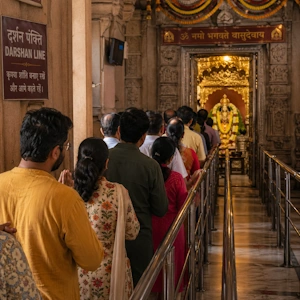
You think darshan means just seeing.
Standing in a line.
Looking at the murti.
Folding hands and leaving.
That is the outer layer.
The real thing is far deeper.
Darshan is not you seeing Bhagavan.
It is Bhagavan allowing you to be seen.
This flips everything.
You go to the temple thinking you are observing.
But actually, you are being observed.
Your state is being read.
Your mind is being measured.
Your inner condition is being touched.
That is why darshan is powerful even if you do nothing.
Because it is not based on your effort.
It is based on His presence.
Now understand why time matters.
Not all moments are equal.
There are specific times when the deity is awakened.
Decorated.
Energized through mantra and ritual.
Morning darshan.
Alankara darshan.
Aarti darshan.
Shayana darshan.
Each one is a different state of Bhagavan.
And each state interacts differently with you.
Early morning darshan hits when your mind is quiet.
It cleans deeply.
Aarti darshan hits with sound, fire, and movement.
It shakes your inner dullness.
Night darshan is soft.
It settles and calms.
This is not random tradition.
This is precise design.
Now look at something very important.
Why do people feel something even if they don’t understand anything?
Because darshan bypasses logic.
You may not know the mantra.
You may not know the meaning.
Still something shifts.
Because your system is responding.
The eyes become the entry point.
What you see affects what you become.
That is why temples focus so much on form.
The posture.
The eyes of the murti.
The ornaments.
The lighting.
Everything is arranged to impact you silently.
You don’t realize it.
But your mind is being tuned.
Slowly.
Subtly.
Now see the mistake people make.
They rush.
They push.
They try to get a quick glimpse and leave.
They treat darshan like a task.
That weakens the impact.
Darshan works when there is stillness.
Even a few seconds of full attention is enough.
Stand.
Look properly.
Let the mind stop reacting.
That moment goes deep.
Another thing.
Repeated darshan matters.
Not once.
Again and again.
Because each time, a layer drops.
Just like sitting near fire.
You don’t feel the heat instantly.
But stay longer, and the warmth spreads.
Same here.
Darshan slowly reshapes your inner state.
Without you forcing anything.
That is why people who regularly go to temples become different.
Not by theory.
By exposure.
Now understand the final point.
Darshan is not only about blessing.
It is about alignment.
You stand in front of something higher than you.
Perfectly balanced.
Completely stable.
Untouched by your chaos.
And slowly, you start adjusting.
Without words.
Without instruction.
Just by seeing.
That is darshan.
Simple outside.
Transformative inside.
If you approach it properly, it becomes one of the most direct ways to purify and stabilize your mind.
Not through effort.
Through contact.
That is the real importance of darshan.
Why do people become impatient in darshan queues instead of calm
Because the queue removes control. When control is gone, the real mind comes out. Impatience is not created there, it is revealed there. That exposure is the first step toward inner correction.
Is agitation in the queue a failure of spirituality
No. It is a diagnostic moment. It shows exactly where you stand. If you observe your reactions instead of just acting on them, the queue itself becomes a form of practice.
How can a restless queue still lead to a meaningful darshan
Because darshan depends on the final state of attention, not the journey alone. Even after agitation, if you gather yourself and become still for a few seconds before Bhagavan, the impact can still go deep.
What is the hidden benefit of dealing with difficult people in the queue
They trigger your ego, impatience, and judgment. Each trigger is a chance to see your inner patterns clearly. Without such situations, these patterns stay hidden and untouched.
Why is self-awareness in the queue more important than external discipline
External discipline can organize movement, but it cannot purify the mind. Self-awareness turns every irritation into insight. That shift is what makes the entire process meaningful.
Objection: If people are behaving badly, the system is flawed
Reply: The system is exposing behavior, not causing it. The same situation can make one person angry and another person steady. That shows the difference is within, not in the system.
Objection: Spiritual places should feel peaceful, not chaotic
Reply: A temple is not only for those who are already peaceful. It is for all kinds of people. The outer chaos often reflects inner states. The purpose is transformation, not comfort.
Objection: Getting irritated in a queue cancels any spiritual benefit
Reply: Only if you remain unconscious. If you notice the irritation and understand it, that moment itself becomes growth. Awareness converts disturbance into progress.
Objection: It is unrealistic to expect people to stay calm in such conditions
Reply: Calmness is not expected, awareness is. Even noticing that you are losing calm is a step forward. The process begins there, not at perfection.
Objection: Quick darshan after such chaos has no value
Reply: Value does not come from perfect conditions. It comes from the shift you make. Even a brief moment of genuine stillness after chaos can have a strong impact.






English
Temples
Click on any topic to open
7
30
Astrology
Bhagavad Gita
Bhagavatam
Bharat Matha
Devi
Devi Mahatmyam
Ganapathy
Garuda Puranam
Glory of Venkatesha
Hanuman
Kathopanishad
Mahabharatam
Mantra Shastra
Mystique
Practical Wisdom
Purana Stories
Radhe Radhe
Ramayana
Rare Topics
Rigveda Explained
Rituals
Sages and Saints
Shiva
Spiritual books
Sri Suktam
Story of Sri Yantra
Temples
Vedas
Vishnu Sahasranama
Yoga Vasishta
26
17
10
0


