Garbha Griha: The Place Where Bhagavan Truly Resides
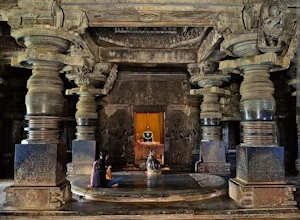
Walk into any traditional temple and notice what pulls you inward.
Not the pillars.
Not the carvings.
Not even the crowd.
It is a quiet pull toward a small, dark chamber.
That chamber is the garbha griha.
Garbha means womb.
Griha means house.
This is not poetic decoration.
It is a precise statement.
The temple is not treated as a building.
It is treated as a living body.
And the garbha griha is its innermost core.
Everything in the temple points toward this one place.
The layout funnels you inward.
The corridors narrow your attention.
The light reduces.
The noise fades.
You are being guided, step by step, from the outer world into a concentrated center.
Now look at the design.
The garbha griha is small.
Almost restrictive.
It has no windows.
The walls are thick.
The entrance is narrow.
Light is minimal.
Why build it like this?
Because the goal here is not visibility.
The goal is containment.
Energy, once invoked, should not scatter.
It should stay, intensify, stabilize.
That is why the chamber is closed.
That is why silence is enforced.
That is why only limited people enter.
Inside this space, the deity is installed.
But installation alone is not enough.
Before the structure even becomes a temple, a process is done beneath it.
A seed of energy is placed in the foundation through a precise ritual.
That unseen layer supports what you see above.
So when you stand outside and look into the sanctum, you are not just looking at a statue.
You are facing a system that has been built from the ground up to hold presence.
Now observe your own experience.
Outside the temple, the mind is scattered.
Inside the mandapa, it slows a little.
Near the sanctum, it becomes alert.
At the doorway of the garbha griha, something shifts.
You do not need belief for this.
You just need attention.
The design works on the human system directly.
The darkness forces your senses inward.
The stillness removes distraction.
The geometry stabilizes perception.
Even the lamp inside plays a role.
One steady flame in a dark space becomes the anchor for your awareness.
This is not accidental.
This is deliberate engineering.
Another important point.
You are usually not allowed to walk freely inside the garbha griha.
You stand outside.
You take darshan from the threshold.
This is not exclusion.
This is control.
If everyone moves freely inside, talks, touches, and lingers, the field gets disturbed.
The sanctum is kept protected so that its intensity does not dilute.
So access is regulated.
Not to create distance.
But to preserve depth.
Now understand something deeper.
Why call it a womb?
Because it holds and generates.
In a biological womb, life forms in silence.
No noise.
No display.
No disturbance.
In the same way, the garbha griha holds a concentrated presence that nourishes those who come near it.
You may stand outside for just a few seconds.
But if your attention is steady, that moment can leave a strong imprint.
That is the whole point.
Not long rituals.
Not complicated philosophy.
Just a direct encounter with a concentrated center.
Over time, with continuous worship, mantra, and discipline, the sanctum becomes more stable.
More responsive.
More powerful.
That is why ancient temples feel different from newly built ones.
They have accumulated presence.
And that presence is anchored in the garbha griha.
Strip everything else away, and the temple still stands because of this one space.
Remove this, and the rest becomes structure without depth.
So when you go to a temple next time, do not rush.
Watch how you move.
Watch how your mind behaves.
Stand at the doorway of the sanctum.
Stay still for a moment.
That silent, dark chamber is not empty.
It is the most alive point in the entire space.
Q1. Why is the garbha griha designed to be small, dark, and closed instead of open and grand?
A. Because its purpose is not display but concentration. When space is open, energy and attention spread out. When space is closed, both are forced inward. The darkness removes visual distraction. The silence removes mental noise. The structure acts like a container that holds and intensifies presence. What looks simple from outside is actually a precision design to create depth.
Q2. What is the real difference between the garbha griha and the rest of the temple?
A. The rest of the temple prepares you. The garbha griha confronts you. Outer areas allow movement, conversation, and gradual settling. The sanctum removes all that and brings you face to face with a concentrated point. It is not meant for activity. It is meant for direct contact. That is why everything in the temple ultimately leads to this one place.
Q3. Why is access to the garbha griha restricted?
A. Because unrestricted movement breaks stability. Every human carries restlessness, thoughts, and emotional disturbance. If that enters the core space constantly, the intensity reduces. Restriction is not about exclusion. It is about preserving the condition required for the sanctum to function as intended. It protects the field from dilution.
Q4. How does the garbha griha affect a person without any belief?
A. It works at the level of experience, not belief. When you stand in front of a silent, dark, focused space, your senses naturally withdraw. Your attention becomes sharper. Your mental activity slows down. This shift happens whether you believe or not. The design interacts with your system directly, not through ideas.
Q5. What unseen process supports the garbha griha?
A. Before the visible structure is completed, an energy base is established in the foundation through a precise method. That base acts like a seed. The sanctum is built above it. Over time, with continuous worship and discipline, this base stabilizes and strengthens the presence. What you see is only the surface. The real support lies beneath.
Objection 1. This is just imagination. It is only a small room with a statue.
Reply. If it were just a room, all rooms would feel the same. But they do not. Structure, proportion, sound, light, and usage change how a space affects you. The garbha griha is built with specific constraints that alter perception and attention. The effect can be observed directly without needing belief.
Objection 2. Restricting entry is outdated and unfair.
Reply. Not every space is meant for free movement. A laboratory, a control room, or a surgical area also has restrictions to maintain conditions. The sanctum is treated similarly. The restriction is functional, not social. It ensures the environment remains stable and undisturbed.
Objection 3. Darkness and silence are just old design limitations, not intentional.
Reply. If it were a limitation, all parts of the temple would be the same. But only the sanctum is designed this way. Other areas are open and well lit. The contrast itself shows intention. The darkness and silence are used deliberately to shift the way a person perceives and responds.
Objection 4. If there is real power, it should be visible or measurable.
Reply. Not everything works through direct visibility. Sound, gravity, and thought itself are not seen, but their effects are clear. The garbha griha operates through experience. Its impact is observed in how people respond, how the space feels, and how attention changes within it.
Objection 5. Ancient people did not have advanced knowledge to design such systems.
Reply. Complexity does not always require modern tools. It requires observation, repetition, and refinement over time. Temple design is not random. It follows consistent patterns across regions and centuries. That level of consistency shows a developed understanding, not guesswork.





English
Temples
Click on any topic to open
7
30
Astrology
Bhagavad Gita
Bhagavatam
Bharat Matha
Devi
Devi Mahatmyam
Ganapathy
Garuda Puranam
Glory of Venkatesha
Hanuman
Kathopanishad
Mahabharatam
Mantra Shastra
Mystique
Practical Wisdom
Purana Stories
Radhe Radhe
Ramayana
Rare Topics
Rigveda Explained
Rituals
Sages and Saints
Shiva
Spiritual books
Sri Suktam
Story of Sri Yantra
Temples
Vedas
Vishnu Sahasranama
Yoga Vasishta
26
17
10
0


