Antiquity of Pancharatra Vaishnavism
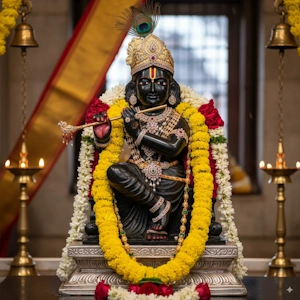
Today we will look at the meaning of the divyanama vasumanaha and also look at the antiquity of the pancharatra form of vaishnavism from a historical perspective.
vaumanaha –
vasu means wealth – wealth is connected to fame. His mana is famous, hence he is vasumana. Why is his mind famous?
रागद्वेषादिभिः क्लेशैः मदादिभिरुपक्लेशैश्च यतो न कलुषितं चित्तं ततस्तन्मनः प्रशस्तम्
His mind is not affected by kleshas such as love and hatred.
There are five kinds of kleshas:
avidya – ignorance
asmita – ahamkara, feeling that I am separate from others
ragaha – passion, love
dvesha – hatred
abhinivesha – marana bhayam, fear of death
These are called kleshas because they cause grief in the mind, they make the mind perturbed.
Then there are upa kleshas – kama, krodha, lobha, moha, mada, matsarya – lust, anger, greed, confusion, arrogance and jealousy. His mind is devoid of the kleshas and the upakleshas. Hence Sri Hari’s mind is famous, vasumanaha.
वसुनीव् निधौ तॆषु मनॊ यस्यास्ति सर्वदा |
सर्वैः वसुमनाः प्रॊक्तॊ मातृवत् पॊषकॊ मनुः ||
Vasu – wealth – treasure – nidhi. If you have a treasure hidden somewhere, your mind always will be there. You will be constantly thinking about it. In the same way, Sri Hari’s mind is constantly upon his devotees. He is always thinking about them. A mother even when she is away, her mind will be constantly concerned about her child. In the same way Sri Hari always thinks about the well-being of his devotees. His wealth vasu is his devotees.
Bhagavata we know was written towards the end of Dwapara yuga when the Lord was present on earth in his Krishnavatara.
In Bhagavata utmost importance is given to Krishnavatara. Followers of Bhagavata became known as Bhaagawatas.
Pancharatra is also known as Bhaagawata Shastra or Satwata Samhita. Vamana Purana says.
Originally the Vrishni vamsha, the clan of the Lord, had five heroes. Vayu Purana calls them पञ्चैते वंशवीराः. Mora is a village near Mathura. An inscription dating back to the 1st century BC was found here.
It says this is not pure Sanskrit, this is hybrid language. Rajuvala was a famous ruler in the dynasty of the northern satraps, around the year 10 BC. His son was Shodasha. He consecrated the idols of the five heroes of the Vrishni vamsha in a stone temple. The inscription says that the temple was already there built by a lady called Tosha. The idols were also made of stone and were beautiful and brilliant.
These inscriptions upon three idol remains and one doorjamb are available at Mathura museum.
The fifth hero is Samba, son of the Lord and Jambavati. But later on in the Pancharatra system four heroes, Vasudeva, Samkarshana, Pradyumna and Aniruddha became prominent and they became known as the Chaturvyuhas.
The Vrishnis were also called Saatwatas. Going back, Mahabharata says it was Lord Balarama himself who propounded the Satwata system or the Pancharatra system of the Lord's worship.
द्वापरस्य युगस्यान्ते आदौ कलियुगस्य च।
सात्वतं विधिमास्थाय गीतः संकर्षणेन वै
Another inscription dating back to the 1st and 2nd century BC found at Naagari village near Chittorgarh, Rajasthan also known as घोसुंडी or हाथीबाडा inscription.
The king Gaajayana son of Parashari who was a Bhaagawata built a stone temple for the worship of the unconquerable Ishwaras Vasudeva and Samkarshana.
An inscription on a pillar found at बेसनगर in the Vidisha district of Madhya Pradesh, also known as the Heliodoros pillar, says that
This Garuda-standard of Vāsudeva, the God of Gods
was erected here by the devotee Heliodoros,
the son of Dion, a man of Taxila,
sent by the Great Yona King Antialkidas, as ambassador
to King Kasiputra Bhagabhadra,
the Savior son of the princess from Varanasi,
in the fourteenth year of his reign.
Three immortal precepts (footsteps)... when practiced lead to heaven: self-restraint, charity, consciousness.
Heliodoros was an ambassador sent by King Antialkidas of Takshashila, an Indo-Greek king. Heliodoros converted and became a Bhaagawata, and he erected this Garuda dhwaja to honour the Lord.
Our Puranas and Itihasas are not mythology. They are our real history substantiated by archeological evidence.
-
If Bhagavan already lives in all beings, what changes when I chant his names?
Your attention turns toward the indwelling Lord. With that alignment, thought, speech, and action fall into order. Daily sahasranama recitation makes this alignment steady, not occasional. -
How does nama japa clean the mind of raga, dvesha, and other kleshas?
Repetition replaces the mind’s looping stories with a single holy current. The name interrupts craving and aversion at the root, so reactions cool and judgment becomes fair. -
Why is a disciplined count like 108 essential rather than ‘as and when’?
Fixed sankhya builds a clear track in the mind. The name becomes the default response under stress. Without a count, the practice remains optional and weak. -
What is the link between chanting and sharper decisions during the day?
Japa trains pause. In that pause, buddhi sees options without the fog of anger or pride. You choose well not by luck, but because the mind is already quiet. -
How can I make this practice help my physical health?
Sit straight, chant audibly but soft, and match one name to one calm exhale. Pulse steadies, breath deepens, and sleep improves. Ten to fifteen minutes morning and night is enough to feel the change. -
Will sahasranama help with fear of death and insecurity?
Yes. Constant remembrance loosens the grip of ‘I alone’. The Lord’s presence felt within gives courage to face pain, loss, and change without collapse. -
How do I bring family into the practice without arguments or pressure?
Fix a short common slot. One person leads ten names; others respond with ‘namah’. End with one minute of silence and goodwill for each other. Keep it simple and consistent. -
Is it better to chant fast and finish or slow and fewer?
Clear and steady wins. Every name should be heard by your own ear. Increase count only when clarity and posture remain firm throughout. -
What should I watch as proof that the practice is working?
Shorter recovery time after anger, fewer harsh words, quicker forgiveness, and a natural pause before decisions. These are objective, trackable signs. -
How do I handle days when the mind keeps drifting?
Do not fight. Gently return to the next bead and next name. Note distractions on a slip of paper and continue. Finishing the count on a noisy day is powerful tapas. -
Can I rely on recordings, or must I chant myself?
Learn from recordings; practice with your own voice. Your body, breath, and mind then move together, which gives the transformation its force. -
What if I miss a day due to travel or illness?
Resume the next day at your fixed count. Stability across months matters more than rare long sessions. -
How does this connect to the Lord’s power in the world, not just inside me?
The same Lord who sustains the universe hears the name in your heart. Trusting that unity gives fearlessness in duty and humility in success. -
How should I set up a traditional, respectful routine at home?
Clean corner facing east if possible, lamp or diya, washed hands, straight spine, mala or tally. Begin with a short sankalpa, chant your count, and end with shanti and a prayer for all beings. -
What weekly rhythm keeps the practice strong?
Daily: 108 names morning; 54 names night. Weekly: one session of 1008 names. On that day, reduce unnecessary talk, eat light, and keep the mind on the name. -
How do I use the name during conflict at home or work?
Rule of three: take three beads before speaking. In that brief space, words become measured, and outcomes improve without force. -
Why is sticking to sahasranama and plain nama japa enough?
Because the name carries the Lord’s full presence. Tradition is clear: the name itself is the path, the practice, and the fruit. Keep to it with faith and discipline.
How can you call Vishnu’s mind free of emotions like love and hatred? Isn’t that just poetry?
No. The definition of kleshas is clear in Patanjali’s system and echoed in the Gita. Love, hatred, fear, ego, ignorance – these distort the human mind. The claim about Vishnu is that his consciousness does not undergo these distortions. It is a precise philosophical distinction, not flowery exaggeration.
If devotees are his ‘wealth’, how do you prove that’s more than sentimental talk?
Epigraphs and texts describe kings treasuring jewels or coins as nidhi. By analogy, the mind of Vishnu is always with his ‘nidhi’ – devotees. Inscriptions and the Bhagavata consistently show communities identifying themselves as Bhagavatas, proving this was not just sentiment but a social reality that lasted centuries.
How can you say Pancharatra is ancient when it looks like later sectarian invention?
Archaeology disproves that objection. The Mora inscription (1st century BC), the Ghosundi inscription (1st–2nd century BC), and the Heliodoros pillar all reference Vasudeva and Samkarshana worship in formal temples. These are datable stone records, not later sectarian legends.
Isn’t Heliodoros just a Greek ambassador putting up a pillar? How does that prove Vishnu worship?
The text of the pillar is unambiguous: ‘This Garuda-standard of Vasudeva… erected by Heliodoros the devotee’. It records him not only as an ambassador but as a declared Bhagavata. That is conversion recorded in stone, evidence that Vasudeva worship was real and recognized.
How do you know the Vrishnis’ five heroes are connected to Pancharatra theology? Couldn’t they be just local folk deities?
The Vayu Purana explicitly calls them ‘vamsha-viras’. Inscriptions place them in temples with Vasudeva and Samkarshana. Later systematization into Chaturvyuha shows continuity, not rupture. The same figures evolve into the structured Pancharatra framework.
Isn’t it mythology to say Balarama taught the Satwata system? Where is proof?
The Mahabharata verse is there in black and white, attributing Satwata vidhi to Sankarshana (Balarama). You can debate interpretation, but you can’t deny the textual presence. Combined with inscriptions, it proves the antiquity of this system far before sectarian codification.
How can you claim Puranas and Itihasas are history? Don’t they contain miracles and myths?
History does not mean absence of miracles; it means continuity of memory corroborated by material evidence. When names, places, clans, and practices in texts match inscriptions and archaeological finds, the burden of proof shifts. Pancharatra, Bhagavata identity, and Vasudeva worship are demonstrated as historical facts.





English
Vishnu Sahasranama
Click on any topic to open
7
30
Astrology
Bhagavad Gita
Bhagavatam
Bharat Matha
Devi
Devi Mahatmyam
Ganapathy
Garuda Puranam
Glory of Venkatesha
Hanuman
Kathopanishad
Mahabharatam
Mantra Shastra
Mystique
Practical Wisdom
Purana Stories
Radhe Radhe
Ramayana
Rare Topics
Rigveda Explained
Rituals
Sages and Saints
Shiva
Spiritual books
Sri Suktam
Story of Sri Yantra
Temples
Vedas
Vishnu Sahasranama
Yoga Vasishta
26
17
10
0


