The Scientists of the Ancient World
Imagine standing outside the operation theatre of a modern hospital. A team of surgeons is performing a heart transplant. They are taking a heart that has stopped, placing it into a new body, and making it beat again. When the doctor steps out and says, ‘The patient will live, we look at them almost like gods. They have hacked the rules of nature. They have defeated death.
Today, we call this biotechnology. But thousands of years ago, our ancestors had a different name for it: 'Mrit-Sanjivani Vidya'.
In our Puranas, there is an endless rivalry between the Devas and the Asuras. Growing up, we are often told a very simple version of this: the Devas were the ‘good gods’ in heaven, and the Asuras were the 'evil demons' with horns. But if you read the ancient texts closely, a very different and fascinating picture emerges.
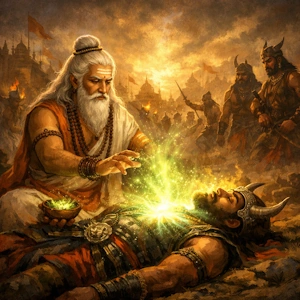
During their great wars, the Devas realized they had a terrifying problem. Whenever they killed an Asura warrior in battle, that warrior would rise again the next day, fully healed. The Devas were baffled. They were the rulers of heaven, yet they could not do this.
The secret belonged to the Asura Guru, Shukracharya. Through years of intense, obsessive research and meditation—what we might today call extreme R&D—he had unlocked the exact science of cellular regeneration. He could literally bring the dead back to life.
Have you ever stopped to wonder about this in detail? Why did the Puranas give the ultimate medical technology to the Asuras, and not to the Devas?
To understand this, we need to look at what Devas and Asuras truly represent. It is not just a battle of good versus evil; it is a clash of two different mindsets.
The Devas represent the natural order. They are the forces of nature—rain, wind, sun, and fire. They believe in the cosmic balance. If autumn comes, leaves must fall. If a creature is born, it must eventually die. They accept the limits placed upon them by the universe.
The Asuras, however, represent human ambition, intellect, and the relentless desire to conquer the material world. An Asura does not accept limits. If nature says, 'You must die,' the Asuric mind asks, 'How do I rewrite this rule? How do I build a tool, or find a chemical, or invent a technology to defeat this?'
Shukracharya was not a monster; he was the ultimate ancient scientist. He represented the path of radical biotechnology.
When we view the story through this lens, the Puranas suddenly read like a brilliant piece of science fiction, or perhaps, a forgotten history. The ancients were exploring a profound question: What happens when you learn to manipulate biology itself?
To manipulate life—to play with genetics, to clone, or to reverse death—you need an obsessive focus on the physical body. You have to view the body not just as a temple, but as a machine that can be dismantled and fixed. This is exactly what the Asuras did. The Devas couldn't invent 'Sanjivani Vidya' because their mindset was about accepting nature, not hacking it.
Today, we live in a world that is heavily influenced by the Asuric mindset, and honestly, we should be thankful for it. Every time we take an antibiotic to kill a bacteria, or use stem-cell therapy to grow new tissue, we are walking the path of Shukracharya. We are refusing to let nature simply take its course. We are using human brilliance to fight back against the natural cycle of decay.
But the Puranas also offer a quiet warning. They remind us that while the Asuras possessed incredible scientific knowledge, their constant desire to control nature often led to chaos. They became so obsessed with their power over life and death that they forgot 'how' to live peacefully.
This is a beautiful insight for our modern times. As we step deeper into the age of artificial intelligence, genetic engineering, and biotechnology, we are holding the 'Sanjivani' in our own hands. We have the power to hack the human body.
But the ancient stories ask us a simple, profound question: As we use our brilliant minds to conquer the limits set by nature, do we have the wisdom to keep our world in balance?
Science gives us the power to rewrite the rules. But it is wisdom that tells us which rules are worth rewriting.
Question 1: How does the narrative reframe the traditional understanding of ancient mythology, specifically regarding the Devas and Asuras?
The narrative shifts the traditional view of Devas as purely righteous and Asuras as wicked entities. Instead, it presents a profound philosophical clash. It reveals a hidden secret: the stories might not be about morality, but about the tension between accepting natural cosmic laws and the relentless human drive to conquer and manipulate the physical realm through advanced knowledge.
Question 2: What is the unlooked mystery behind Shukracharya possessing the Mrit Sanjivani Vidya instead of the rulers of heaven?
The mystery lies in the psychological requirements of profound scientific discovery. The rulers of heaven represented harmony with the universe and acceptance of decay. In contrast, Shukracharya possessed a restless, investigative intellect. The ancient texts suggest a great principle here: radical breakthroughs require an obsessive, almost rebellious focus on dismantling and understanding the physical world, a trait naturally belonging to the Asuric mindset.
Question 3: How does the ancient concept of Mrit Sanjivani Vidya mirror the profound ambitions of modern biotechnology?
Mrit Sanjivani Vidya translates to the exact science of cellular regeneration and reversing death. Just as a modern surgical team hacks nature to make a stopped heart beat again in a new body, the ancient practice involved extreme research and development to conquer mortality. Both represent the ultimate quest to manipulate biology and rewrite the fundamental rules of existence.
Question 4: What profound shift in perspective is required to master life altering technologies according to the ancient texts?
To master such technologies, one must transition from viewing the body merely as a sacred temple to seeing it as a complex biological machine. This perspective is a hidden secret of scientific advancement. It requires dismantling the mechanisms of life, understanding genetic blueprints, and treating biology as a system that can be repaired and upgraded rather than blindly accepted.
Question 5: What greatness is hidden within the Asuric mindset that modern society benefits from today?
The greatness of this mindset is its refusal to surrender to suffering and physical limitation. Modern society relies entirely on this rebellious principle. Every time we develop stem cell therapies, eradicate diseases with antibiotics, or perform organ transplants, we channel this ancient drive. It is the core engine of human progress and survival against the harsh realities of natural decay.
Question 6: If the Asuric approach brings life saving advancements, what hidden danger do the ancient stories warn us about?
The secret warning within the ancient texts is the danger of losing inner balance. While acquiring immense power over the material world and defeating physical death, there is a risk of forgetting how to live peacefully. The pursuit of endless control can lead to chaos, where technological capability outpaces ethical wisdom, resulting in a world that survives but lacks harmony.
Question 7: How do the ancient texts act as a forgotten history or early science fiction regarding genetic engineering?
When viewed closely, the ancient records explore the societal and ecological consequences of extreme biological manipulation long before modern laboratories existed. They ask deep predictive questions about what happens when sentient beings unlock the codes of life and death. This positions the texts not as mere fables, but as profound psychological and perhaps historical explorations of advanced civilizations.
Question 8: What is the great philosophical principle behind the Devas inability to revive their fallen warriors?
The greatness of the Devic principle is their absolute alignment with cosmic balance. They represent the forces of the universe that maintain order through cycles of creation and destruction. Their inability to revive the dead is not a weakness, but a conscious adherence to the law of nature. They understand that for the universe to function, the cycle of mortality must remain unbroken.
Question 9: How does the narrative explore the tension between scientific capability and true wisdom?
The narrative highlights that while extreme research gives us the mechanics to rewrite natural laws, it does not automatically grant the wisdom to use them properly. Science provides the power of the Mrit Sanjivani, but true wisdom involves understanding the long term ecological and spiritual impacts of deploying such power. It is the difference between knowing how to hack nature and knowing if you should.
Question 10: In the context of artificial intelligence and biohacking, what ultimate question does this ancient philosophy pose to our current generation?
As we stand on the brink of godlike technological power, the ancient philosophy asks if we have cultivated enough wisdom to maintain global balance. We are holding the power of regeneration and creation in our own hands. The mysterious and urgent question is whether our moral framework can evolve fast enough to handle our capacity to conquer the limits set by nature.






English
Rare Topics
Click on any topic to open
7
30
Astrology
Bhagavad Gita
Bhagavatam
Bharat Matha
Devi
Devi Mahatmyam
Ganapathy
Garuda Puranam
Glory of Venkatesha
Hanuman
Kathopanishad
Mahabharatam
Mantra Shastra
Mystique
Practical Wisdom
Purana Stories
Radhe Radhe
Ramayana
Rare Topics
Rigveda Explained
Rituals
Sages and Saints
Shiva
Spiritual books
Sri Suktam
Story of Sri Yantra
Temples
Vedas
Vishnu Sahasranama
Yoga Vasishta
26
17
10
0


