How Ayurveda Views the Human Body
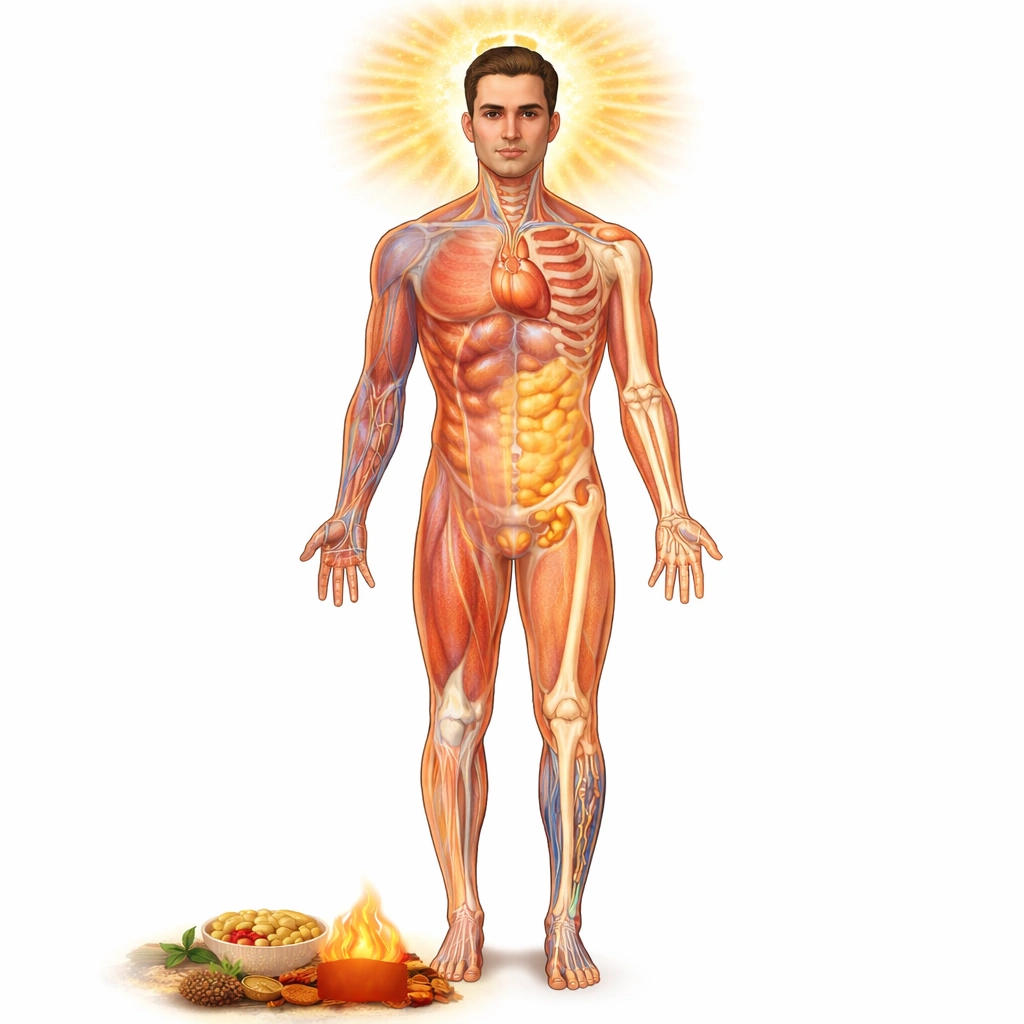
Ayurveda describes the human body as a living system built from seven fundamental tissues, called the Sapta Dhatu. These dhatus are not just physical substances. They are functional layers of nourishment and structure that sustain life. Health exists when all these tissues are properly formed, balanced, and nourished.
The process begins with food. Whatever we eat is digested by the digestive fire, called Agni. After digestion, the useful portion of food becomes a nutritive essence. This essence then gradually transforms into the seven dhatus, one after another.
First comes Rasa Dhatu.
This is the primary nourishing fluid of the body. It forms immediately after digestion and circulates throughout the system. Rasa carries nutrients to every part of the body. It maintains hydration, supports immunity, and provides the basic nourishment needed for all other tissues to develop.
From Rasa is formed Rakta Dhatu, the blood tissue. Rakta carries life energy through the body and supports vitality. It maintains healthy skin color, sustains the organs, and enables oxygen and nutrients to reach every cell. When Rakta is strong, the body feels energetic and active.
From Rakta develops Mamsa Dhatu, the muscle tissue. Mamsa builds the bulk and shape of the body. It gives physical strength, supports movement, and protects internal organs. Well-developed Mamsa Dhatu gives firmness and stability to the body.
Next comes Meda Dhatu, the fat tissue. Meda stores energy and provides lubrication to the body. It keeps the joints smooth and protects internal organs. It also helps maintain body warmth and supports endurance.
From Meda arises Asthi Dhatu, the bone tissue. Asthi forms the skeletal framework that supports the entire body. Bones give structure, protect vital organs, and allow movement. Teeth and nails are also considered part of Asthi Dhatu in Ayurvedic understanding.
From Asthi develops Majja Dhatu. Majja fills the cavities of bones and includes bone marrow and the deeper nourishing elements connected to the nervous system. It supports strength, coordination, and the proper functioning of the body’s internal systems.
Finally comes Shukra Dhatu, the reproductive tissue. This is the most refined of all the dhatus. In men it refers to semen, and in women it represents the reproductive essence related to fertility and the ovum. Shukra supports reproduction, vitality, creativity, and deep physical strength.
Ayurveda explains that these tissues are formed in a precise sequence:
Food → Rasa → Rakta → Mamsa → Meda → Asthi → Majja → Shukra
Each dhatu takes nourishment from the previous one and transforms it into the next level of tissue. Because of this sequence, if the earlier tissues are weak or poorly nourished, the later tissues will also become weak.
From the complete refinement of all seven dhatus emerges an even subtler essence called Ojas. Ojas represents the deepest strength of the body. It is the basis of immunity, mental stability, enthusiasm, and overall vitality. When Ojas is strong, the person feels energetic, calm, and resilient.
This model shows how Ayurveda views the human body: not as a collection of isolated parts, but as a continuous chain of nourishment where every level of tissue supports the next, ultimately sustaining life and vitality.
- Why is the sequence of Dhatu formation so rigid and specific?
The sequence represents a journey from the gross to the subtle. Each tissue is a more refined version of the one before it. Food is the most external, while Shukra and Ojas are the most internal and powerful. This hierarchy ensures that the body prioritizes basic survival needs, like hydration and circulation, before allocating energy to more complex functions like skeletal structure or reproduction. - What is the hidden relationship between Rasa Dhatu and emotional health?
Rasa is not just plasma; its name also means taste and emotion. Ayurveda teaches that if the primary nutritive fluid is of poor quality, it affects the mind immediately. A healthy Rasa Dhatu leads to a sense of satisfaction and contentment, whereas a depleted or toxic Rasa leads to a feeling of being drained, anxious, and emotionally dry. - How does the body decide how much of each tissue to create from a single meal?
This is governed by Agni, the digestive fire, and the Dhatu Agnis (tissue-specific fires). Each tissue has its own small metabolic fire that selects what it needs from the nutritive stream. If the fire of the muscle tissue is too high, one might become overly muscular but depleted in fat; if it is too low, the muscles become weak and flabby despite eating well. - What happens to the body if the sequence is interrupted at the Meda Dhatu (Fat) stage?
If the transformation from Meda to Asthi (Bone) is blocked, the body continues to accumulate fat without nourishing the bones. This is a mysterious explanation for why some individuals may gain weight easily yet suffer from weak teeth or bone density issues. The "nutritive fire" is stuck at the fat layer and cannot leap to the skeletal layer. - Why are teeth and nails considered by-products of the bone tissue?
In Ayurveda, every Dhatu produces a Mala (waste product) and an Upadhatu (secondary tissue). Teeth and nails are the visual indicators of the health of the Asthi Dhatu. If your nails are brittle or your teeth decay easily, it is a hidden signal that the core skeletal structure deep within is not receiving proper nourishment. - What is the spiritual significance of Shukra Dhatu being the final stage?
Shukra is the essence of all the other six tissues combined. It is considered so powerful because it has the potential to create new life. Beyond physical reproduction, this refined essence is what the body uses for deep creative thinking and spiritual clarity. It is the fuel for the "inner light" of a human being. - How does the concept of Ojas differ from simple physical strength?
Physical strength is the result of Mamsa (Muscle), but Ojas is the result of total metabolic harmony. You can have large muscles but low Ojas, leaving you prone to frequent illness or mental burnout. Ojas is the biological equivalent of a shield; it is the "glow" on the skin and the "calm" in the eyes that persists even during times of stress. - Can a person have healthy tissues if their Agni is weak, even if they eat the best organic food?
This is an overlooked principle. Without a strong Agni, food does not become nutritive essence; it becomes Ama, or toxic sludge. Ama clogs the channels (Srotas) between the Dhatus. Even the most expensive supplements cannot reach the bones or the reproductive system if the transformational fires are too weak to process them. - Why does Ayurveda emphasize that the health of the child depends on the Dhatus of the parents?
Since Shukra is the final refinement of the parents' Dhatus, it carries the "nutritional history" of both individuals. If a parent's Rasa or Rakta is toxic at the time of conception, the "refined essence" will be compromised. This hidden link suggests that preparing for parenthood involves purifying all seven layers of one's own body first. - Is it possible to "jump-start" a deeper Dhatu like Majja or Shukra without fixing the earlier ones?
It is very difficult. Because the system is a chain, trying to nourish the marrow or the reproductive system while having poor blood quality is like trying to water the leaves of a plant while the stem is blocked. True health is a bottom-up process. One must first ensure proper hydration (Rasa) and healthy blood (Rakta) for the deeper, more mysterious layers of the body to flourish.





English
Rare Topics
Click on any topic to open
7
30
Astrology
Bhagavad Gita
Bhagavatam
Bharat Matha
Devi
Devi Mahatmyam
Ganapathy
Garuda Puranam
Glory of Venkatesha
Hanuman
Kathopanishad
Mahabharatam
Mantra Shastra
Mystique
Practical Wisdom
Purana Stories
Radhe Radhe
Ramayana
Rare Topics
Rigveda Explained
Rituals
Sages and Saints
Shiva
Spiritual books
Sri Suktam
Story of Sri Yantra
Temples
Vedas
Vishnu Sahasranama
Yoga Vasishta
26
17
10
0


