The Origin of Radha Rani
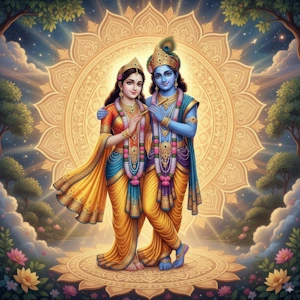
Today we will try to understand a little bit about Radha Rani and also the meaning of the divya nama
कृतज्ञः – प्राणिनां पुण्यापुण्यात्मकं कर्म जानातीति कृतज्ञः – he knows all the good and bad deeds performed by everyone and gives them results accordingly.
He can measure exactly how sincere you are. He can grade you precisely. He has got the means to do that. He doesn’t measure the quantity of how much you have offered. Somebody may be covering the vimana of his temple with gold or offering him a gold crown. Somebody else can only pluck a tulasi leaf and offer at his feet. Doesn’t matter.
पत्रपुष्पाद्यल्पमपि प्रयच्छताम् मोक्षं ददाति
Even to someone who has offered as little as a small flower or a tulasi leaf, he confers moksha. Because he knows how to measure the bhava, the intensity of the sincerity of the devotee.
Draupadi cried out to him from far away, he rushed to her. That one 100% sincere cry from her was sufficient. Someone may be taking his names from morning to evening, mechanically, with mind wandering here and there, desiring for something or the other. You don’t see anything happening. But one cry from Draupadi, he rushed to her to save her.
That’s why he is kritajna.
अपि चेत्सुदुराचारो भजते मामनन्यभाक्।
साधुरेव स मन्तव्यः सम्यग्व्यवसितो हि सः
Suduracharaha – worst offender, if he comes to me fully focused on me, he should be considered as a noble person. Because the Lord knows why someone is doing something.
Vrindavana is a replica of Goloka. Goloka is the abode of Lord Krishna. Just as Kailasa is the abode of Mahadeva and Vaikuntha is the abode of Maha Vishnu, Goloka is the abode of Sri Krishna. And that is where Lord Krishna, Radharani, the gopas and gopikas, they all live together eternally.
Vrindavana is only a replica of Goloka on earth. The Lord gave us an opportunity to see on earth what his permanent abode Goloka looks like. He recreated the Goloka on earth in the form of Vrindavana.
And in Goloka, where did Radha Rani come from? From the left side of Sri Krishna himself. That means they are not different from each other. They are the masculine and feminine aspects of the same truth.
Veda says - initially everything was one, single, then that one felt lonely, wanted the company of a companion and that one itself grew to double its size and split into two parts like a bean seed. Two parts that looked similar, like the two halves of a bean seed. The same is the case here also. Radharani came out of the left half of Lord Krishna.
As soon as she was born, she came into existence, she went running and came back with some flowers and offered arghya at his lotus feet to show her respect. So don’t lose the connectivity. A part of Lord Krishna coming out of him in feminine form and worshipping his own lotus feet. They are not different from each other. They are one and the same. And all this is happening in rasa mandala in Goloka.
Why is she called Radha?
रासे संभूय गोलोके सा दधाव हरेः पुरा । तेन राधा समाख्याता
She was born in rasa mandala – so the first letter in her name raa. Then what did she do? She ran and got flowers for Bhagawan. Running in Sanskrit is called dhavanam – so the second letter dhaa from dhavanam.
She came out of the left half of Lord Krishna – but she was, in fact, the prana of the Lord himself. His prana itself manifested in physical form is Radharani. Hence for him, she is dearer than his own prana.
Poornasya poornamaadaya – don’t forget this. Coming out of prana does not mean there is no prana left in the Lord’s body. In the case of divinity – even if the whole is taken out of the whole, still the whole would remain. This is not like 1-1 = 0. This is 1-1 = 1 itself.
-
If Radha and Krishna are one truth, what does that mean for my daily practice?
-
Balance feeling and focus. Do sahasranama for steadiness, then one minute of tender nama japa feeling you are held. Head and heart together work best.
-
-
How does oneness help me handle loneliness?
-
Chant one name on each exhale and picture companionship already present. The breath proves you are not separate; anxiety loosens.
-
-
Why does sincerity matter more than the size of my offering?
-
He is kritajna, the knower of motives. One clear round of names with full attention outweighs scattered hours. Quality, not drama.
-
-
How do I turn a rushed city evening into a small Vrindavana?
-
One lamp, sit together, five names aloud, 30 seconds of silence. The room softens; arguments lose urgency.
-
-
What should I do when devotion feels dry or forced?
-
Switch to one favorite name and slow the exhale. Three minutes of unhurried japa turns duty into sweetness.
-
-
Can chanting help my sleep cycle without gadgets?
-
Yes. Eight names in a whisper, lights low, then lie down. Longer exhales cue the body into rest mode.
-
-
How do I bring children in without preaching?
-
Give them one name for a week and the role of closing the last three repetitions. Ownership makes bhakti playful.
-
-
How can nama steady me during work pressure?
-
Before tough tasks, nine breaths with one name. After finishing, three soft names. Entry and exit markers keep the mind clean.
-
-
What do I do with guilt about past mistakes?
-
Offer it into the mantra: one round naming the mistake and placing it at Bhagavan’s feet. The knot loosens; energy returns to action.
-
-
How can sahasranama support physical health in a visible way?
-
Do one minute per hour: four slow names, longer exhale. Heart rate steadies, jaw relaxes, evening headaches drop.
-
-
How do I keep family peace when opinions clash?
-
Pause one breath, say one name silently, then speak. The tone shifts from winning to understanding.
-
-
Is solo chanting enough, or do I need a group?
-
Use both rails. Group once a week for momentum; solo on other days for depth. Momentum plus depth sustains.
-
-
What name should I use when the mind is noisy?
-
Pick the name that softens your breath within three repeats. Stay with it for 21 days. Depth beats variety.
-
-
How do I hold the thread while traveling?
-
Fix a travel count of 27 names. Same count anywhere. Use a tiny mala or counter app; single-task only.
-
-
Can nama guide choices about money or studies without superstition?
-
Do one round, then write the decision in one line. If breath tightens, wait; if breath stays free, proceed.
-
-
How do I end a session so the effect lingers?
-
Last five names in a whisper, palms on heart, one soft thank you. Leave the seat slowly; calm follows you out.
-
-
What is the minimum that still keeps the bond alive on a crazy day?
-
Three names on waking, three before sleep. If all else fails, one long ‘Govinda’ with full exhale. Never zero.
-
-
How do I know it is working even if life stays messy?
-
Track inner metrics: quicker recovery after stress, kinder words under pressure, steadier sleep, less doom-scrolling. If these rise, you are on track.
-





English
Vishnu Sahasranama
Click on any topic to open
7
30
Astrology
Bhagavad Gita
Bhagavatam
Bharat Matha
Devi
Devi Mahatmyam
Ganapathy
Garuda Puranam
Glory of Venkatesha
Hanuman
Kathopanishad
Mahabharatam
Mantra Shastra
Mystique
Practical Wisdom
Purana Stories
Radhe Radhe
Ramayana
Rare Topics
Rigveda Explained
Rituals
Sages and Saints
Shiva
Spiritual books
Sri Suktam
Story of Sri Yantra
Temples
Vedas
Vishnu Sahasranama
Yoga Vasishta
26
17
10
0


