The Nine Brothers of Bharata Known as Yogeeshwaras
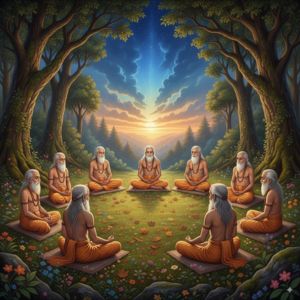
Today we will look at the nine yogeeshwaras and also the meaning of the divya nama atmavan.
Presently we are in Vaivaswata Manvantara. The first Manvantara of the present kalpa is Swayambhuva Manvantara which started roughly 200 crore years back. The first man and woman of Swayambhuva Manvantara was Swayambhuva and Shatarupa. Their son was Priyavrata. Priyavrata's son was Agneedhra. Agneedhra's son was Nabhi. Nabhi's son was Rishabhadeva.
Rishabhadeva had 100 sons, all of them very well versed in Vedas and Shastras. The eldest was Bharata. Bharata Varsha got its name after this Bharata only, not Bharata of Ramayana. Out of the remaining 99 sons of Rishabhadeva, 81 focused on karma kanda, propounded several systems of rituals. Nine became the rulers of nine islands, parts of Bharata Varsha. And the remaining nine became sanyasis. They are known as yogeeshwaras.
They are:
कवि, हरि, अन्तरिक्ष, प्रबुद्ध, पिप्पलायन, आविर्होत्र, द्रुमिल, चमस, करभाजन.
For them, this entire universe was a manifestation of Paramatma, Bhagawan. They didn’t look at it as an illusion, unreal. It was very much real for them and just one kind of manifestation of the Lord. They used to roam around freely, they used to go wherever they wanted.
Once, Nimi the king of Videha was conducting a yajna. The nine yogeeshwaras came there. Nimi asked them his doubts about dharma. How to attain Lord Krishna – Nimi asked. The first yogeeshwara Kavi in reply to this question gave him upadesha of Bhagavad dharma. The second yogeeshwara Hari added further to this – how to conduct oneself as a devotee so that the Lord can be achieved, the signs of a true bhakta, the nature of true devotees. Nimi wanted to know the nature of Maya. The third yogeeshwara Antariksha explained to him the true nature of Maya.
The fourth yogeeshwara Prabuddha told Nimi how to overcome Maya, how to go beyond Maya and reach the Lord. Maya is quite limited you see. Maya is just one aspect of the Lord. Someone comes to India from abroad, roams around Delhi for a couple of days, thinks that he has seen the whole of India. This created universe is just a small part of Sri Hari. Thinking that this is everything is ignorance. How to go beyond this, this is what Prabuddha taught Nimi.
Pippalayana taught Nimi about Paramatma, Narayana. Nimi wanted to know how to act in the world without getting attached to it, or incurring karma. You cannot survive in the world without action. Is there a way by which you act and at the same time don’t get bound to the results of your actions, you don’t enjoy or suffer the consequences of your action? This is called karma yoga. Aavirhotra the sixth yogeeshwara explained karma yoga to Nimi.
The seventh yogeeshwara Drumila told Nimi about the avataras of Sri Hari. Nimi asked – someone who has not given up desires, who doesn’t have control over the organs, both jnanendriyas and karmendriyas, still attached to the world, what happens to them after death? The eighth yogeeshwara Chamasa explained this to him.
Nimi wanted to know whether the Lord has the same color and form in all the yugas. The ninth yogeeshwara Karabhajana described Sri Hari’s forms in all the yugas. These are the yogeeshwaras, parama bhaktas of Sri Hari.
Now the divya nama atmavan.
आत्मवान् –
स भगवः कस्मिन् प्रतिष्ठित इति स्वे महिम्नि.
He is the support of everything. The universes rest on him, are placed on him. What does he rest upon? What is that never moving, never changing base upon which Sri Hari rests? We call him Vidhata because he is the support for all the supports. What is the support for him? What does he rest upon? Upon his own glory, upon his own greatness, which never changes, never moves. He doesn’t have an external support. His glory is his support. Hence he is atmavan.
He owns all the atmas. He is the owner of all atmas. That’s why only his grace can make you progress. Your effort can show your earnestness to him, that you want to progress. But your effort will not produce any result.
Then why do sadhana, upasana? Two reasons – one, to show your earnestness, your eagerness to be with him. Two – so that you get tired. You try everything out, try every kind of ritual, sadhana, upasana. Then finally say, oh Lord, I am done, I have not progressed an inch. I have realized that I cannot progress an inch on my own.
When you become tired after all your efforts, when you finally surrender to him, his will, his mercy, then he will lift you up.
-
If grace finally lifts me, what is the use of my daily effort?
Effort is how you knock; grace is the door opening. Chant the Vishnu sahasranama and do steady nama japa to keep the mind at the door without wandering. A mind that stays put receives quickly. Consistency signals readiness; grace acts. -
How do I know my chanting is working and not self-hypnosis?
Three signs appear: impatience reduces, honesty increases, and worry shortens. Track these weekly. If even one improves, the names are purifying. Keep japa count modest but daily; never bargain with results. -
Maya feels huge; how does chanting cut through it in normal life?
Maya distracts through overthinking and compulsive urges. Name recitation breaks the loop by giving the mind a superior object. Do fast japa bursts in craving moments: 108 names before reacting. You reclaim choice. -
What is a practical bridge from knowledge to surrender?
Knowledge says Sri Hari is the support of all; surrender is letting him support you. Tie every decision to a small sankalpa: recite one name, decide, then act. This trains the nervous system to lean on Bhagavan, not on panic. -
How can I work hard without getting bound to results?
Start and close each task with brief nama japa. Offer credit and blame to Bhagavan before outcomes arrive. This locks your identity to the servant role, not the achiever role. Work sharp; carry light. -
I slip into old habits at night. What is the night shield?
Keep a pocket mala near your pillow. Do 5 minutes of sahasranama segments or nama japa before sleep. It cools the mind, reduces late-night scrolling, and steadies dreams. Mornings become calmer because nights ended well. -
How does chanting help my physical health in a concrete way?
Japa sets a rhythmic breath and lowers baseline arousal. Use a 4-4 rhythm while reciting: inhale 4 counts, exhale 4 counts with the name. Blood pressure steadies, digestion improves, and headaches reduce. Body follows breath; breath follows name. -
My family environment is noisy. How do we keep devotion alive together without forcing anyone?
Establish a two-minute household pause after dinner. Softly recite a short stretch of sahasranama or 27 nama japa. No speeches. No corrections. The culture settles in by repetition, not debate. -
What do I do when guilt over past mistakes blocks prayer?
Put the heaviest memory on your palm, chant 12 names, and state clearly: I accept responsibility and I return to you. Guilt becomes fuel for humility. The names wash the stain and push you to practical amends. -
How do I deal with spiritual jealousy or comparison with others?
Convert comparison into intercession. When envy arises, chant 11 names for the person you envy. This dissolves the knot instantly and wins you inner space. In bhakti, another’s rise is your lift. -
I have restless senses; control feels impossible. Where do I start?
Do pre-temptation japa. Identify your peak trigger hour and schedule a fixed 9-minute sahasranama segment or nama loop right before it. You weaken the habit at the root instead of fighting it mid-storm. -
What is a simple weekly sankalpa that actually compounds?
Choose one theme name set from the sahasranama, like protector or remover of fear, and recite that cluster daily for a week. Journal one line on how it showed up. The mind learns to notice grace and cooperate with it. -
How do I bring the avatars of Sri Hari into my day without theatrics?
Map one avatar to one duty: Rama for truth in speech, Narasimha for courage, Vamana for restraint, Krishna for wise affection. Whisper the linked name before each duty. Duty becomes worship; worship becomes natural. -
What should I do when prayer feels dry and I feel unworthy?
Do service-first, then japa. Help at home, call a lonely relative, resolve a small conflict. Immediately sit and recite. Service softens the ego; the names then sink in. Dryness breaks when the heart moves. -
How do I end a bad day without carrying it into tomorrow?
Close with a three-step routine: recount one grace, one lesson, one request. Seal it with 108 nama japa. Sleep under the name; wake lighter and ready to serve.





English
Vishnu Sahasranama
Click on any topic to open
7
30
Astrology
Bhagavad Gita
Bhagavatam
Bharat Matha
Devi
Devi Mahatmyam
Ganapathy
Garuda Puranam
Glory of Venkatesha
Hanuman
Kathopanishad
Mahabharatam
Mantra Shastra
Mystique
Practical Wisdom
Purana Stories
Radhe Radhe
Ramayana
Rare Topics
Rigveda Explained
Rituals
Sages and Saints
Shiva
Spiritual books
Sri Suktam
Story of Sri Yantra
Temples
Vedas
Vishnu Sahasranama
Yoga Vasishta
26
17
10
0


