Some Important Aspects of Nama Sankeerthana
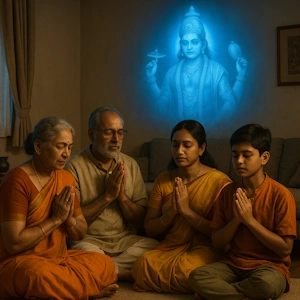
Today we will discuss the meaning of the divya nama suresha and also some important aspects of nama sankeerthana.
सुरेशः – सुराणामीशः सुरेशः – chief of devas. He rules over the devas from inside, as their antaryami, controller from inside. When a deva blesses, it works because, in fact it is Sri Hari who blesses sitting inside him. The deva is a medium, who carries the blessing of Sri Hari who is occupying him as his antaryami. Doesn’t Raja Prithu ask.
He is varadesara, ishwara of the varada, those capable of giving varas, boons.
Who are suras?
सुष्टु राति ददात्यभीष्टमिति सुरः
This is one of the definitions. They grant our wishes, desires. Generally those Gods in Swarga loka such as Indra, Agni, Vayu, they are the ones denoted by the term sura or deva. Sri Hari is the eesha or lord of all of them. He only controls them from inside.
Scriptures say that Kaliyuga is the worst among the four yugas. Every Purana would tell you how dharma depletes from yuga to yuga. 100% dharmik people in Satya yuga, every single person is dharmik. Then as the yugas progress, 75% in Treta yuga, 50% in Dwapara, and 25% in Kaliyuga.
But there is something good about Kaliyuga.
Any spiritual activity, be it tapas, brahmacharya or japa, what takes ten years to achieve in Krita yuga or Satya yuga, the same can be achieved in a year during Treta yuga, the same can be achieved in a month in Dwapara yuga, and the same can be achieved in just a day in Kaliyuga.
This is just a comparison. What does this mean? Say someone tells you, you want to be in Brahma’s loka, you want to go there. In Satya yuga – you have to stand on one leg for ten years. The same can be achieved by standing on one leg for one year in Treta yuga. The same can be achieved by standing on one leg for one month in Dwapara yuga. The same can be achieved by standing on one leg for just one day during Kali yuga.
That means sadhana is much more effective in Kali yuga. Because the obstacles are much more in Kali yuga. That is the problem in Kali yuga. Overcoming the obstacles is the biggest problem in Kali yuga. If you can overcome all those obstacles and do a little bit, it is much more effective than the other three.
You are rewarded based on the toughness of what you do. It is most difficult to climb Everest. There are much smaller mountains. But the name that you get by conquering Everest is much much higher than climbing a local hill or mountain. The whole world will know you if you climb Everest.
So what you have to focus on is your discipline, commitment. Because there are so many things to distract you in Kali yuga. But then you can use them to your advantage. That is the benefit of living in Kali yuga. When every other person is dharmik, everybody else is dharmik, when it is easy to observe dharma it won’t have much value. It has value when the obstacles are very many.
And because of this the method for Kali yuga is also very simple.
Only nama sankeertana is enough in Kaliyuga. No need for yajnas, no need for dhyana, yoga, mantra sadhana, archana, nothing. Just take the Lord’s name. That is the best method for Kaliyuga.
Start loving the Lord’s name, you will soon realize that you have started loving the Lord himself. Start having faith in the Lord’s name. So many people do sadhana of the namatraya mantra and they have got tremendous health benefits. Have faith in the Lord’s name, that it can help me, it can protect me. You will soon realize that you have started having faith in the Lord himself.
All the qualities which are there in the Lord, they are there in his names also – aiswarya, veerya, yashas, shree, jnana, vairagya. All of them are there in his names also, because of the abhinnatva of nama and name. They are one and the same.
We say fiction. Anything that is unreal we call it fiction, a creation of imagination. This is what Suta told sage Shaunaka, a clear definition of fiction. Only those stories that describe the greatness of the Lord, they alone are real and true, as true as his names, as true as his forms.
-
If Sri Hari rules from within, how do I align my day with that inner guidance?
Begin and end each task with 12 names from the sahasranama. Pause, name, act. This resets ego and lets decisions flow from a quieter mind rather than impulse. -
What is the simplest daily structure for nama japa that actually sticks?
Three anchors: 5 minutes on waking, 5 minutes before lunch, 5 minutes before sleep. Same spot, same beads. Small, fixed, and lifelong beats big, irregular bursts. -
Why does chanting feel more powerful in this age despite more distractions?
Resistance is high, so even short focused effort carries geometric weight. Think strength training: higher load, fewer reps. A steady sahasranama habit cuts through noise faster than scattered methods. -
How do I deal with the feeling that blessings come from many deities?
Treat every blessing as Sri Hari’s antaryami act. Offer a quick inner line: ‘O Hari, I receive from you.’ This unifies the heart and prevents spiritual fragmentation. -
What is a practical sign that my work karma is loosening?
You can stop mid-task, chant a few names, and return sharper, without anxiety about credit or blame. If you can do that twice a day, you are already lighter. -
How should I chant when anger rises suddenly?
Do a 27-name cooldown: slow exhale on each name. Keep eyes half-closed, shoulders relaxed. Anger needs breath and story; japa breaks both. -
Can chanting improve sleep without elaborate routines?
Yes. Sit on the bed edge, back straight, 108 names with soft nasal exhale. It lowers heart rate and rumination. Many find fewer wake-ups and calmer mornings. -
What is a family practice that does not feel preachy?
After dinner, two minutes of soft sahasranama together. No lecture, no targets. Children absorb cadence and safety; elders feel seen. Culture forms by repetition, not argument. -
How do I chant on busy days without skipping?
Use micro-loops. Every elevator wait or download bar equals 12 names. Tie japa to cues already in your day. Busy becomes devotional instead of an excuse. -
What should I do when guilt or shame blocks the tongue?
Place the memory on the left palm, cover with the right, chant 12 names, then say: ‘I accept, I amend, I return to you.’ Move to one concrete restitution step. Japa plus action cleanses faster than rumination. -
How do I keep devotion steady when I am praised or criticized?
Before reacting, whisper one name for the person involved and one for yourself. Offer both outcomes to Sri Hari. Praise will not inflate; criticism will not crush. -
Which names do I choose when fear spikes?
Pick a ‘fear cluster’ from the sahasranama and memorize it. Recite the cluster three times whenever fear rises. The mind trusts a known sequence and steadies. -
How do I bring the names into money or career decisions without superstition?
Do a name-based decision sandwich: japa, write pros-cons, japa. Then choose. You are training clarity with devotion, not replacing thinking with wishful hopes. -
Can japa support physical health in a concrete way?
Pair each name with a 4-count inhale and 4-count exhale for 5 minutes. It tones the vagus nerve, eases headaches, and improves digestion. Body follows breath; breath follows name. -
What do I do when devotion turns dry and mechanical?
Serve first, then chant. Wash dishes for someone, call a lonely relative, fix one small mess. Sit immediately and recite. Service softens; the names then penetrate. -
How do I restart after missing many days?
Do a mercy reset: 54 names only, for three days. No back-calculations, no self-scolding. On day four return to your normal count. Bhakti grows by returning quickly, not by perfection.





English
Vishnu Sahasranama
Click on any topic to open
7
30
Astrology
Bhagavad Gita
Bhagavatam
Bharat Matha
Devi
Devi Mahatmyam
Ganapathy
Garuda Puranam
Glory of Venkatesha
Hanuman
Kathopanishad
Mahabharatam
Mantra Shastra
Mystique
Practical Wisdom
Purana Stories
Radhe Radhe
Ramayana
Rare Topics
Rigveda Explained
Rituals
Sages and Saints
Shiva
Spiritual books
Sri Suktam
Story of Sri Yantra
Temples
Vedas
Vishnu Sahasranama
Yoga Vasishta
26
17
10
0


