The Madhu Vidya of Dadhyancha
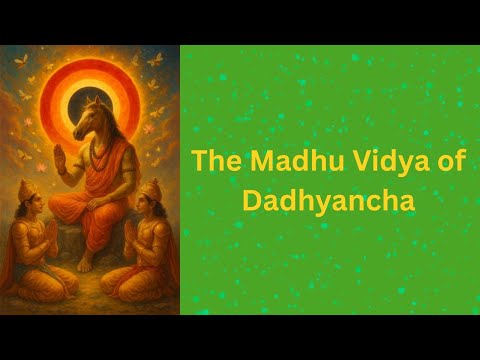
Today, we’re going to talk about a secret. Not just any secret, but a secret so powerful, the king of the gods wanted to keep it all to himself. This is the story of the Maduvidya, the knowledge of Honey.
It all started with Indra and a wise teacher, a sage named Dadhyancha.
One day, Indra decided to share a very special secret with the sage. He leaned in and whispered about something called “Madhu Vidya,” which means the knowledge of Honey.
But then, Indra gave him a serious warning. He said, "Do not tell this secret to anyone. If you do, I will strike off your head."
That’s a pretty intense warning, right? So what was this secret that was so important?
Well, it wasn't a secret about treasure or magic spells. It was a secret idea, a truth so big it could change how everyone saw the world.
The knowledge of Honey said this: Everything is connected to everything else.
Think about it like this: bees need flowers to make honey, and flowers need bees to spread their pollen. They exist for each other. The knowledge of Honey teaches that everyone and everything is like that. You, me, the animals, the trees, and even the stars are all connected.
Imagine a bicycle wheel. It has lots of spokes, right? But they all connect to one single spot in the middle—the hub. The secret says we are all like the spokes, and we all connect to one great, single Spirit at the center of everything. There is nothing outside of it.
Sage Dadhyancha didn't just learn this secret; he understood it with his whole heart. He felt that connection to everything.
Now, word got around that Dadhyancha knew this incredible secret. The twin gods, called the Ashwins, heard about it. The Ashwins were known for being healers and super fast. They really, really wanted to learn the knowledge of Honey, but Indra had told them they weren't allowed to know it.
So, they went to Sage Dadhyancha and asked him to teach them.
But Dadhyancha was in a tough spot. He wanted to share this beautiful truth, but he had promised Indra he would keep it a secret. He was loyal and didn't want to break his promise.
The Ashwins were very clever, though. They came up with a wild plan.
They told the sage, "Listen. Let us do something strange. We will gently take off your human head and keep it safe. Then, we will give you the head of a horse."
Dadhyancha was probably a little confused!
But the Ashwins explained, "You can then teach us the secret through the horse's head. Your human head is the one that made the promise to Indra. So, you won’t be breaking your promise! When Indra finds out and attacks, let him strike the horse's head. After that, we will give you your real head back."
It was a risky and brilliant plan. And Dadhyancha agreed. He knew this secret was too important to be hidden forever.
So, with the head of a horse, the great sage spoke. He shared the knowledge of Honey with the Ashwins. He taught them that the whole world is connected, that there is one great Atma wearing many different faces, and that this Spirit isn't far away in the sky—it's inside every single one of us.
Of course, Indra found out. He was furious! He threw his powerful weapon and, just as the Ashwins predicted, he struck the horse's head.
But it was too late. The secret was out.
The Ashwins, true to their word, returned Dadhyancha’s human head, and he was whole again. The knowledge was now free. The story shows us that you can't stop a great truth from being shared.
So, what did Sage Dadhyancha risk his life for?
He taught a lesson that even the gods wanted to hide: that we are not separate. We are all part of one big, amazing family. There are no heavens you need to earn or scary places to fear, because that great, central Spirit is right here, right now, in everything.
The next time you see bees buzzing around a flower, remember the knowledge of Honey. Remember that you are connected to everyone and everything around you. And that is a secret worth sharing.
Q1. Why was Indra so protective about the Maduvidya?
A: Because it stripped away the illusion of separateness. If everyone understands that all beings are rooted in one Atma, then fear, hierarchy, and control collapse. Indra represents cosmic order and sovereignty, and when you hold power, the last thing you want is people waking up to the fact that the throne is not separate from the subjects.
Q2. What does 'Honey' symbolise here?
A: Honey is the sweetness that comes from mutual dependency. Flowers need bees, bees need flowers. Life works because everything serves and completes something else. Honey is the symbol of interconnected existence and shared nourishment. That is why the scripture calls it 'Madhu' — the essence that runs through all beings.
Q3. What exactly is the philosophical punchline of Maduvidya?
A: That everything rests in everything else. The Upanishadic formula for this is simple: there is one Atma wearing many masks. You are not a lonely bubble. You are a spoke connected to the same hub. Once you know that, the fear of death, competition, or isolation loses its grip.
Q4. Why did Indra threaten Dadhyancha with death?
A: Because sacred truths dismantle monopoly. If only the king of the gods knows how reality works, he can play gatekeeper. If everyone knows, there is no gate to guard. Indra is not stupid; he understands that knowledge is power, so he tries to keep it scarce.
Q5. Why did the Ashwins want the knowledge so badly?
A: The Ashwins are divine physicians. They heal. And you cannot heal deeply unless you understand unity. If you see every being as an isolated fragment, you treat symptoms. If you see every being as expressions of one self, you treat the root. They wanted Maduvidya because it is the medicine behind all medicines.
Q6. Why the crazy trick with removing the sage's head?
A: Because they were navigating dharma with intelligence. The sage had given his word. Breaking a promise corrupts inner integrity. The Ashwins devised a loophole that preserved his vow and still freed the teaching. It was legally clever, ethically balanced, and spiritually driven. Vedic stories love that kind of layered solution.
Q7. What does the horse-head detail signify?
A: The horse symbolizes prana and vitality in Vedic symbolism. Wisdom transmitted through the horse-head hints at knowledge carried by life-force, not just by speech. Also, it shows that truth survives even when the ordinary ego (symbolized by the human head) is set aside.
Q8. What does Indra's failure to stop the teaching reveal?
A: You cannot police truth. Once the right people decide to move it, the dam breaks. The weapon lands, but the knowledge already travelled. That is how revelation works — it does not ask for permission.
Q9. What exactly did Dadhyancha risk his life to preserve?
A: The idea that the universe is not a battlefield of separate units. It is one Spirit looking out through billions of eyes. There is no outsider. There is no rival. There is no enemy. That kind of clarity untangles fear and competition from the root.
Q10. How should a modern person use Maduvidya?
A: Stop imagining you are a sealed container. The anxieties we carry today — loneliness, competition, alienation — are built on the assumption that we are cut off. Maduvidya flips that. It says you are plugged into everything already. When you really get that, compassion stops being a moral duty and becomes simple logic.





English
Vedas
Click on any topic to open
7
30
Astrology
Bhagavad Gita
Bhagavatam
Bharat Matha
Devi
Devi Mahatmyam
Ganapathy
Garuda Puranam
Glory of Venkatesha
Hanuman
Kathopanishad
Mahabharatam
Mantra Shastra
Mystique
Practical Wisdom
Purana Stories
Radhe Radhe
Ramayana
Rare Topics
Rigveda Explained
Rituals
Sages and Saints
Shiva
Spiritual books
Sri Suktam
Story of Sri Yantra
Temples
Vedas
Vishnu Sahasranama
Yoga Vasishta
26
17
10
0


