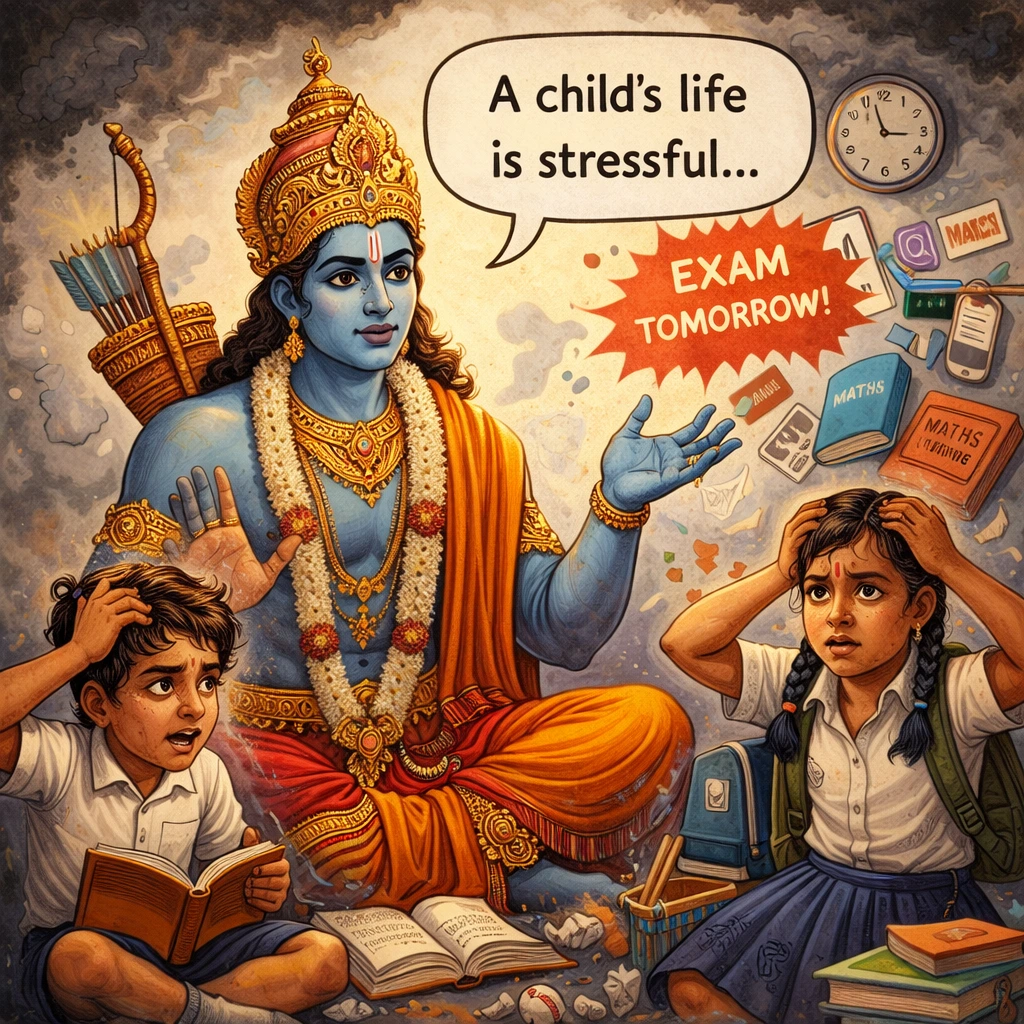
A Child's Life Is Stressful, Says Lord Rama
How to live life properly.
Before knowing that, we have to see how not to live your life.
For this, whatever we normally consider as important in worldly materialistic life, their importance needs to be negated.
This is what Lord Rama is doing in the Viragya-prakarana of Yoga Vasishta.
The present topic is glorification of infancy and childhood.
Lord is pointing out how hypocritical this is.
We have already covered many aspects of this.
Continuing now.
A child is mostly tense inside, and has tears in the eyes.
The Lord is comparing this with:
Parched land of summer — after the first shower, if you see, vapour will be rising up from that land.
Still hot inside, but steam, vapour will be rising up from that.
If you say that man takes birth to suffer, only to suffer — at least that is true during infancy and childhood.
Physical weakness.
Fears.
Anxieties.
Domination by others.
Absolute restriction of freedom.
Dangers.
What else is there in a child's life?
Desires are much more in the child,
And most of them are not achieved.
This pushes the child more and more into disappointment and sadness.
At home there is no freedom.
It is worse in the school.
The child is like an animal bound by a rope to a pillar.
The mind of the child is more sensitive.
Hence, the suffering is also more.
If an adult's freedom is restricted, he can reason with it, come to terms with it —
'OK, this is probably for my own benefit.'
The child will not be able to do this.
Hence, the suffering of the child will be more.
The child actually believes whatever you tell him or her.
If you say, 'Shall I get you the moon from the sky, you can play with it?' —
The child would actually believe you.
That this is going to happen.
The child cannot separate the real from the unreal, the truth from the lie.
Can a tree protect itself from heat or cold?
No.
Like this, the child also cannot protect itself from heat or cold.
You will have to do it.
Even that much a child cannot do for itself.
So much dependent on others.
Is this what is great about childhood?
Childhood, infancy — is a scare house.
Fear house.
You know, they have them during festivals and exhibition grounds, entertainment parks.
It is a dark room, you have to walk through.
At every turn, something jumps at you — a skeleton, a monster, some loud screaming is heard.
To summarise: this is the life experience during infancy and childhood.
Lord Rama is telling Sage Vishwamitra.
-
To understand how to live wisely, one must first examine how life is commonly mislived through misplaced priorities.
-
Things the world praises—like childhood or material gains—need to be stripped of their false glory to see truth clearly.
-
Childhood, often romanticised, is actually filled with tension, fear, dependence, and unfulfilled desires.
-
Children suffer physically and emotionally but are too young to process or reason with their suffering.
-
Their minds are soft and impressionable, making every disappointment feel deeper and sharper.
-
They live under constant control—at home, at school, and in society—without any real freedom.
-
Children accept everything told to them as truth, unable to differentiate between real and imaginary.
-
Just like a tree can't protect itself from heat or cold, children can't shield themselves from life’s basic discomforts.
-
The dependence of a child on others for survival is total, yet this dependence is seen as cute instead of burdensome.
-
Childhood resembles a scare house—externally colourful but filled with surprise shocks, confusion, and dread.
-
True disillusionment begins by exposing the hidden suffering behind life's most praised stages, like infancy.
What does it mean to say childhood is full of suffering?
It means that the early years of life are marked by helplessness, fear, and constant emotional strain. The child has desires that are rarely fulfilled and lacks the freedom or understanding to deal with that disappointment. This suffering goes unacknowledged because of the romanticised view of childhood as innocent and joyful.
Why would someone challenge the idea that childhood is joyful?
Because beneath the surface of cuteness and innocence lies deep vulnerability. When someone begins to observe the mental world of a child, they see confusion, dependency, and unprocessed fear. This insight makes the glorification of childhood seem hollow.
Isn't it too harsh to call childhood a time of suffering?
Not when you see the truth without sentimentality. A child's emotional pain, lack of autonomy, and inability to express or understand what’s happening are real forms of suffering—even if adults don’t recognise them.
Why is the child compared to a parched land steaming after rain?
The image shows a surface that looks like it’s cooling down, but inside it’s still burning. Just like that, a child may appear calm or happy on the outside, while internally there is stress and emotional heat.
Isn’t that a beautiful image for inner healing?
No, it’s actually revealing a tragic truth. The steaming land shows that the pain hasn’t gone—only the surface has changed. The child’s suffering isn’t resolved; it’s just hidden.
But isn’t emotional pain subjective? How do you prove a child suffers?
The proof lies in behaviour—frequent crying, fear of abandonment, clinging, and anxiety. These are signs of a nervous system under pressure, not bliss. The comparison to steaming land is a precise psychological metaphor.
Why can’t children reason with their pain like adults do?
Because their mental faculties haven’t matured. They don’t have the ability to weigh pros and cons, think long-term, or understand why rules exist. So, they just feel restricted and helpless, without any coping logic.
Can’t that innocence be a good thing?
Innocence doesn't mean absence of pain. It means inability to understand it. That makes the pain worse because there’s no clarity or control—just pure experience of discomfort.
Isn’t it normal for children to face rules and discipline? Why call it suffering?
Discipline isn’t the problem—lack of understanding is. An adult knows why they must wait or sacrifice. A child only feels denial and powerlessness. That’s what makes it suffering.
How do children interpret promises and lies?
They believe everything literally. If you say you’ll bring the moon, they wait for it. They don’t yet have the ability to distinguish imagination from reality, so they get emotionally invested in falsehoods.
Isn’t it sweet that they trust so much?
It’s sweet until that trust leads to repeated disappointment. What starts as innocent belief often turns into silent confusion and mistrust later on.
Isn’t imagination a strength in children?
Imagination without guidance is vulnerability. If a child can’t filter what’s real and what’s not, their world becomes a swirl of mixed signals, making them insecure and prone to fear.
What does the tree metaphor teach us?
Just as a tree can’t defend itself from heat or cold, a child can’t protect themselves from even basic discomforts. They are completely at the mercy of others for physical and emotional needs.
Isn’t that just the nature of growing up?
Yes, but that doesn’t make it less painful. The point is not to avoid childhood, but to stop pretending it’s a golden phase. Dependency comes with helplessness, and helplessness comes with fear.
Doesn't that apply to old age too?
It does—but the elderly at least understand what’s happening. Children suffer without clarity or tools to deal with it. That ignorance makes their vulnerability sharper.
What’s meant by calling childhood a scare house?
It’s a metaphor for how life feels to a child—uncertain, unpredictable, and filled with invisible threats. Just like a scare house surprises you at every turn, childhood has confusing rules and sudden emotional shocks.
Why use such a dark metaphor for childhood?
Because the cheerfulness we associate with childhood is often adult projection. From within, the child experiences fear, confusion, and tension—even if they can’t articulate it.
But aren’t there happy memories from childhood?
Yes, but scattered happiness doesn’t cancel out deep emotional patterns. Just like a horror ride may have a few laughs, the dominating experience can still be fear and helplessness.





English
Yoga Vasishta
Click on any topic to open
7
30
Astrology
Bhagavad Gita
Bhagavatam
Bharat Matha
Devi
Devi Mahatmyam
Ganapathy
Garuda Puranam
Glory of Venkatesha
Hanuman
Kathopanishad
Mahabharatam
Mantra Shastra
Mystique
Practical Wisdom
Purana Stories
Radhe Radhe
Ramayana
Rare Topics
Rigveda Explained
Rituals
Sages and Saints
Shiva
Spiritual books
Sri Suktam
Story of Sri Yantra
Temples
Vedas
Vishnu Sahasranama
Yoga Vasishta
26
17
10
0


