The Kingdom Is Ready, The King Is Broken
Shlokas 1–2
ते तु तां रजनीमुष्य ब्राह्मणा वेदपारगाः।
उपतस्थुरुपस्थानं सह राजपुरोहिताः॥ १॥
अमात्या बलमुख्याश्च मुख्या ये निगमस्य च।
राघवस्याभिषेकार्थे प्रीयमाणाः सुसंगताः॥ २॥
Valmiki opens Sarga 15 with a public certainty that feels almost cruel. The Veda-knowing Brahmanas arrive with the royal priests. Along with them come ministers, army chiefs, and leading citizens. Everyone is pleased, well-organized, and fully aligned toward one goal: Rama’s abhisheka.
This is the key: the kingdom is functioning perfectly. The king is not. So the tragedy is no longer only inside Dasharatha’s room. It is now a clash between a broken father and an unstoppable public schedule. The coronation is moving like a ritual engine that does not know the heart of its own driver has stopped.
Shloka 3
उदिते विमले सूर्ये पुष्ये चाभ्यागतेऽहनि।
लग्ने कर्कटके प्राप्ते जन्म रामस्य च स्थिते॥ ३॥
This verse is Valmiki stamping the moment with authority. Clean sunrise. Pushya day. Karkataka lagna. Rama’s birth alignment. It is the universe saying: 'This is the time.'
And that is exactly what makes the coming injustice feel sharper. When time itself is auspicious, but humans twist the outcome, the reader feels a particular rage: not at the sky, but at the moral ugliness inside the palace. The cosmos is ready to crown Rama. The palace is ready to betray him.
Shlokas 4–5
अभिषेकाय रामस्य द्विजेन्द्रैरुपकल्पितम्।
काञ्चना जलकुम्भाश्च भद्रपीठं स्वलंकृतम्॥ ४॥
रथश्च सम्यगास्तीर्णो भास्वता व्याघ्रचर्मणा।
गङ्गायमुनयोः पुण्यात् संगमादाहृतं जलम्॥ ५॥
Gold water pots. A decorated throne. A chariot spread with shining tiger-skin. Water carried from the holy Ganga-Yamuna sangama. These are not poetic props. These are sacred instruments. Their presence makes one point unavoidable: Rama is not 'almost' king in imagination. He is minutes away in physical reality.
Valmiki is making the loss measurable. When the ritual objects are already positioned, the reversal becomes like a hand snatching food from a mouth that was already tasting it.
Shlokas 6–7
याश्चान्याः सरितः पुण्या ह्रदाः कूपाः सरांसि च।
प्राग्वहाश्चोर्ध्ववाहाश्च तिर्यग्वाहाश्च क्षीरिणः॥ ६॥
ताभ्यश्चैवाहृतं तोयं समुद्रेभ्यश्च सर्वशः।
क्षौद्रं दधि घृतं लाजा दर्भाः सुमनसः पयः॥ ७॥
Water is gathered from rivers, lakes, wells, ponds, and from every kind of flow, in every direction. Even from seas. Then the full set of ritual essentials: honey, curd, ghee, laja, darbha, flowers, milk.
This is Valmiki’s way of saying: the whole land is being invited into Rama’s kingship. The coronation is being made into a cosmic agreement between king, people, and geography. That is why Kaikeyi’s demand is not just a family crime. It is sabotage of the public order itself.
Shlokas 8–11
अष्टौ च कन्या रुचिरा मत्तश्च वरवारणः।
सजलाः क्षीरिभिश्छन्ना घटाः काञ्चनराजताः॥ ८॥
पद्मोत्पलयुता भान्ति पूर्णाः परमवारिणा।
चन्द्रांशुविकचप्रख्यं पाण्डुरं रत्नभूषितम्॥ ९॥
सज्जं तिष्ठति रामस्य वालव्यजनमुत्तमम्।
चन्द्रमण्डलसंकाशमातपत्रं च पाण्डुरम्॥ १०॥
सज्जं द्युतिकरं श्रीमदभिषेकपुरस्सरम्।
पाण्डुरश्च वृषः सज्जः पाण्डुराश्वश्च संस्थितः॥ ११॥
Eight maidens, a prime elephant, gold and silver pots covered and filled, lotus and water-lilies, moon-white and jewel-bright arrangements. Rama’s yak-tail fan is ready. The white umbrella is ready. White bull ready. White horses ready.
Valmiki is stacking visual purity on purpose. White here is not decoration. It signals auspiciousness, sanctity, and royal legitimacy. Everything outside is saying: 'This is dharma’s day.' But in the inner chambers, dharma is being used like a chain. The contrast is the entire emotional weapon of this Sarga.
Shlokas 12–13
वादित्राणि च सर्वाणि वन्दिनश्च तथापरे।
इक्ष्वाकूणां यथा राज्ये सम्भ्रियेताभिषेचनम्॥ १२॥
तथाजातीयमादाय राजपुत्राभिषेचनम्।
ते राजवचनात् तत्र समवेता महीपतिम्॥ १३॥
Instruments, bards, and all the formalities as per Ikshvaku tradition are assembled. This is important: it is not merely Rama the person being crowned. It is the dynasty reaffirming itself publicly.
And then comes the hard edge: they have gathered 'by the king’s command'. That means the system is obeying yesterday’s royal order with perfect discipline, even though the king who issued that order is now trapped in a nightmare born from a different royal promise. Words have become snares. One promise started the celebration. Another promise will destroy it.
Shlokas 14–16
अपश्यन्तोऽब्रुवन् को नु राज्ञो नः प्रतिवेदयेत्।
न पश्यामश्च राजानमुदितश्च दिवाकरः॥ १४॥
यौवराज्याभिषेकश्च सज्जो रामस्य धीमतः।
इति तेषु ब्रुवाणेषु सर्वांस्तांश्च महीपतीन्॥ १५॥
अब्रवीत् तानिदं वाक्यं सुमन्त्रो राजसत्कृतः।
रामं राज्ञो नियोगेन त्वरया प्रस्थितो ह्यहम्॥ १६॥
The first crack appears: the sun is already up, yet the king is not seen. That detail matters. In a royal city, the king’s appearance is not casual. It is the signal that the day is real.
They start asking, almost helplessly, 'Who will inform the king for us?' That question is a pressure wave. It means the crowd is ready, the ritual is ready, the clock is moving, but the center is absent.
Then Sumantra speaks like an official seal: 'I am going quickly to Rama by the king’s order.' This is tragic because his statement protects the public mood. It reassures everyone that the coronation is still on track. In reality, the same 'king’s order' is about to summon Rama into the trap.
Shlokas 17–18
पूज्या राज्ञो भवन्तश्च रामस्य तु विशेषतः।
अयं पृच्छामि वचनात् सुखमायुष्मतामहम्॥ १७॥
राज्ञः सम्प्रतिबुद्धस्य चानागमनकारणम्।
इत्युक्त्वान्तःपुरद्वारमाजगाम पुराणवित्॥ १८॥
Sumantra does something very telling: he begins with respect. 'You are honored by the king, and even more by Rama.' That line shows how stable Ayodhya’s hierarchy is. It is a city trained in dharma-language.
Only after that does he move to the real issue: the king is awake, yet not coming out. So Sumantra goes to the inner palace door. This is the moment the public world tries to enter the private world. And in epics, once that boundary breaks, events become irreversible.
Shlokas 19–20
सदा सक्तं च तद् वेश्म सुमन्त्रः प्रविवेश ह।
तुष्टावास्य तदा वंशं प्रविश्य स विशाम्पतेः॥ १९॥
शयनीयं नरेन्द्रस्य तदासाद्य व्यतिष्ठत।
सोऽत्यासाद्य तु तद् वेश्म तिरस्करणिमन्तरा॥ २०॥
Valmiki shows Sumantra as someone who belongs inside the palace. He enters confidently, praising the king’s lineage as he moves. This is crucial: Sumantra is not walking in with fear. He is walking in with affection and habit.
He reaches the king’s sleeping place, the inner chamber zone with screens and curtains. The staging tells you: this is intimate space. And that intimacy makes what follows sharper, because the person entering is innocent and loyal, not politically cautious.
Shlokas 21–24
आशीर्भिर्गुणयुक्ताभिरभितुष्टाव राघवम्।
सोमसूर्यौ च काकुत्स्थ शिववैश्रवणावपि॥ २१॥
वरुणश्चाग्निरिन्द्रश्च विजयं प्रदिशन्तु ते।
गता भगवती रात्रिरहः शिवमुपस्थितम्॥ २२॥
बुद्ध्यस्व राजशार्दूल कुरु कार्यमनन्तरम्।
ब्राह्मणा बलमुख्याश्च नैगमाश्चागतास्त्विह॥ २३॥
दर्शनं तेऽभिकांक्षन्ते प्रतिबुद्ध्यस्व राघव।
स्तुवन्तं तं तदा सूतं सुमन्त्रं मन्त्रकोविदम्॥ २४॥
These verses are outwardly pure: blessings from Soma and Surya, Shiva and Vaishravana, Varuna, Agni, Indra; the night has gone, an auspicious day has arrived; wake up and do the required duty; the brahmanas, army chiefs, and merchants are waiting; they want your darshan.
But inside this story, the blessing becomes pressure. It turns into a ritual alarm bell. 'Wake up, do the work' is exactly what Dasharatha cannot do without dying inside. And the word 'darshan' sharpens it further: the people do not merely want an order. They want the king’s presence to legitimize their joy.
Sumantra is doing his duty perfectly. That is why it hurts. His loyal words become the sound of the world demanding performance from a man whose heart has already been shredded.
Shlokas 25–27
प्रतिबुद्ध्य ततो राजा इदं वचनमब्रवीत्।
राममानय सूतेति यदस्यभिहितो मया॥ २५॥
किमिदं कारणं येन ममाज्ञा प्रतिवाह्यते।
न चैव सम्प्रसुप्तोऽहमानयेहाशु राघवम्॥ २६॥
इति राजा दशरथः सूतं तत्रान्वशात् पुनः।
स राजवचनं श्रुत्वा शिरसा प्रतिपूज्य तम्॥ २७॥
Dasharatha wakes and immediately grabs the one thing he can still be: a king. He is not calm. He is sharp. 'I already told you: bring Rama. Why is my order being delayed? I am not asleep. Bring Rama now.'
This is not ordinary impatience. This is panic wearing royal authority. When your inner world is collapsing, you cling to outer command. That is what he is doing.
Also, notice the repetition: 'Bring Rama.' In Sarga 14, the same command carried grief and helplessness. Here it carries urgency, like a man who feels time cutting down his remaining breath. Rama is not being called for celebration in Dasharatha’s heart. He is being called because Dasharatha needs to see him before everything becomes irreversible.
Shlokas 28–29
निर्जगाम नृपावासान्मन्यमानः प्रियं महत्।
प्रपन्नो राजमार्गं च पताकाध्वजशोभितम्॥ २८॥
हृष्टः प्रमुदितः सूतो जगामाशु विलोकयन्।
स सूतस्तत्र शुश्राव रामाधिकरणाः कथाः॥ २९॥
Sumantra bows and leaves thinking something wonderful is happening. The royal road is full of flags and banners. He walks happily, looking around, hearing excited talk about Rama everywhere.
This is the chapter’s quiet cruelty: the messenger carrying the summons that will end joy is himself walking inside joy. He does not suspect the truth. He is basically swimming through celebration, while the reader knows the celebration is already dead inside the palace.
Shlokas 30–33
अभिषेचनसंयुक्ताः सर्वलोकस्य हृष्टवत्।
ततो ददर्श रुचिरं कैलाससदृशप्रभम्॥ ३०॥
रामवेश्म सुमन्त्रस्तु शक्रवेश्मसमप्रभम्।
महाकपाटपिहितं वितर्दिशतशोभितम्॥ ३१॥
काञ्चनप्रतिमैकाग्रं मणिविद्रुमतोरणम्।
शारदाभ्रघनप्रख्यं दीप्तं मेरुगुहासमम्॥ ३२॥
मणिभिर्वरमाल्यानां सुमहद्भिरलंकृतम्।
मुक्तामणिभिराकीर्णं चन्दनागुरुभूषितम्॥ ३३॥
Shlokas 34–39
गन्धान् मनोज्ञान् विसृजद् दार्दुरं शिखरं यथा।
सारसैश्च मयूरैश्च विनदद्भिर्विराजितम्॥ ३४॥
सुकृतेहामृगाकीर्णमुत्कीर्णं भक्तिभिस्तथा।
मनश्चक्षुश्च भूतानामाददत् तिग्मतेजसा॥ ३५॥
चन्द्रभास्करसंकाशं कुबेरभवनोपमम्।
महेन्द्रधामप्रतिमं नानापक्षिसमाकुलम्॥ ३६॥
मेरुशृङ्गसमं सूतो रामवेश्म ददर्श ह।
उपस्थितैः समाकीर्णं जनैरञ्जलिकारिभिः॥ ३७॥
उपादाय समाक्रान्तैस्तदा जानपदैर्जनैः।
रामाभिषेकसुमुखैरुन्मुखैः समलंकृतम्॥ ३८॥
महामेघसमप्रख्यमुदग्रं सुविराजितम्।
नानारत्नसमाकीर्णं कुब्जकैरपि चावृतम्॥ ३९॥
Valmiki now shifts the camera and floods the scene with auspicious beauty. Rama’s residence is described like Kailasa, like Meru, like Indra’s palace, like Kubera’s house. It is jeweled, perfumed with sandal and agaru, alive with birds and peacocks, shining in a way that steals the mind and eyes of living beings.
This is not random ornamentation. It is moral architecture. Rama’s house looks like this because Rama’s presence sanctifies it. The world around him is naturally auspicious.
And that is why the coming command from Dasharatha is so horrifying. The story is about to take a man standing inside a house that looks like heaven, and push him toward the forest like a criminal. Valmiki is forcing you to feel the injustice through contrast: maximum radiance, maximum betrayal.
Shlokas 40–41
स वाजियुक्तेन रथेन सारथिः
समाकुलं राजकुलं विराजयन्।
वरूथिना राजगृहाभिपातिना
पुरस्य सर्वस्य मनांसि हर्षयन्॥ ४०॥
ततः समासाद्य महाधनं महत्
प्रहृष्टरोमा स बभूव सारथिः।
मृगैर्मयूरैश्च समाकुलोल्बणं
गृहं वरार्हस्य शचीपतेरिव॥ ४१॥
Valmiki turns Sumantra into a moving symbol of good news. His horse-drawn chariot rolls through a city already vibrating with anticipation, and just seeing him makes people’s hearts rise. They assume he is coming to escort Rama for coronation.
That is the twist: Sumantra is being read like a celebratory announcement. In reality, he is carrying the king’s desperate summons, born from a shattered inner chamber. The city celebrates the messenger, not knowing the message is poison.
Also notice the second verse: Sumantra’s body reacts with joy, hair standing on end, as he reaches the wealthy place, the grand home, described like the house of Indra (Shachi’s lord). The epic is showing how fully the world believes in a happy ending right now.
Shlokas 42–45
स तत्र कैलासनिभाः स्वलंकृताः
प्रविश्य कक्ष्यास्त्रिदशालयोपमाः।
प्रियान् वरान् राममते स्थितान् बहून्
व्यपोह्य शुद्धान्तमुपस्थितौ रथी॥ ४२॥
स तत्र शुश्राव च हर्षयुक्ता
रामाभिषेकार्थकृतां जनानाम्।
नरेन्द्रसूनोरभिमङ्गलार्थाः
सर्वस्य लोकस्य गिरः प्रहृष्टाः॥ ४३॥
महेन्द्रसद्मप्रतिमं च वेश्म
रामस्य रम्यं मृगपक्षिजुष्टम्।
ददर्श मेरोरिव शृङ्गमुच्चं
विभ्राजमानं प्रभया सुमन्त्रः॥ ४४॥
उपस्थितैरञ्जलिकारिभिश्च
सोपायनैर्जानपदैर्जनैश्च।
कोट्या परार्धैश्च विमुक्तयानैः
समाकुलं द्वारपदं ददर्श॥ ४५॥
Here Valmiki does the 'crowd-close-up'. Sumantra pushes through beautiful halls and chambers, like divine residences, clearing the way past people devoted to Rama. This is important: the house is not empty. It is packed with Rama’s supporters, admirers, well-wishers.
And what are they doing? They are speaking mangala words, full of joy, for Rama’s coronation. These are blessings spoken before the crown touches the head. It is like the world has already crowned him in its mind.
Then the doorway itself becomes a symbol: it is crowded with people bringing gifts, hands folded, and even luxurious vehicles. The image is of a nation pouring its love toward one man. This is the exact moment where the reader feels the scale of what will be broken.
Shloka 46
ततो महामेघमहीधराभं
प्रभिन्नमत्यङ्कुशमत्यसह्यम्।
रामोपवाह्यं रुचिरं ददर्श
शत्रुञ्जयं नागमुदग्रकायम्॥ ४६॥
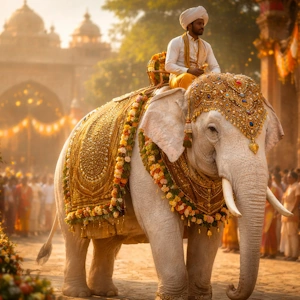
The elephant appears like a mountain-cloud, mighty, hard to control, radiantly fit to carry Rama. Even the name-feel is pointed: 'shatrunjaya' (conqueror of enemies). This elephant is a living proclamation of sovereignty.
And that is the sting: nature itself seems to have arranged a throne-on-legs for Rama. The animal world is ready to serve his kingship. But the human world inside the palace is about to treat him like an exile.
Shloka 47
स्वलंकृतान् साश्वरथान् सकुञ्जरा-
नमात्यमुख्यांश्च ददर्श वल्लभान्।
व्यपोह्य सूतः सहितान् समन्ततः
समृद्धमन्तःपुरमाविवेश ह॥ ४७॥
Decorated chariots, horses, elephants, chief ministers, beloved supporters. Everything that usually surrounds a new king is already stationed here, as if they are waiting for one signal.
Valmiki is showing that Rama is not alone, and he is not weak. He has social power, administrative support, and public love all around him. So Kaikeyi’s strategy (from the previous sarga) becomes clearer: she must summon Rama privately, not publicly. If this scene ever fully becomes aware of the truth, Ayodhya could explode.
Shloka 48
ततोऽद्रिकूटाचलमेघसंनिभं
महाविमानोपमवेश्मसंयुतम्।
अवार्यमाणः प्रविवेश सारथिः
प्रभूतरत्नं मकरो यथार्णवम्॥ ४८॥
This is the closing image of the Sarga: Sumantra enters without obstruction into Rama’s grand residence, described like a palace-vimana, filled with abundant jewels. The simile is sharp: like a makara entering the ocean of gems.
Meaning: he has fully crossed into Rama’s world now. The messenger has reached the target. The trap is ready to shut.
Final Eye-Opening Insight of Sarga 15
Sarga 15 is the Sarga of 'Public Certainty'.
Everything is arranged, everyone is convinced, and the whole city is emotionally invested in one outcome. Valmiki stretches this certainty to the limit so that the coming reversal does not feel like a simple plot twist. It feels like a moral earthquake.
The deeper warning is also clear: when a society runs purely on momentum, ritual, and assumption, it becomes vulnerable to one hidden manipulation inside the palace. Kaikeyi does not need to fight the whole city. She only needs to control the doorway of information.
- The coronation machine is already running. Brahmanas, priests, ministers, army chiefs, and top citizens are assembled and coordinated. The kingdom is functioning perfectly even though the king is not.
- Cosmic timing is stamped as ideal (clean sunrise, Pushya day, Karkataka lagna, Rama’s birth alignment). Undercurrent: the universe approves, but humans are about to corrupt the outcome. Auspicious time gets used for an ugly act.
- The chapter doubles down on the inventory of abhisheka materials (waters from all directions and seas, honey, curd, ghee, laja, darbha, flowers, milk, gold and silver pots, umbrella, fans, bull, horses, elephant, music, bards). Undercurrent: Valmiki is making the loss physical. The reader feels the reversal as theft of something already in the hand.
- The first public doubt appears: the sun is up, but the king is unseen. Undercurrent: in a monarchy, the king’s absence is a crack where rumor and anxiety can enter.
- Sumantra becomes the narrative bandage. He announces he is going to Rama by the king’s order, which preserves public confidence. Undercurrent: the same royal authority that started celebration is now being used to pull Rama into a private crisis.
- Protocol still rules the surface. Sumantra speaks with courtesy and formal respect before addressing the delay. Undercurrent: institutions try to solve moral collapse with procedure, but procedure cannot fix a poisoned inner chamber.
- Sumantra enters the inner palace with loyalty, not suspicion, praising the lineage as he goes. Undercurrent: innocence walks into danger because the palace is supposed to be safe for a trusted servant.
- The wake-up blessing turns into a deadline. Sumantra’s hymnic language (victory, auspicious day, people waiting for darshan) functions like pressure on a broken man. Undercurrent: public expectation can become cruelty without intending it.
- Dasharatha’s sharp command shows a king clinging to the only control he has left: obedience to his word. Undercurrent: when the heart collapses, the crown becomes a mask people hide behind.
- The cruel irony peaks: Sumantra leaves happy, moving through flag-lined roads, hearing joyful Rama-talk everywhere, while carrying the summons that will end that joy. Undercurrent: catastrophe often travels inside celebration, not against it.
- Rama’s residence is painted as Kailasa/Meru/Indra-Kubera-like splendor, perfumed and jewel-lit, alive with birds and peacocks. Undercurrent: the world around Rama is naturally auspicious because of who he is, which makes the coming injustice feel even more obscene.
- The doorway scene shows the scale of public love: folded hands, gifts, crowds, luxury vehicles, mangala talk. Undercurrent: Rama is surrounded by support, so the conspirators must isolate him privately. Information control becomes the real weapon.
- The elephant ‘fit to carry Rama’ and the assembled ministers/chariots form a living proclamation of kingship. Undercurrent: sovereignty is already waiting outside, but legitimacy is about to be sabotaged inside.
- The closing image is Sumantra fully crossing into Rama’s world. Undercurrent: once the messenger reaches Rama’s threshold, the story is past the point of stopping. The trap is ready to shut.
- Q: Why does Valmiki open with officials and priests assembling, instead of showing Dasharatha again?
A: Because the crisis has moved from personal emotion to institutional momentum. Once the machinery of state is in motion, a king’s private collapse stops being private. The chapter’s tension comes from this: the kingdom is ready to crown, but the king is not ready to live. - Q: What is the real impact of stating Pushya day, Karkataka lagna, and Rama’s birth alignment?
A: It locks in a cosmic 'yes'. Valmiki is telling you: conditions are perfect, so if the outcome becomes ugly, you cannot blame time, omens, or fate. You must blame human choice and manipulation. - Q: Why does the text obsess over ritual items like waters from seas and all directions?
A: To show that Rama’s kingship is being framed as a covenant with the entire land and cosmos. It is not just 'Ayodhya appoints a prince'. It is 'creation witnesses legitimacy'. So denying Rama becomes a wound to collective moral order, not just family politics. - Q: What is the quiet meaning of the line: 'the sun has risen, but the king is not seen'?
A: Kingship is partly presence. When the king does not appear, certainty leaks. This is how rumor begins: not through lies, but through a missing sight that everyone expected to be automatic. - Q: Why is Sumantra’s announcement so powerful: 'I am going to Rama by the king’s order'?
A: It stabilizes the crowd. One official sentence prevents panic, questions, and delay. It also shows how easily a narrative can be managed: people do not need truth, they need a credible voice to keep their assumption intact. - Q: What is the deeper danger in Sumantra’s politeness and protocol (praising them, asking well-being)?
A: Courtesy delays suspicion. When everyone keeps behaving 'properly', nobody forces the hard question early. Etiquette keeps the surface smooth while a moral crime can complete itself underneath. - Q: Why does Valmiki make Sumantra’s wake-up hymn so grand and reassuring?
A: Because in this context, reassurance becomes pressure. A hymn that says 'the auspicious day has arrived, do your duty' turns into a deadline hammering a shattered man. It is loyal speech that accidentally hurts because it assumes the world is normal. - Q: Why does Dasharatha’s command sound sharp and almost angry here?
A: It is a man clinging to the last thing that still obeys him: his order. When your inner life is collapsing, you grip the outer levers harder. That is why his kingship voice spikes even as his fatherhood is breaking. - Q: Why is Sumantra shown walking happily through flags, hearing joyful talk about Rama?
A: To show how catastrophe travels inside celebration. The messenger of disaster is being treated as a messenger of good news. This is what makes the reader feel helpless: the one person moving between worlds does not know which world has already died. - Q: Why is Rama’s house described like Kailasa, Meru, Indra, Kubera, with birds, perfume, jewels, crowds?
A: Because Valmiki is proving legitimacy through atmosphere. Rama’s space looks like heaven because his presence makes it so. Then the story is about to drag that 'heaven-ready king' into a humiliation narrative. The beauty is not decoration; it is evidence of how wrong the coming act will be.




English
Ramayana
Click on any topic to open
7
30
Astrology
Bhagavad Gita
Bhagavatam
Bharat Matha
Devi
Devi Mahatmyam
Ganapathy
Garuda Puranam
Glory of Venkatesha
Hanuman
Kathopanishad
Mahabharatam
Mantra Shastra
Mystique
Practical Wisdom
Purana Stories
Radhe Radhe
Ramayana
Rare Topics
Rigveda Explained
Rituals
Sages and Saints
Shiva
Spiritual books
Sri Suktam
Story of Sri Yantra
Temples
Vedas
Vishnu Sahasranama
Yoga Vasishta
26
17
10
0


