The Arrogant Roar Before the Fall: Meghnada’s Challenge to Lakshmana
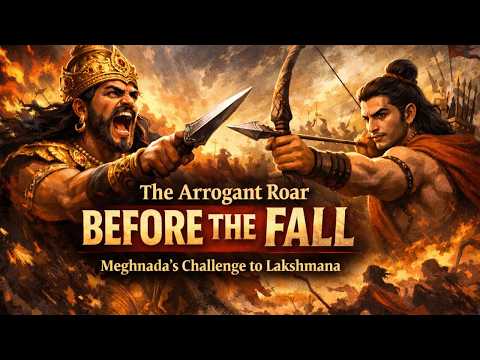
The battlefield of Lanka had already witnessed many impossible sights. Mountains had been lifted. Oceans had been crossed. Armies of vanaras had shaken the pride of rakshasas. Yet now, a new storm was rising — not of wind, but of ego.
क्षुद्राः संत्रासमेते विजहत हरयः क्षुण्णशक्रेभकुम्भा
युष्मद्देहेषु लज्जां दधति परममी सायका निष्पतन्तः।।
सौमित्रे तिष्ठ पात्रं त्वमसि न हि रुषां नन्वहं मेघनादः
किञ्चिद्भ्रूभङ्गलीलानियमितजलधिं राममन्वेषयामि ।।
This shloka captures one of the most dramatic moments in the Ramayana — when Meghnada, also known as Indrajit, confronts Lakshmana on the battlefield.
He says -
'O weak monkeys! Run away in terror. These arrows that have shattered the temples of Indra’s elephant Airavata will feel ashamed to strike your petty bodies. O Saumitra (Lakshmana), stand aside. You are not the proper person for my anger. I am Meghnada. I seek Rama, who merely with the play of his eyebrows can restrain the ocean itself.'
This is not just a statement. This is pure arrogance speaking. This is power intoxicated with itself.
Meghnada: The Warrior Who Conquered Even Indra
Meghnada was no ordinary warrior. His name itself carried his achievement.
He was called Indrajit — the conqueror of Indra.
He had defeated the king of the devas. He had bound Indra. He had shaken the heavens. His arrows had tasted celestial blood. His confidence was not baseless. It was built on real victories.
When such a warrior entered the battlefield, fear naturally followed him.
The vanara army, though brave, were still creatures of flesh. They had seen many rakshasas fall, but Meghnada was different. His presence carried the weight of countless victories.
And Meghnada knew it.
That is why he first addressed the vanaras with contempt:
'O weak ones! Run away.'
He did not even consider them worthy opponents. To him, they were beneath the dignity of his arrows.
This is the first sign of ego — when strength stops seeing others as equals.
The Pride of Weapons and the Delusion of Superiority
Meghnada says something remarkable:
'These arrows that have broken the temples of Airavata will feel ashamed to strike your bodies.'
Airavata was no ordinary elephant. He was the mount of Indra. His strength symbolized divine authority.
Meghnada had already struck Airavata. His arrows had already proven their power against celestial beings.
Now he looked at the vanaras and felt they were too insignificant even to be struck.
This reveals a dangerous transformation. Power had begun to distort his perception.
True strength sees reality clearly. Ego creates illusions.
When ego grows, the mind stops seeing truth. It sees only its own greatness.
Lakshmana: The Silent Mountain Standing Firm
Then Meghnada turns his attention to Lakshmana.
'Saumitra, stand aside. You are not worthy of my anger.'
This is not merely an insult. This is dismissal.
Meghnada is saying Lakshmana is beneath him. He refuses to even consider Lakshmana as an opponent.
This is the blindness of arrogance.
Lakshmana was no ordinary warrior. He was the embodiment of discipline. He was the one who had renounced comfort, sleep, and pleasure to serve Rama.
For fourteen years, he had stood guard without rest.
His strength was not built on conquest. It was built on sacrifice.
Meghnada’s strength came from victory over others. Lakshmana’s strength came from mastery over himself.
There is a vast difference between the two.
One collapses when challenged. The other becomes unshakable.
Lakshmana did not respond with words. He did not boast. He did not defend his honor verbally.
Because true strength does not need to announce itself.
It reveals itself through action.
Meghnada’s Ultimate Target: Rama
Finally, Meghnada declares his true intention.
'I am Meghnada. I seek Rama.'
He acknowledges something extraordinary about Rama.
He describes Rama as one who can restrain the ocean merely by the movement of his eyebrows.
This is not exaggeration. Meghnada had witnessed Rama’s power.
He had seen how Rama’s presence alone had altered the balance of the war.
He understood that Rama was no ordinary human.
Yet his ego pushed him forward.
This is the tragic nature of arrogance.
It recognizes greatness. Yet it refuses to bow.
It sees truth. Yet it refuses to accept it.
Ego would rather fight and perish than surrender and live.
The Eternal Pattern: Ego Before Collapse
This moment represents a universal pattern that repeats across time.
Before Ravana fell, he spoke with arrogance.
Before Hiranyakashipu fell, he spoke with arrogance.
Before Duryodhana fell, he spoke with arrogance.
Before Meghnada fell, he spoke with arrogance.
Arrogance is always loud before it is silenced.
Because ego feeds on illusion. It creates a false sense of invincibility.
It convinces the mind that defeat is impossible.
But reality does not obey ego.
Reality obeys dharma.
And Lakshmana stood on the side of dharma.
The Deeper Symbolism: Two Types of Strength
This encounter is not merely between two warriors.
It is between two kinds of strength.
Meghnada represents strength born from conquest, power, and external victories.
Lakshmana represents strength born from restraint, service, and inner mastery.
External strength creates pride.
Inner strength creates calmness.
External strength needs recognition.
Inner strength needs nothing.
External strength rises quickly and falls suddenly.
Inner strength rises slowly and stands forever.
The Silent Answer of Lakshmana
Lakshmana did not argue. He did not react emotionally.
Because he knew something Meghnada did not.
He knew that dharma itself stood behind him.
He knew that he was not fighting for ego.
He was fighting for righteousness.
When a person fights for ego, fear always exists.
When a person fights for dharma, fear disappears.
Because the outcome is no longer personal.
It becomes cosmic.
And that is why Lakshmana would soon do what even Indra could not do.
He would defeat Indrajit.
Not by arrogance.
But by dharma.
The Lesson for All Time
This shloka is not just about a battle in Lanka.
It is about the battle inside every human being.
Meghnada represents ego.
Lakshmana represents discipline.
Ego always speaks loudly.
Discipline stands silently.
Ego seeks recognition.
Discipline seeks truth.
Ego falls.
Discipline prevails.
Every time.
That is the eternal law revealed in this moment.
And that is why this scene continues to echo across ages.
1. Why did Meghnada insult the vanara army instead of attacking them immediately?
Meghnada’s insult reveals the psychological state created by repeated victory. He had defeated devas, conquered Indra, and fought celestial beings. His mind had become conditioned to see only ‘worthy’ opponents. The vanaras, though instrumental in Rama’s mission, appeared insignificant to him.
This shows how ego changes perception. When arrogance grows, one stops seeing actual strength and starts seeing imagined superiority. Meghnada was not evaluating reality. He was evaluating through the lens of his past victories.
This was the first step toward his downfall — underestimating dharma’s instruments.
2. Why did Meghnada dismiss Lakshmana specifically and seek Rama instead?
Meghnada understood hierarchy. He knew Rama was the center of the entire war. Lakshmana appeared to him as secondary — merely a brother, merely a supporter.
This reveals a common mistake — confusing visible leadership with actual power.
Lakshmana’s strength did not come from position. It came from alignment with dharma and total surrender to Rama’s mission. Meghnada evaluated based on external roles. He could not see inner strength.
In dharmic battles, inner alignment determines victory, not outward rank.
3. Why did Meghnada mention Airavata, Indra’s elephant?
This was not random boasting. It was a deliberate psychological tactic.
Airavata symbolized divine authority and celestial invincibility. By reminding everyone that his arrows had already shattered Airavata’s temples, Meghnada was asserting that he had already conquered the highest known powers.
He was trying to weaken the morale of opponents before fighting physically.
But this also reveals insecurity. True strength does not need to remind others of past victories. Only ego repeatedly refers to its past to justify its present.
4. Why did Lakshmana remain silent instead of responding verbally?
Lakshmana’s silence came from clarity, not weakness.
He had nothing to prove personally. His entire existence was dedicated to serving Rama and dharma. Words were unnecessary because his purpose was pure.
Silence in such moments is a sign of inner stability. The mind that is anchored in dharma does not get disturbed by insult or praise.
Lakshmana knew that action, not speech, would reveal truth.
This is the difference between ego-driven reaction and dharma-driven action.
5. Why is arrogance often seen just before destruction in dharmic narratives?
Arrogance creates blindness. When ego reaches its peak, it disconnects the individual from reality.
Ravana ignored wise counsel. Duryodhana ignored Krishna’s peace offer. Meghnada ignored Lakshmana’s true strength.
Ego creates a false world where defeat appears impossible.
This blindness ensures that corrective force becomes inevitable.
Dharma restores balance by removing ego that refuses to correct itself voluntarily.
6. Why did Meghnada acknowledge Rama’s greatness yet still oppose him?
This is one of the most profound psychological truths.
Meghnada clearly recognized Rama’s extraordinary power. He even described Rama as capable of restraining the ocean with mere eyebrow movement.
Yet he still opposed him.
This shows that knowledge alone does not transform behavior. Ego can coexist with knowledge. Recognition of truth does not automatically create surrender.
Transformation happens only when ego dissolves.
Meghnada had knowledge of Rama’s greatness, but he did not have humility.
7. What does this moment teach about the difference between outer power and inner power?
Meghnada represented outer power — weapons, victories, reputation, and fear.
Lakshmana represented inner power — discipline, restraint, clarity, and devotion.
Outer power depends on circumstances. It can increase and decrease.
Inner power is independent of circumstances. It remains stable.
Outer power creates noise.
Inner power creates silence.
Ultimately, inner power always outlasts outer power.
8. Why is Lakshmana, not Rama, destined to defeat Meghnada?
This reveals a subtle law of dharma.
Rama represents supreme consciousness. Lakshmana represents disciplined human effort aligned with that consciousness.
Ego in the individual must be destroyed through disciplined effort, not by external intervention alone.
Lakshmana symbolizes that effort.
Meghnada symbolizes ego born from achievement.
Their confrontation represents the inevitable victory of disciplined clarity over egoistic pride.





English
Ramayana
Click on any topic to open
7
30
Astrology
Bhagavad Gita
Bhagavatam
Bharat Matha
Devi
Devi Mahatmyam
Ganapathy
Garuda Puranam
Glory of Venkatesha
Hanuman
Kathopanishad
Mahabharatam
Mantra Shastra
Mystique
Practical Wisdom
Purana Stories
Radhe Radhe
Ramayana
Rare Topics
Rigveda Explained
Rituals
Sages and Saints
Shiva
Spiritual books
Sri Suktam
Story of Sri Yantra
Temples
Vedas
Vishnu Sahasranama
Yoga Vasishta
26
17
10
0


