The Killer Is Too Late
Bhagavatam Skandha 10, Chapter 4 –
After Krishna’s divine birth in Chapter 3, Vasudeva carries him secretly to Gokula and leaves Yogamaya in his place by Devaki’s side . Now, in Chapter 4, the scene shifts back to the prison.
Shuka said—
The prison was locked again—
doors shut, chains drawn, guards posted.
But something had changed.
The silence cracked open—
a baby’s cry pierced the night.
Startled, the guards sprang up from their slumber.
They rushed to the birthing chamber,
faces pale, breaths quick.
The child had been born—
to Devaki again.
Without delay,
they reported to King Kamsa,
whose anxious heart had been waiting
for this very cry.
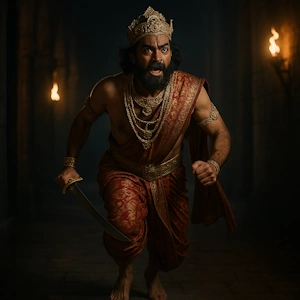
Kamsa rose from his bed
like a man roused by thunder.
'This is the time,' he muttered,
his limbs trembling.
Hair unbound,
mind on fire,
he stumbled down the corridor
towards the chamber of fate.
Devaki, seated weak and weary,
saw him enter—
the killer of her sons.
With eyes full of mercy
and voice soft as dusk,
she pleaded,
'O noble brother,
this is your daughter-in-law—
do not raise your hand against this child.'
Vasudeva = Kamsa’s brother-in-law
The child = Vasudeva’s daughter
Hence, The child = Kamsa’s snusha (daughter-in-law)
'You have already slain
many children born of me—
their brilliance like flames,
yet they fell before your fear.
But this… this is a daughter.
Just this once,
let me keep
what little remains of my motherhood.'
Devaki’s voice cracked with grief.
'O Lord, am I not your younger sister?
Broken, childless, crushed by sorrow.
Please—have pity.
Let this dull-hearted woman keep
this one last daughter,
this final breath of motherhood
that clings to my arms.'
Shuka said—
Clutching her child close,
Devaki wept like the world itself.
A mother’s cry,
raw and helpless,
rose through the stone walls.
But Kamsa, cold as a blade,
ignored her pleas.
He snatched the infant
from her trembling hands.
The cruel-hearted tyrant,
driven only by fear,
gripped the newborn by the feet.
Though she had done him no harm,
he lifted her high—
and dashed her
against the stone.
What friendship? What blood?
His heart had become iron.
But the leela was far from over.
The infant slipped from his hands—
rising into the air,
clothed in light.
Before Kamsa could blink,
she stood above him—
eight-armed and blazing,
a goddess beyond comprehension.
She was adorned with divine garlands,
gems burning like stars.
Each arm held a weapon—
bow, sword, conch, discus,
mace, trident, shield,
and lotus.
Kamsa staggered back,
his pride shattered
by the child he could not kill.
As she hovered in the air,
her eight arms glowing with weapons,
the skies filled with sound.
Siddhas, Charanas, Gandharvas,
Apsaras, Kinnaras, Nagas—
they all gathered in awe,
offering garlands, hymns, and praise.
She stood radiant—
untouched, untamed.
Then the Devi spoke—
her voice calm as judgment.
'O fool,
what would killing me have changed?
The one who ends you
has already been born.
Where? When? How?—
you will not know.
Stop wasting your fury
on the helpless.'
Having said this,
the Devi, Bhagavati Maya,
vanished from the prison.
She now dwelled in many forms—
known by countless names,
in countless places,
throughout the earth.
Kamsa heard her words
and stood frozen.
Fear swallowed him.
He looked at Devaki and Vasudeva,
not with rage—
but with folded hands.
A broken man.
A stunned brother.
He spoke with shame
in his eyes.
'O Devaki… O gentle one…
how blinded I have been!
You are my sister,
yet I killed your sons like a beast.
What demon lived inside me
that I crushed your children
with my own hands?'
'I have thrown away compassion.
I betrayed my own blood.
I have become a beast in human form.
What worlds remain for such a man?
What world is left for a sinner like me?
Even a man who kills a Brahmana has a chance.
But I—though alive—am as good as dead.'
'They say only mortals lie.
But even fate lies.
It made me trust it—
and in that trust,
I killed my sister’s sons.
How could I fall
so far,
so blind,
so cursed?'
'O noble ones, do not mourn.
The children are gone,
but by their own karma.
Living beings are scattered by fate,
brought together by time,
only to be pulled apart.
Nothing stays.
Not even sorrow.'
'Just as creatures come and go
on the surface of the earth,
so too, souls
pass through bodies—
but the Self remains still,
like the earth beneath it all.'
'But those who don’t know this,
cling to illusions.
They think death is the end
and birth the beginning.
Bound by false identity,
they are tossed between unions and separations,
and the wheel of rebirth
keeps turning.'
Kamsa said—
'O noble sister,
even if I killed your sons
with my own hands,
don’t grieve like one lost.
Every soul is bound
to reap only the fruit
of their own karma.
I was merely the instrument.'
'As long as one thinks—
“I am the doer, I am the slayer”—
he remains in the grip of ignorance.
The wise see
no killer and no victim,
only the wheel of samsara
spinning roles on a stage.'
'O saints,
you who cherish the brokenhearted—
forgive me.
My wickedness clouded my soul.'
Saying this,
his eyes welled with tears.
He fell at Devaki’s feet,
the very feet he once approached
with a sword.
Kamsa, though deeply shaken,
acted outwardly composed—
because the goddess had told him
that his destroyer had already been born elsewhere.
He no longer saw Devaki and Vasudeva
as immediate threats.
So he unchained them—
not from peace,
but from strategy.
He’s not fearless — he’s calculating.
He's temporarily changing tactics.
Devaki, seeing her brother
bowed low in remorse,
let go of her anger.
So did Vasudeva.
With a soft laugh
and the stillness of a knower,
he said—
'Yes, Kamsa.
What you’ve said reflects the truth
of embodied beings.
The sense of "I" and "mine,"
of friend and foe—
these arise
only from ignorance.
We fight shadows
cast by our own misunderstanding.'
'Blinded by sorrow, joy, fear, and hatred,
driven by greed, deluded by pride,
people clash with each other,
never seeing
that it’s the same spirit in all.
Bound by narrow vision,
they destroy one another
without ever grasping
who or what they truly are.'
Shuka said—
Hearing these pure and forgiving words,
spoken by Devaki and Vasudeva,
Kamsa bowed once more,
muttered his excuses,
and left for his palace—
pretending peace,
but carrying poison in his mind.
As dawn broke,
Kamsa called his ministers.
His eyes burned.
His voice trembled with fear.
He told them everything—
about the goddess in the sky,
her words, her form,
and the prophecy
that had now cornered him.
Hearing his account,
the ministers —
Daityas loyal to asura blood —
gritted their teeth.
Their hatred for the gods surged.
Without wisdom,
but full of vengeance,
they spoke like vipers
coiling around false pride.
The daityas spoke—
'O King of the Bhojas,
why wait?
Let us strike today.
In every village, city, forest, and cowshed—
we will kill every child
ten days old or less.
Born or unborn,
boy or girl—
none shall be spared.'
'What can the devas do?
They fear your bowstring
more than thunder.
At the sound of your arrows,
they tremble.
Their minds are never at peace—
because your fury
keeps them sleepless.'
'They once fought—
but now they run.
Your arrows fall like rain.
Every direction,
they scatter.
Those who still wish to live
throw away their weapons
and vanish into the skies.'
'Some stand begging for mercy,
palms joined,
heads lowered.
Others cast away their sacred threads,
loose their hair,
and cry out—
"We are no threat!
We are no warriors!"
Cowards, all of them.'
'You have never slain
those stripped of weapons.
You never crushed those without chariots,
or the terrified,
or the unarmed.
Your arrows never struck
the backs of those who fled,
nor the mouths of those
who had turned silent.'
'What use are gods who hide?
What safety comes
from warriors who never face battle?
Shiva wanders forests like a madman.
Hari sits in caves, silent.
Indra, the so-called king,
has no real strength.
And Brahma?
He just stares at his breath.'
'Still…
even weak enemies
should not be ignored.
So let us strike
at the very root—
not the branches.
Give us command, O King,
and we, your loyal ones,
will rip the base of their strength
from the soil of this world.'
'When disease takes root
and is left alone,
it becomes incurable.
So too a powerful enemy—
if neglected—
grows beyond reach.
The wise treat it
before it spreads.
The foolish wait
until they are swallowed.'
'Vishnu is the heart of the devas.
Dharma rests in Him.
And from Him arise
brahmanas, cows, tapas, yajnas—
the true spine
of the divine order.
Destroy these…
and the gods will crumble
like a palace of sand.'
'So, O King,
strike with your full strength.
Let brahmanas fall—
those who chant mantras,
those who live in tapas,
those who pour ghee into sacred fires.
Kill the cows too—
those that give havis,
those that nourish yajna.
Let the roots wither.'
'The brahmanas,
the cows,
the Vedas,
austerity, truth, self-control, peace,
faith, compassion, endurance,
and all yajnas—
these are not just pillars of dharma—
they are the limbs of Hari Himself.
Destroy them,
and you strike Him.'
'Vishnu is the hidden ruler
of all devas.
He lives unseen
in every heart.
Even Brahma and Rudra
draw from His source.
To kill Him,
hurt those who hold Him dear—
the sages, the seers, the sacrificers.'
Shuka said—
Thus poisoned by evil counsel,
Kamsa—the asura in human skin—
decided that killing brahmanas
was not sin,
but strategy.
Bound by the noose of Time,
he mistook adharma
for victory.
He summoned the dark-hearted—
asuras who could change form at will.
He sent them in all directions
with one order:
tear the world of the righteous
limb by limb.
Crush what shines.
Break what prays.
Burn what remembers Vishnu.
These beings, born of rajas and tamas,
burning with delusion,
hated the saints.
They moved like shadows,
with venom in their speech,
and death in their eyes.
They were not messengers—
they were fate,
dressed in flesh.
Whenever man crosses the divine,
and lifts a hand against the great-souled—
his life, his fortune, his fame, his dharma,
his very worlds—
they all vanish.
To harm the pure
is to stab oneself
with a blade made of curses.
Highlights of Chapter 4
- Kamsa hears of a birth in the prison
The guards report that Devaki has given birth again. Kamsa rushes to kill the child, as he did before. - Devaki pleads for mercy
She begs him to spare this child, saying it is only a girl. She appeals as a broken mother and as his younger sister. - Kamsa tries to kill the girl
He snatches the baby and dashes her against a stone, but she slips from his hands and rises into the air. - Yogamaya reveals her true form
The baby transforms into an eight-armed goddess, warns Kamsa that his killer is born elsewhere, and then disappears. - Kamsa is terrified and temporarily repentant
He begs forgiveness from Devaki and Vasudeva, speaks about karma and ignorance, and releases them. - Vasudeva replies with philosophical wisdom
He explains how ignorance leads to hatred, and how the soul is beyond killing and being killed. - Kamsa summons his asura ministers
Once alone, he returns to fear and rage. He tells his ministers what the goddess said. - The asuras advise a violent plan
They suggest killing all children and destroying the roots of dharma—brahmanas, cows, yajnas, and Vedas. - Kamsa accepts the plan
He commands asuras to go across the land in disguise and wipe out anything sacred or righteous. - The chapter ends with a warning
Those who harm the pure, says Shuka, bring destruction not just upon others—but upon themselves.
Chapter 4 ends with Kamsa dropping all pretence of repentance. Driven by fear, he chooses destruction over surrender. Guided by wicked counsel, he targets not just Krishna—but the very roots of dharma. The battle has not yet begun, but the storm has been unleashed.




English
Bhagavatam
Click on any topic to open
7
30
Astrology
Bhagavad Gita
Bhagavatam
Bharat Matha
Devi
Devi Mahatmyam
Ganapathy
Garuda Puranam
Glory of Venkatesha
Hanuman
Kathopanishad
Mahabharatam
Mantra Shastra
Mystique
Practical Wisdom
Purana Stories
Radhe Radhe
Ramayana
Rare Topics
Rigveda Explained
Rituals
Sages and Saints
Shiva
Spiritual books
Sri Suktam
Story of Sri Yantra
Temples
Vedas
Vishnu Sahasranama
Yoga Vasishta
26
17
10
0


