Nanda's Joy, Vasudeva’s Concern
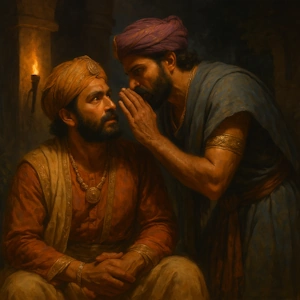
After the divine exchange of babies in the prison, Krishna is now safe in Gokula. The village bursts into celebration as Nanda rejoices at the birth of his son. Brahmanas chant, drums thunder, and Gopis rush to Yashoda's home with gifts and songs. Meanwhile, Nanda travels to Mathura to pay the annual tax to Kamsa. There, he quietly meets Vasudeva, who warns him of upcoming dangers — even as Gokula remains blissfully unaware. The storm is silently approaching.
Nanda was overwhelmed with joy.
His own son was born.
He bathed, dressed in clean, fine clothes.
He called learned brahmanas well-versed in the Vedas.
They chanted Swastyayana — prayers for protection.
The Jatakarma ritual was done properly.
He also worshipped ancestors and the devatas.
He gifted a thousand beautifully adorned cows.
Also gave seven hills of sesame and heaps of gems,
all wrapped in golden cloth, to the brahmanas.
Baths and rituals cleanse only the surface.
True purification comes from austerity, yajna, charity, and knowledge.
Nanda understood this deeply.
The village rang with auspicious sounds.
Brahmanas chanted blessings.
Poets sang. Drums and conches echoed.
A divine child had arrived — and the earth celebrated.
Vraja turned radiant.
Houses were swept, sprinkled, cleaned inside and out.
Doors wore garlands.
Cloth, leaves, flags, streamers danced in the wind.
Cows and bulls were anointed with turmeric and oil.
Calves too gleamed with color.
They wore ornaments of cloth, metals, feathers, and gold chains.
The gopas arrived in festive dress.
They wore rich silks, jewelry, turbans, and robes.
Each carried unique gifts — no one came empty-handed.
The gopis heard the news:
Yashoda had given birth!
Delighted, they dressed themselves—
new clothes, kohl, perfumes, and ornaments.
Their faces glowed like lotuses dusted with fresh kumkum.
Heavy-hipped, full-chested,
they hurried with offerings in hand,
their joy as radiant as their beauty.
The gopis sparkled—
jewelled earrings, polished necklaces, bright silks fluttering.
Their arms jingled with bangles.
Flower garlands swayed from their hair as they walked.
Their breasts and earrings moved rhythmically—
they lit up the path to Nanda’s house.
Blessings poured from their lips—
'May this child live long!'
They sprinkled turmeric and oil on people,
singing and shouting in joy.
Musical instruments thundered—
flutes, drums, cymbals, conches—
celebrating the arrival of Krishna,
the Lord of the Universe, in Nanda’s home.
The gopas rejoiced wildly.
They splashed each other with milk, curd, ghee, and water.
They smeared fresh butter on each other and laughed.
Nanda, overwhelmed with joy,
gave clothes, jewels, cows, and gold
to bards, singers, and all who lived by knowledge and praise.
Nanda, without pride,
worshipped the sages, singers, and all guests
with whatever they desired—
as an offering to Vishnu,
and a thanksgiving for his son’s birth.
Rohini, the blessed one,
was honoured by Nanda and all of Vraja.
She walked radiant—
draped in divine garments, garlands, and glowing ornaments.
From that day on,
Vraja bloomed with abundance.
With Hari dwelling there,
it became the playground of Lakshmi herself.
Leaving Gokula in safe hands,
Nanda went to Mathura—
to pay the annual tax to King Kamsa.
Vasudeva heard Nanda had come.
Knowing the tax was paid,
he hurried to meet his brother—
hoping for a moment of freedom.
As soon as Vasudeva saw Nanda,
he rose like life returning to a lifeless body.
Tears filled his eyes,
and he embraced his dear friend—his very soul—tight in love.
With honor, he seated Nanda,
worshipped him with affection,
and asked warmly,
'How have you been, my friend?'
He said—
'O brother, how fortunate you are!
In old age, without seeking it,
a child has been born to you.'
'Wandering in this endless wheel of samsara,
how rare it is to see someone dear—
yet today I see you!
What a blessing.'
'No friendship lasts forever in this world,
not even the company of loved ones.
We are like boats—
carried apart by a flood’s current.'
Vasudeva asked—
'Is your land still fertile, brother?
Are your fields green,
your forests full,
and your cattle free from disease?
Is your Vrindavan still a haven for friends?'
'And my son—
is he with his mother in your home?
Does he treat you as his own father,
clinging to you in love?'
'For a man,
dharma, wealth, and desire
are meaningful only when friends flourish.
If they suffer,
no goal feels complete.'
Nanda replied—
'Alas! Devaki’s sons—
all slain by Kamsa.
Only a daughter remained,
and even she…
she vanished into the heavens.'
'This world runs on unseen force.
Destiny decides all.
One who knows the truth of the unseen
never gets confused by what’s visible.'
Vasudeva said—
'The annual tax has been paid.
The king has seen us; all is done.
But don’t stay here long, brother.
Gokula is stirring with omens.
Strange things are coming.'
Shuka said—
Thus warned by Vasudeva,
Nanda and the Gopas bowed,
mounted their bullock carts,
and returned to Gokula—
hearts anxious, but hopeful.
Thus ends the fifth adhyaya of the tenth skandha of the Bhagavatam — a chapter glowing with joy, music, and hidden mysteries. While Gokula dances in celebration, far-off currents are beginning to stir. What looks like a festival... may just be the silence before another storm.





English
Bhagavatam
Click on any topic to open
7
30
Astrology
Bhagavad Gita
Bhagavatam
Bharat Matha
Devi
Devi Mahatmyam
Ganapathy
Garuda Puranam
Glory of Venkatesha
Hanuman
Kathopanishad
Mahabharatam
Mantra Shastra
Mystique
Practical Wisdom
Purana Stories
Radhe Radhe
Ramayana
Rare Topics
Rigveda Explained
Rituals
Sages and Saints
Shiva
Spiritual books
Sri Suktam
Story of Sri Yantra
Temples
Vedas
Vishnu Sahasranama
Yoga Vasishta
26
17
10
0


