The sinner’s breath leaves from below — and that changes everything…
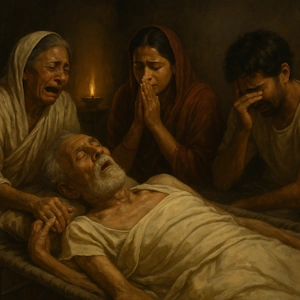
We are stepping into a realm where the veil thins—where the soul’s fate begins to unfold beyond the breath. This is the Prathama Adhyaya of the Preta Kalpa from the Garuda Purana — a doorway into the unseen path of the soul after death.
शृणुध्वं भो विवक्ष्यामि यममार्गं सुदुर्गमम्।
सुखदं पुण्यशीलानां पापिनां दुःखदायकम्॥ (6)
Listen, O seekers!
Sūta rises to speak, not with idle tales, but with the echo of cosmic truth. He speaks of a path—no, not a gentle trail in the forest of life, but a perilous route that begins when the last breath slips out. This is Yama’s path—unseen, unspoken of in daily chatter, feared in whispers.
For the righteous, it becomes a smooth ascent—like the cool breeze on a hilltop. But for sinners... oh, for them, it is a road laid with thorns of regret and flames of consequence. What was once ignored now screams.
यथा श्रीविष्णुना प्रोक्तं वैनतेयाय पृच्छते।
तथैव कथयिष्यामि सन्देहच्छेदनाय वः॥ (7)
What is about to unfold isn’t born of imagination.
These are not Sūta’s opinions. These are the very words spoken by Mahavishnu himself—to his most trusted carrier, the mighty Garuda, the eagle of divine wings. This isn't folklore. It’s scripture. It’s law.
And why tell it? To slash your doubts like a sword cuts through illusion. So the mind may not wander in speculation but anchor in knowing.
कदाचित्सुखमासीनं वैकुण्ठे श्रीहरिं गुरुम्।
विनयावनतो भूत्वा अपृच्छद्विनतासुतः॥ (8)
Picture this—Vaikuntha.
Where time stands still and bliss flows like nectar. There, seated in radiant serenity is Lord Vishnu, the Supreme Guru. And before him, with folded wings and bowed head, is Garuda—vinayāvanataḥ, the embodiment of humility despite his unmatched power.
Even he, the bearer of the Lord, seeks to know… for when questions arise about the soul’s journey, even gods fall silent unless Vishnu speaks.
गरुड उवाच ॥
भक्तिमार्गे बहुविधः कथितो भवता मम।
तथा च कथिता देव भक्तानां गतिरुत्तमा॥ (9)
Garuda speaks, not with pride but with longing.
'O Lord, you’ve shown me the many roads of bhakti — the songs, the japa, the seva. I’ve seen how the hearts soaked in devotion rise like suns, heading toward you. You’ve shown me what becomes of those who remember you with every breath. But...'
अधुना श्रोतुमिच्छामि यममार्गं भयङ्करम्।
त्वद्भक्तिविमुखानां च तत्रैव गमनं श्रुतम्॥ (10)
‘…what of the others?’
Garuda dares to ask what few do.
What of the ones who turn away from bhakti — from truth, from dharma, from the very naam that could've saved them? What becomes of those who lived for themselves, not the divine?
He wants to know the terrifying path of Yama, where pain teaches what life ignored.
सुगमं भगवन्नाम जिह्वा च वशवर्तिनी।
तथापि नरकं यान्ति धिग्धिगस्तु नराधमान्॥ (11)
This is the heartbreak of it all.
The name of the Lord — Bhagavannama — is so simple, so effortless. And the tongue is under your control. Just uttering it sincerely could wipe lifetimes of sorrow. It’s the easiest thing in the universe.
And yet...
And yet, people still plunge into hell.
Why? Not out of ignorance — but arrogance.
Dhig dhig astu narādhamān! — shame, shame on such degraded beings who had the key in their hand and still chose the dungeon.
अतो मे भगवन् ब्रूहि पापिनां या गतिर्भवेत्।
यममार्गस्य दुःखानि यथा प्राप्नुवन्ति वै॥ (12)
Garuda speaks again — not with curiosity now, but with urgency.
‘Tell me, O Lord… what is the fate of the sinner?
What horrors await them on the path to Yama?
How exactly do they suffer? What is the journey like?
You showed me the glory of devotion.
Now show me what happens without it.’
श्रीभगवानुवाच —
वक्ष्ये, शृणु पक्षीन्द्र, यममार्गं च येन याः।
नरके पापिनो यान्ति शृण्वतामपि भीतिदम्॥ (13)
The Lord responds — calm, steady, but unsparing.
‘Listen closely, O Garuda, king of the skies.
I will reveal the dreadful path of Yama —
the trail that sinful souls are dragged through.
Even the mere hearing of it is enough to stir fear in the heart.
And yet, it must be heard — for truth must be seen to be avoided.’
ये हि पापरतास्तादृशा,दया-धर्म-विवर्जिताः।
दुष्टसङ्गाश्च सच्छास्त्र-सत्सङ्गति पराङ्मुखाः॥ (14)
These are the ones who fall — no accident, no surprise.
They are addicted to sin, completely given to it.
They’ve cut themselves off from mercy and dharma.
They surround themselves with the wicked.
They scoff at holy texts.
They turn away from saints like they were nothing.
In their pride, they think they’ve outgrown religion.
In truth, they’ve shrunk below even basic humanity.
आत्मसंभाविताः स्तब्धा धनमानमदान्विताः।
आसुरं भावमापन्ना देवीसंपद्विवर्जिताः॥ (15)
They worship themselves.
They are puffed with ego, stiff with pride.
They flaunt their wealth, drown in status, and laugh in arrogance.
They walk with a demonic attitude — full of selfishness and cruelty.
There is no divinity in them.
Not a trace of softness, surrender, or sweetness.
What remains is a cold, sharp force… that burns others and blinds itself.
अनेकचित्रविभ्रान्ता मोहजालसमावृताः।
प्रसक्ताः कामभोगेषु पतन्ति नरकेऽशुचौ॥ (16)
And so, wrapped in a thousand colorful delusions, they fall.
Entangled in webs of confusion spun by their own minds,
they cling to pleasures like lifeboats —
but those boats are full of holes.
They sink. Fast.
Into the most impure, unbearable realms of hell.
No dignity. No light. No rest.
Only decay… echoing every choice they made in life.
Now, the next verses take us right to the threshold of death — the last stage of life, where the consequences of karma begin to manifest.
ये नरा ज्ञानशीलाश्च ते यान्ति परमां गतिम्।
पापशीलानरा यान्ति दुःखेन यम-यातनाम्॥ (17)
There are two kinds of humans — and their fates split like rivers at a fork.
Those who are grounded in knowledge and character —
not just believers, but doers of dharma,
they walk into the highest realm, gently led, like a child returning home.
But the others…
The ones who lived a life steeped in sin,
they’re not led.
They are dragged — through the fires, the fears, the claws of Yama's world.
Not metaphor. Not myth.
A literal journey.
A consequence, not a punishment.
पापिनामैहिकं दुःखं यथाभवति तच्छृणु।
ततः ते मरणं प्राप्य यथा गच्छन्ति यातनाम्॥ (18)
‘Listen now,’ says the Lord —
‘I will describe the kind of suffering that sinners face in this very life.
Their hell doesn't start after death.
It starts here. On earth. In their bodies. In their minds.
The consequences of adharma come not just after death — they come before.
And when death finally arrives —
you will see exactly how they begin their descent
into the endless torments that await.
Not just physical pain — but the spiritual horror of the preta yatra.’
सुकृतं दुष्कृतं वापि भुक्त्वा पूर्वं यथार्जितम्।
कर्मयोगात् तदा तस्य कश्चित् व्याधिः प्रजायते॥ (19)
Whether good or bad karma — whatever was earned —
it first manifests through experiences in this very life.
He eats, drinks, enjoys, suffers — all based on the past.
But then, the karmic weight begins to erupt as disease.
Yes, the first crack is always in the body.
No one else sees it, but it’s already begun.
Karma doesn’t stay hidden forever.
आधि-व्याधि-समायुक्तं जीविताशा-समुत्सुकम्।
कालो बलीयानहिवदज्ञातः प्रतिपद्यते॥ (20)
The man lies there —
wracked by mental stress (aadhi) and physical disease (vyaadhi).
Even as his body fails, his heart clings to life like a stubborn vine.
He still hopes. Still dreams.
Still wants to live — just a little longer.
But time — Kaala —
is mightier than will, stronger than hope.
It doesn’t come with a warning, or a chime, or a whisper.
It arrives unannounced, like a silent snake in the dark.
And once it strikes…
nothing can stand in its way.
तत्राप्यजात -निवेदः भ्रियमाणः स्वयंभूतैः।
जरया उपात्त-वैरूप्यः मरणाभिमुखः गृहे॥ (21)
And there he lies — in his own house,
not knowing, not able to even express what is happening to him.
His body is being taken over by natural forces —
age disfigures him, strength deserts him.
He’s facing death, but he cannot name it.
Everyone watches, but no one sees what’s really happening.
आस्ते एवं अत्युपन्यस्तं गृहपाल इव आहरत्।
आमयाव्यप्रदीप्ताग्निः अल्पाहारः अल्पचेष्टितः॥ (22)
There he lies…
Collapsed.
The once-proud man now eats like a dog,
grabbing whatever little is placed near his mouth —
not with appetite, but with instinct.
No control. No awareness. No dignity.
The fire of disease (aamaya) is burning within him —
not a bright flame, but a sickly, corroding heat
that slowly devours his vitality.
His food? Barely a few spoonfuls.
His movement? Just a twitch here and there.
Even blinking feels like labor.
This is not rest. This is a living slow death.
And yet… this is still not the end.
The soul hasn’t left — not yet.
The torment is only just beginning.
वायुनोत्क्रमतोत्तारः कफसंरुद्धनाडिकः।
कासश्वासकृतायासः कण्ठे घुरघुरायते॥ (23)
The life-air tries to escape —
but it can’t.
The naadis, those fine subtle channels — once flowing like rivers of light —
are now choked with phlegm, blocked like old, forgotten tunnels.
The prāṇa wants to rise, to break free…
but every passage is sealed.
It’s like a bird trapped in a burning cage.
The man coughs — a dry, violent sound.
He gasps for air — but every breath is a battle.
Each inhale brings more pain. Each exhale brings fear.
And then — from deep in his throat —
a sound no one forgets:
Ghur-ghur.
It’s not a word. Not a cry.
It’s the body’s final resistance,
the terrifying rattle when breath claws at death’s grip.
This is not a peaceful passing.
This is the body collapsing.
This is what sin feels like when it comes to collect its due.
शयानः परिशोचद्भिः परिवीतः स्वबन्धुभिः।
वाच्यमानोऽपि न ब्रूते कालपाशवशं गतः॥ (24)
He lies there — flat, unmoving —
surrounded by his family, by his dear ones.
They’re sobbing. Wailing. Whispering prayers.
Calling his name, begging him to speak… just once more.
‘Papa, can you hear me?’
‘Thatha, say something.’
‘We’re right here. Please don’t go…’
But he says nothing.
Not because he doesn’t want to.
But because he can’t.
He’s now under the control of Kaala-Paasha —
Time’s noose has caught him, tight around the soul.
Even if he wants to speak, the lips won’t move.
The eyes won’t open.
Only the soul within watches — helpless, unseen, unheard.
And this… is the cruel silence of death.
Not peaceful. Not poetic.
It is the soul’s first moment of total isolation.
एवं कुटुम्ब-भरणे व्यापृतात्मा जितेन्द्रियः।
म्रियते रुदतां स्वानाम् उरु-वेदनयाऽस्तधीः॥ (25)
He lived the perfect worldly life.
Always engaged in duty —
feeding the family, guiding the children, protecting his home.
He controlled his senses, stayed away from indulgence, walked the straight path.
By society's measure, he was a noble man.
But…
what did he do for his own soul?
Not once did he pause and ask —
'Who am I?'
'Where am I going?'
'What happens when all this ends?'
He built a house, but never built inner stillness.
He earned wealth, but never earned the name of the Lord.
He raised a family, but never raised his own awareness.
And now?
He lies on the floor, screaming in pain,
his loved ones weeping beside him —
but his mind is shattered, his strength gone.
All his life’s labor can’t help him now.
Because in all that busy-ness,
he forgot to prepare for death.
And now…
the path he walks will be alone.
It’s a sobering moment, isn’t it?
तस्मिन्नन्तक्षणेतार्क्ष्य दैविदृष्टिः प्रजायते ॥
एकीभूतं जगत्सर्वं न किंचिद्वक्तुमीहते ॥ २६ ॥
At that final moment, O Garuda —
something otherworldly unfolds.
The dying man suddenly sees — not with his eyes, but with divine vision.
Daivi Drishti arises — not earned, but granted —
so he may witness the truth behind the illusion.
And what does he see?
Everything merges.
All that was scattered — his house, his wife, his name, his enemies, his status —
it all becomes one.
No distinctions. No titles. No 'mine' and 'theirs.'
The world appears like a single wave,
and he… just a grain of foam about to vanish.
And in that state?
He wants to speak.
He wants to ask for help.
He wants to say something.
But he can’t.
His tongue has frozen.
His mind is stunned.
He has no desire left — not even the will to cry out.
Because the truth has burned through every last veil.
And now?
All that remains…
is the soul, about to step into the unknown.
This verse is haunting. It strips everything down to that one blinding second where illusion dies before the body does.
विकलेन्द्रियसंघाते चैतन्येजडतांगते ||
प्रचलन्तित तः प्राणायाम्यैर्निकटवर्तिभिः ॥ २७ ॥
The senses have failed.
The eyes no longer see.
The ears hear but do not understand.
The limbs lie limp, like sticks scattered by wind.
The body has turned into a mute shell,
and the spark of consciousness — once bright —
now flickers like a dying ember in the storm.
And just then…
they arrive.
The Yamadootas — emissaries of Yama, dark and fierce —
draw near.
They don’t wait politely.
They pull.
They tug at the soul like hunters dragging prey.
The prāṇas, still lingering in the shattered body, begin to move, to stir, to tremble.
Not out of will —
but because karma demands it.
This isn’t a graceful leaving.
This is extraction.
And those nearby?
They may still be chanting, touching, crying —
but the soul now sees only them —
those dark beings who have come to claim what is owed.
This is the moment where life has left but death hasn’t yet finished.
The soul is between realms — between rights and regrets.
स्वस्थानाच्चलिते श्वासे कल्पाख्योह्यातुरक्षणः ॥
शतवृश्चिकदष्टस्य या पीडा सानुभूयते ॥ २८ ॥
And then… the breath leaves its seat.
The prāṇa, which once rested calmly in its sacred dwelling within the heart-lotus —
is now ripped from its root.
This moment — called 'Kalpa' — is no gentle passing.
It is the ultimate rupture.
The last tether snaps.
And what does it feel like?
Imagine this:
A man, bitten by not one, not two —
but a hundred scorpions, all at once.
That burning, stabbing, venomous agony…
that is the kind of pain the soul endures in that one second.
It’s not symbolic.
It’s not poetic exaggeration.
It’s a direct experience — a payment in pain for a life unexamined, a soul unprepared.
No mantra can be chanted.
No repentance is heard.
Only that white-hot surge of karmic discharge —
as the soul is torn from its temple.
And now, the body is just flesh.
And the jiva — the individual soul — is on the move.
Stripped of status. Of name. Of support.
फेनमुद्गिरतो सोथमुखं लालाकुलं भवेत् ॥
अधोद्वारेण गच्छन्ति पापिनां प्राणवायवः ॥ २९ ॥
The final image of the sinner’s body is not peaceful.
It is disturbing. Distorted. And painfully revealing.
His mouth — overflowing with foam,
his face — swollen, puffed like something bloated from within.
This is not natural swelling — it is the outward scream of blocked prāṇa,
of life being violently pulled from its roots.
Sothamukha — his once-strong face now distorted, stretched, filled with pressure.
Eyes bulge. Saliva pours. No speech, only gasps.
He is drenched in his own fluids,
his body betraying the battle inside.
And then?
The prāṇas — the life-airs — don’t rise to the crown.
They don’t float upward to merge with divinity.
Instead, they exit from below — through the adhodvāra (anus).
Like filth washed out of a drain,
the life-energy of a sinner departs downward —
the final insult of a life lived in denial of the sacred.
Why?
Because when the soul refuses to look up in life,
it is denied the ascent in death.
This verse is a mirror.
What exits through the crown is grace earned.
What exits below is karma unleashed.
यमदूतौ तदा प्राप्तौ भीमौ सरभसेक्षणौ ॥
पाशदंडधरौ नग्नौ दन्तैः कटकटायितौ ॥३०॥
And then — they arrive.
Not in dreams. Not as metaphors.
But as they are.
The Yamadootas — the terrifying agents of Yama.
Their eyes? Fierce, wide, and blazing with savage speed .
They don’t walk.
They burst into presence.
No robes. No armor.
Naked. Raw. Ruthless.
Clutching in their hands the noose and rod — pāsha and daṇḍa —
symbols of capture and punishment.
Their teeth?
Gnashing, snapping, not for show, but for fear.
This is the welcome committee…
not garland-bearing devas,
but flesh-ripping hunters,
come to claim what is owed.
There is no dialogue.
No negotiation.
No pleading.
The sinner’s soul — freshly ripped from the body —
now faces what his choices summoned.
This is not myth.
This is what Garuda heard directly from Lord Vishnu himself.
This is what waits for the one who laughed at dharma,
mocked bhakti,
and ignored the naam when it was just a breath away.
ऊर्ध्वकेशौ काककृष्णौ वक्रतुण्डौ नखायुधौ ॥
सदृष्ट्वा त्रस्तहृदयः शकृन्मूत्रं विमुञ्चति ॥३१॥
Hair standing upright — wild and unkempt, shooting toward the sky like black flames.
Bodies as dark as a crow’s wing, glistening with otherworldly fear.
Their faces? Twisted, bent, warped, not human, not beast, something else.
And their weapons?
Nails.
Yes — sharpened, jagged claws, like steel hooks extending from their fingers — nakhāyudha.
Not to threaten. To tear.
And when the preta — the freshly detached soul — sees them?
He doesn’t scream.
He doesn’t fight.
His heart collapses in fear.
And then… the ultimate sign of helplessness:
He loses control of his bowels.
He soils himself — not metaphorically, literally —
overcome by a terror no words can contain.
Even before they touch him,
the horror of simply seeing these messengers of death
is enough to reduce a man to utter ruin.
This is the first step of the Preta Yatra — and it already breaks the soul's strength.
And yet... this is just the beginning.
अंगुष्ठमात्रः पुरुषो हाहा कुर्वन्कलेवरात् ॥
तदैवगृह्यते दूतैर्याम्यैः पश्यन्स्वकं गृहम् ||३२||
Now the soul is out — no longer hidden in the body, no longer protected by flesh or name or family.
It is exposed, raw, and stripped to its true form.
This is the beginning of the Preta’s walk.
This is the moment the soul realizes — 'I am no longer among the living.'
And the Yamadootas don’t wait.
The soul — no longer grand, no longer mighty —
now appears as a tiny being,
just the size of a thumb — aṅguṣṭha-mātraḥ puruṣaḥ.
Once proud of his wealth,
once shouting orders in his house,
now he screams in helplessness — 'Ha ha! Ha ha!'
But no one hears.
He watches — watches his own dead body,
watches his family cry,
watches his house — his room, his bed, his ornaments —
but he cannot go back.
Because right then —
the Yamadootas seize him.
They don’t give him time to understand.
They don’t let him say goodbye.
They grip him — tight —
and he, the thumb-sized soul, is now dragged away.
All he can do is look back —
at his home, his people, his body…
and cry.
That’s the punch of this verse — the soul sees, but cannot return.
It’s the first real cut of separation.
No comfort. No closure. Just the beginning of karma’s extraction.
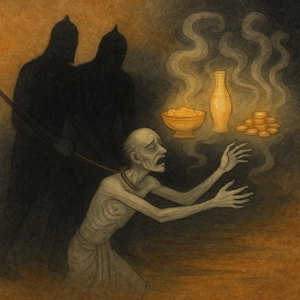
यातनादेह आवृत्य पाशैर्बध्वा गले बलात् ॥
नयतोदीर्घमध्वानं दण्ड्यम् राजभटा यथा ३३ ॥
The Yamadootas don’t simply pull the soul.
They now bind it tightly in a new body —
not a body of flesh, but of pain — yātanā-dehaḥ.
A body made for suffering.
A body meant to feel every sting, every wound, every strike.
Then they tie a noose around his neck — pāśair baddhvā gale —
and drag him by force, like a criminal in chains.
He doesn’t walk —
he is pulled.
He is treated not like a soul, but like a prisoner —
just like prison guards drag a convict
through the streets before his execution.
Except this street?
Is not of earth.
It is the long, long road to Naraka.
There is no rest.
There is no water.
Only pain. Dust. Fire. Fear.
The sinner's journey has begun —
and it will be long.
This verse reveals a terrifying truth:
Even after death, the sinner does not escape the consequences of life.
The yātanā-deha is karma’s vessel.
And the punishment fits the crime.
To avoid such terrifying suffering at the time of death, one must live with dharma, devotion, and inner awareness. This dreadful end is not for everyone — it is only for sinners, those who rejected truth, ignored the Divine, and lived solely for the senses. But the path to freedom is simple: take the name of the Lord, walk the path of compassion, and align your life with righteousness. Serve, surrender, and remember. For one who chants sincerely, who repents, who walks with humility — death becomes a doorway, not a dungeon. Live right now, so you may leave in light.





English
Garuda Puranam
Click on any topic to open
7
30
Astrology
Bhagavad Gita
Bhagavatam
Bharat Matha
Devi
Devi Mahatmyam
Ganapathy
Garuda Puranam
Glory of Venkatesha
Hanuman
Kathopanishad
Mahabharatam
Mantra Shastra
Mystique
Practical Wisdom
Purana Stories
Radhe Radhe
Ramayana
Rare Topics
Rigveda Explained
Rituals
Sages and Saints
Shiva
Spiritual books
Sri Suktam
Story of Sri Yantra
Temples
Vedas
Vishnu Sahasranama
Yoga Vasishta
26
17
10
0


