The Child Is a Rebirth of the Father
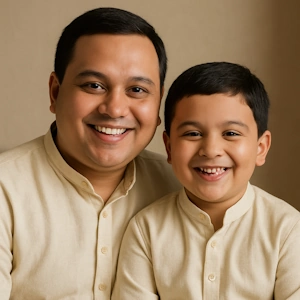
With the next mantra, the father takes the child into his own lap.
अस्मिन्नहं सहस्रं पुष्याम्येधमानस्स्वे वशे
Through this child, may I achieve thousand desires? All my desires, with a respect to a worthy, noble progeny, be achieved through this child. May he grow under my control — not as he wants. Following customs, being righteous, through the path shown by elders.
The desired path ahead for the child is clear. It is not a reckless life in the name of liberty. The growth envisaged here for the child is under the guidance of the father — the one that our wise elders have shown.
The next mantra is chanted by touching the child:
अङ्गादङ्गाथ्संभवसि हृदयादधि जायसे
आत्मा वै पुत्र नामासि स जीव शरदश्शतम्
You are born out of each and every organ of mine. That’s why the child resembles the father — not facial resemblance, the human form. This form is captured in the sperm. The connection with hridaya is that the birth has taken place under the prompt of kama, the seat of which is hridaya.
Then the father smells the head of the child with this mantra:
अश्मा भव परशुर्भव हिरण्यमस्तृतं भव
पशूनां त्वा हिंकारेण अभिजिघ्राम्यसौ
Ashma means stone — firm as a stone. Parashu means here durasadah, dushprapyah — difficult to attain, unique. Astritam hiranyam — become a shining gold, uncovered gold, shine forth, become famous.
You are myself. I realize that you are myself — myself who has taken another birth. I realize this. This is the relationship between father and son.
The sperm is the seed, which is taken from every organ of the father’s body. Don’t get confused with what biology says. Saliva is produced in the mouth. But can saliva reproduce or recreate another being? The sperm is not like that.
Sperm contains a code — whatever you call it, DNA or whatever. Sperm is a cell produced in the father’s body but unlike any other cell, sperm has a print, a blueprint of what it should develop into — into a human body, with two hands, two legs, two eyes, one mouth. That’s why it is said — angadangat sambhavasi — you are born from every organ of mine, as I am.
So the child is not just a copy of the father. The child is the father himself — another birth of the father. Father’s life continuing even after his death.
This the father realizes at the time of birth of the child itself. That’s why this mantra is here.
We are not talking about which diaper to buy, where to order the pram for the child from, where to buy the clothes from — online or offline, what all vaccinations to do — Hepatitis A, B, D, E — what not.
A great realization is being imparted to the father — that this child is not another being. It is you yourself. Don’t forget this.
This should take back the father to his connection with his own father.
Oh, then my father is me myself — he is not another being. Just as I take care of myself — my bodily needs, my mental needs — I should take care of my father’s also. If my father is hurt, I am myself hurt. He is not different from me.
Tell me one thing — did you ever know that such a great principle was there in this Jatakarma? In this simple ritual called Jatakarma, which is done maybe in fifteen–twenty minutes of time. Such an eye opener.
Pashunam tva hinkarena abhijighramyasau — you know how a cow would make a sound while smelling its calf? With a heavy breath it would sniff at its calf. That’s how the cow expresses its love towards its calf. The same is used in this mantra to show affection of the father towards the child.
Here, where the term asau comes, the name for the child as per the nakshatra in which he is to be kept.
Namakarana is another ritual. This is for nakshatra nama. For this, the nakshatra in which the child is born should be known. As per this, the nakshatra nama is kept.
So in the mantra where asau comes, you have to say the nakshatra nama:
रौहिणः
मार्गशीर्षः
माघः
चैत्रः
ज्येष्ठः
प्रोष्ठपादः
रैवतः
These are some of the nakshatra namas.
This nakshatra nama is secret. Nobody should know this nakshatra nama. It should be kept secret. The name kept during Namakarana is vyavaharika nama — the one meant for the world.
But nakshatra nama — nobody should know. This is like how others should not know about your horoscope. Your entire life will be revealed through the horoscope. When you are having weak time, others can take advantage of it.
Similarly, the nakshatra also should be kept hidden.





English
Rituals
Click on any topic to open
7
30
Astrology
Bhagavad Gita
Bhagavatam
Bharat Matha
Devi
Devi Mahatmyam
Ganapathy
Garuda Puranam
Glory of Venkatesha
Hanuman
Kathopanishad
Mahabharatam
Mantra Shastra
Mystique
Practical Wisdom
Purana Stories
Radhe Radhe
Ramayana
Rare Topics
Rigveda Explained
Rituals
Sages and Saints
Shiva
Spiritual books
Sri Suktam
Story of Sri Yantra
Temples
Vedas
Vishnu Sahasranama
Yoga Vasishta
26
17
10
0


