Jatakarma Can Be Performed Even for a Girl Child
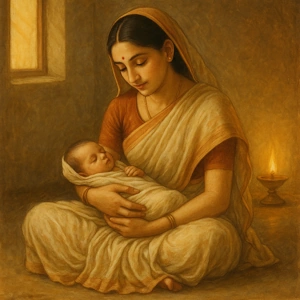
Earlier we had seen that Jatakarma is performed only for the male child. Some perform Jatakarma for the girl child also. In such cases, it is done without chanting the mantras. Because if you see the mantras, they are all addressing a son.
Especially after the ten days of impurity, when punyaha vachana is performed, some do Jatakarma for the girl child also — maybe the Namakarana also. A lot of these depend on convenience also these days.
What I mean to say is that from a welfare point of view of the child, there is no harm even if you do Jatakarma for a girl child. In such cases, the chanting of the corresponding mantras is avoided. Only what you call the tantra or the acts are performed — like taking into the lap, sniffing the head.
Again, as I had told before, we are only discussing this ritual as per Apastamba Grihya Sutra. From sutra to sutra there are variations in the procedure and mantras. Don’t think that if your purohita is following another procedure, it is wrong. Always follow what is your own Grihya Sutra.
Honey and ghee — small quantities, but unequal quantities — they are mixed in a kamsya patra. Kamsya means bronze. Darbha is tied around a piece of gold — like a coin or a ring — and then with this coin, that mixture of ghee and honey is given to the child. Basically, apply it on the child’s tongue.
All these can be done for the girl child also, without chanting mantras. Or if you are not following a particular Grihya Sutra, then there are gender-neutral Pauranika mantras which can be chanted. There are five mantras in this honey–ghee mixture prashana or feeding:
मेधां ते देवस्सविता मेधां देवी सरस्वती
मेधां ते अश्विनौ देवावाधत्तां पुष्करस्रजा
त्वयि मेधां त्वयि प्रजां त्वय्यग्निस्तेजो दधातु
त्वयि मेधां त्वयि प्रजां त्वयीन्द्र इन्द्रियं दधातु
त्वयि मेधां त्वयि प्रजां त्वयि सूर्यो भ्राजो दधातु
Prayer to Savita, Saraswathi, Ashwini Devas, Agni, Indra and Surya — that may they give you (tvayi) intelligence, children and grandchildren. Vamsha vriddhi should happen through this child. Brilliance, indriyas — healthy indriyas, sharp indriyas, like sharp vision, sharp hearing. Bhraja means deepti, again brilliance. May you shine forth in your life.
Why Savita and Surya separately? Because they represent different aspects of Surya. They are not synonyms. Here, prayer to Savita for intelligence, and prayer to Surya for brilliance.
Even when you look at their meaning:
सविता – सूते लोकादीन् इति सविता – he brings forth the universe, he creates the universe.
सूर्यः – सुवति कर्मणि लोकं प्रेरयति इति सूर्यः – he urges, he pushes the world to perform karma, he pushes the world into action.
How? Because he shows time, and all actions are time-bound.
See how much is there even in a name. Not so rigid also. Sometimes, they can be used in a different meaning by deriving the same term from another root.
Another interesting point – see the verb used – it is दधातु – not ददातु.
Why is this so?
त्वयि दधातु –
Had it been ददातु it would have been तुभ्यं ददातु — in chaturthi vibhakti.
Here it is in saptami. Why?
How does a mother feed an infant? She takes food and keeps in the child’s mouth. The child doesn’t receive it with its hand and put it in the mouth. Mother is keeping it in the mouth. It is not give and take. It is merely keeping, placing.
This is the difference between ददातु and दधातु.
ददातु means give — give to someone who has the capacity to accept, maybe by stretching the hand.
दधातु means, this child is too small to accept, even understand that something is being given. So you may simply keep/place all this — intelligence, strong indriyas, progeny, brilliance — upon this child.
Do you see the difference? See how much goes into all these. That’s what Veda is.
Even the type of knot used for tying darbha — even that is specified. It is called निष्टर्क्यम्.
निष्टर्क्यम् – शिखाबन्धनवत् सरन्ध्रेण ग्रन्थिना निष्टर्क्यं बध्नाति
The knot should resemble how the shikha is tied — with a hole in the middle.
Why so much of precision?
Why can’t you just take that gold coin, dip it in that honey and ghee mixture and give?
Why darbha? Why this particular knot?
These are specifications given by Acharyas who have written these procedural texts. They see much more than what a common man sees. If a ritual has to work, then all these are involved.
So much precision goes into it — in terms of the mantras used, even the terms and intent within the mantra, even the way a knot is tied.
So, when you say Jatakarma is for male child — don’t think it is gender inequality.
What is this — aren’t you bothered about the welfare of the female child?
This is all absurd immature thinking — because you don’t know how much of deep thought has gone behind these.
After this, the child is bathed with five mantras. We will see that later.





English
Rituals
Click on any topic to open
7
30
Astrology
Bhagavad Gita
Bhagavatam
Bharat Matha
Devi
Devi Mahatmyam
Ganapathy
Garuda Puranam
Glory of Venkatesha
Hanuman
Kathopanishad
Mahabharatam
Mantra Shastra
Mystique
Practical Wisdom
Purana Stories
Radhe Radhe
Ramayana
Rare Topics
Rigveda Explained
Rituals
Sages and Saints
Shiva
Spiritual books
Sri Suktam
Story of Sri Yantra
Temples
Vedas
Vishnu Sahasranama
Yoga Vasishta
26
17
10
0


