The 5-Layer Structure of Every Purana
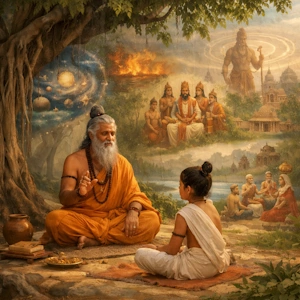
A Purana is not just a book of stories. It is a structured way of explaining the universe, time, beings, and dharma. If you study the five lakshanas in order, the whole design becomes clear.
Step 1: Understand creation through Sarga.
Sarga means the original creation. This is the starting point. Here the Purana explains how the universe arises. It speaks about the emergence of the elements, the worlds, the beings, and the cosmic arrangement. Without understanding Sarga, nothing else can be understood properly. Before asking who lived, what happened, or which avatar came, we must first know the stage on which all this happens. Sarga gives that stage. It answers the question: how did this world begin?
Step 2: Understand cycles through Pratisarga.
After creation, the next thing to understand is that the universe does not remain fixed forever. It goes through repeated cycles of dissolution and recreation. This is called Pratisarga. It teaches that cosmic existence is rhythmic. Worlds arise, dissolve, and arise again. This step is important because it removes the mistaken idea that creation is a one-time event. In Puranic thought, existence moves in cycles. So after learning how the world begins, the next lesson is how it renews itself again and again.
Step 3: Understand continuity through Vamsha.
Once creation and its repeating cycles are understood, the focus shifts to the beings living within that order. Vamsha means lineage. Here the Purana describes the dynasties of kings, sages, and divine families. This is not dry genealogy. It shows continuity. Dharma does not move through empty space. It moves through families, teachers, rulers, and descendants. Vamsha helps us see how values, duties, power, and responsibilities travel from one generation to another. So after understanding the world itself, we next understand the people who carry its history forward.
Step 4: Understand cosmic time through Manvantara.
Now we move from lineage to time. Manvantara means a great cycle ruled by a Manu. Each Manvantara has its own arrangement of beings, rulers, sages, and events. This step expands the student's mind. It shows that Puranic time is vast and organized. Things do not happen in a random way. They happen within larger time cycles. This helps us understand scale. Human history is only a small part of a much bigger cosmic process.
Step 5: Understand lived dharma through Vamshanucharita.
After understanding creation, cycles, lineages, and time, we finally arrive at detailed stories. Vamshanucharita means the narratives of those lineages. Here we see kings making choices, sages giving guidance, and Bhagavan intervening through avatars like Matsya and Kurma. This is where principles become real. Dharma is no longer theory. It becomes action, struggle, fall, recovery, and guidance.
So the teaching sequence is clear: first the universe, then its cycles, then its lineages, then its time structure, and finally its lived stories. That is how a Purana teaches. Not randomly. Systematically.
-
Why does a Purana begin with Sarga instead of stories directly?
Because without knowing the structure of creation, stories lose context. Sarga gives the stage, the laws, and the design of existence. Only after understanding the stage can one understand the meaning of actions performed on it. -
What deeper idea is hidden in Pratisarga beyond repetition?
It shows that nothing in the universe is permanent in its form. Everything moves in cycles. This removes fear of destruction and attachment to form. It reveals that change is built into existence itself. -
Why are lineages given so much importance in Vamsha?
Because dharma is not abstract. It is preserved and transmitted through people. Vamsha shows that values survive only when they are lived, protected, and passed forward consciously. -
What is the hidden purpose of Manvantara?
It expands the mind beyond human scale. It shows that what we call history is only a small segment. This reduces ego and makes one aware of a much larger order governing existence. -
Why are stories placed at the end as Vamshanucharita?
Because stories are meant to be understood after the principles are clear. Otherwise, they become entertainment. When placed last, they become demonstrations of dharma in action. -
What secret does the sequence of five lakshanas reveal?
It shows that knowledge must move from universal to personal. First understand the whole, then the cycles, then the carriers, then time, and finally individual action. -
Why does the Purana not treat creation as a one-time event?
Because reality is dynamic. By teaching cycles, it prevents rigid thinking and shows that renewal is constant and necessary. -
What is the role of Bhagavan’s avatars within this structure?
They are not random miracles. They appear at specific points within cycles, lineages, and time structures to restore balance and guide beings back to dharma. -
How does Vamsha connect to personal life today?
It reminds that one is part of a chain. Actions affect future generations. Responsibility is not limited to oneself but extends forward through time. -
What is the ultimate teaching behind all five lakshanas together?
That existence is ordered, purposeful, and interconnected. Nothing is isolated. Creation, time, beings, and actions are all part of a single designed system.
Objections and replies
-
Objection: These are just myths without any real basis.
Reply: The structure is not about literal events alone. It is a framework to understand existence, cycles, responsibility, and order. Its value lies in the clarity it gives, not just in historicity. -
Objection: There is no evidence for repeated creation cycles.
Reply: Even modern observation shows cycles in nature, seasons, birth and death. The Purana extends this principle to the cosmic level in a structured way. -
Objection: Lineages are irrelevant in modern times.
Reply: Even today, values, culture, and knowledge pass through families and institutions. Vamsha highlights this continuity, which still operates. -
Objection: Manvantara time scales are unrealistic.
Reply: They are meant to expand thinking beyond immediate perception. They train the mind to see existence beyond short-term limits. -
Objection: Stories are exaggerated and symbolic.
Reply: That is their strength. Symbolism allows deeper truths to be conveyed in a way that stays in memory and guides action. -
Objection: Avatars are fictional interventions.
Reply: Avatars represent moments when order is restored. Whether seen literally or symbolically, they express the principle that imbalance invites correction. -
Objection: The system is too complex to be practical.
Reply: The structure simplifies understanding. It moves step by step from basic to complex, making it easier to grasp the whole picture. -
Objection: These teachings are outdated.
Reply: The principles of cycles, responsibility, and order are timeless. Only the context changes, not the core ideas. -
Objection: There is no need for such structured knowledge.
Reply: Without structure, understanding becomes scattered. This system ensures clarity, continuity, and depth. -
Objection: Dharma is subjective, so these teachings cannot define it.
Reply: The Purana does not impose blindly. It shows dharma through examples, consequences, and continuity, allowing one to understand it through observation and reflection.





English
Purana Stories
Click on any topic to open
7
30
Astrology
Bhagavad Gita
Bhagavatam
Bharat Matha
Devi
Devi Mahatmyam
Ganapathy
Garuda Puranam
Glory of Venkatesha
Hanuman
Kathopanishad
Mahabharatam
Mantra Shastra
Mystique
Practical Wisdom
Purana Stories
Radhe Radhe
Ramayana
Rare Topics
Rigveda Explained
Rituals
Sages and Saints
Shiva
Spiritual books
Sri Suktam
Story of Sri Yantra
Temples
Vedas
Vishnu Sahasranama
Yoga Vasishta
26
17
10
0


