How and Why Avatars Appear
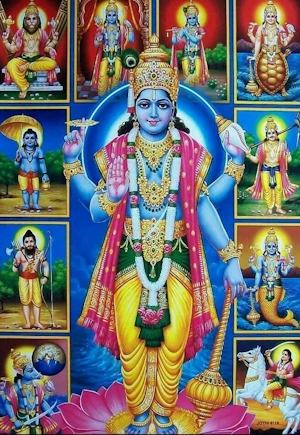
Avatars do not appear randomly. Each form that Bhagavan takes has a clear cause. When the balance of the world is disturbed, when dharma weakens, and when confusion spreads among beings, Bhagavan responds. This response is not abstract. It takes a visible form. That is what an avatar is.
The Purana introduces this idea carefully. First it explains creation, cycles, and lineages. Only after this foundation does it move into the question: why does Bhagavan take form at all? The answer is practical. The universe runs on order. When that order breaks, correction is required. But correction cannot always happen from a distance. It must enter the system itself.
This is where avatars like Matsya come in. During a time of great disturbance, knowledge itself was at risk. The Vedas, which guide creation and dharma, were about to be lost. Bhagavan took the form of a fish. Not a random form. A form suited to the situation. The threat was connected to waters and dissolution. So the response also came through water. Matsya protected the knowledge and guided it safely through the chaos.
The same principle applies to other forms like Kurma. When stability was needed, Bhagavan became the support. When strength was needed, Bhagavan became power. The form always matches the need. This is the key point. Avatars are not symbolic decorations. They are functional responses.
There is also a deeper layer. Bhagavan does not take form because He is limited. He takes form because beings are limited. Humans understand through form, action, and story. If truth remains only abstract, it cannot guide daily life. By appearing within creation, Bhagavan makes dharma visible. People can see, hear, and learn from direct examples.
The Purana uses these avatar narratives to bridge philosophy and life. Earlier sections explain concepts like creation and time. But those remain distant. Through avatars, those same principles become active. A king can see how dharma is protected. A seeker can see how knowledge is preserved. A common person can see how right action works in difficult situations.
Another important point is timing. Avatars do not appear constantly. They appear when needed. This shows that the system has a natural order. Bhagavan intervenes when imbalance crosses a limit. This keeps both freedom and order intact. Beings are free to act, but when actions create large-scale disorder, correction comes.
So the explanation of avatars is not just storytelling. It is a logical extension of the Purana’s structure. First understand the world. Then understand its cycles. Then understand the beings within it. Then understand time. And finally, understand how Bhagavan interacts with all of this.
Avatars like Matsya are the entry point where the divine meets the practical world. They show that dharma is not left alone. It is protected, restored, and guided whenever required. This is the real purpose behind every avatar.
Question 1
Why does Bhagavan choose to enter creation instead of remaining separate?
Bhagavan enters creation because correction from outside does not influence inner behavior. Real change happens only when guidance appears within the system itself, where beings can observe and respond directly.
Question 2
What makes an imbalance serious enough to require an avatar?
Not every disturbance leads to an avatar. Only when imbalance spreads across systems and begins to distort collective understanding of dharma does intervention become necessary.
Question 3
Why are avatars often connected to preservation of knowledge?
Because knowledge is the foundation of right action. When knowledge collapses, even well-intentioned beings act wrongly. Protecting knowledge ensures long-term stability.
Question 4
What is the hidden intelligence behind selecting time and place of an avatar?
An avatar does not appear randomly. It appears where the impact will be maximum. Timing and location are chosen so that correction spreads efficiently through the system.
Question 5
How do avatars influence people beyond direct interaction?
Even those who never directly meet an avatar are influenced through the ripple effect of actions, teachings, and restored systems. The impact is wider than visible contact.
Question 6
Why do avatars withdraw after completing their purpose?
Continuous presence would create dependency. Withdrawal ensures that beings learn to sustain dharma on their own after correction is made.
Question 7
What is the relationship between avatars and cosmic order?
Avatars act as stabilizers. They do not create a new system. They restore the existing order when it becomes distorted.
Question 8
Why do avatar stories focus on specific events instead of full life details?
The focus is always on moments of decision and correction. These moments carry the highest teaching value. Everything else is secondary.
Question 9
What is the deeper meaning of Bhagavan taking different forms repeatedly?
It shows adaptability. The same truth expresses itself differently based on context. This teaches flexibility in applying dharma.
Question 10
What is the unseen continuity between different avatars?
Each avatar is not isolated. They form a continuous chain of corrections across time, maintaining balance through different cycles.
Objection 1
If avatars restore balance, why does imbalance return again?
Reply
Because the system is dynamic. Balance is maintained, not permanently fixed. Reappearance of imbalance shows that the system allows movement and change.
Objection 2
Why are avatars described differently in various traditions?
Reply
Descriptions vary because perspectives vary. Each tradition emphasizes what is relevant to its context, while the underlying principle remains unchanged.
Objection 3
Why do avatars not eliminate all wrong actions permanently?
Reply
Eliminating all wrong action would remove freedom. The goal is correction, not permanent control over every action.
Objection 4
Why are some avatars more well-known than others?
Reply
Recognition depends on impact and preservation of records. Some events are documented widely, while others remain less known.
Objection 5
Why is there no single clear proof accepted by everyone?
Reply
Different people require different standards of proof. Avatars operate within a framework that includes both experience and interpretation, so universal agreement is not expected.
Objection 6
Why do avatars not directly teach everyone at the same time?
Reply
Teaching spreads through layers. Direct teaching to a few creates a chain of transmission. This allows deeper understanding rather than shallow mass instruction.
Objection 7
Why are avatar narratives sometimes difficult to interpret?
Reply
They are layered. Surface meaning gives story, deeper levels give principles. Difficulty comes from trying to read them only at one level.
Objection 8
Why do avatars not prevent future decline after they leave?
Reply
Prevention would require constant control. Instead, avatars restore balance and leave tools and knowledge for beings to maintain it.
Objection 9
Why do some people reject the idea of avatars completely?
Reply
Rejection often comes from expecting material proof alone. The concept of avatars operates across both material and philosophical levels.
Objection 10
Why do avatars appear connected to specific cultures?
Reply
They appear where the need arises. Cultural context shapes how the event is recorded and remembered, not the principle behind it.





English
Purana Stories
Click on any topic to open
7
30
Astrology
Bhagavad Gita
Bhagavatam
Bharat Matha
Devi
Devi Mahatmyam
Ganapathy
Garuda Puranam
Glory of Venkatesha
Hanuman
Kathopanishad
Mahabharatam
Mantra Shastra
Mystique
Practical Wisdom
Purana Stories
Radhe Radhe
Ramayana
Rare Topics
Rigveda Explained
Rituals
Sages and Saints
Shiva
Spiritual books
Sri Suktam
Story of Sri Yantra
Temples
Vedas
Vishnu Sahasranama
Yoga Vasishta
26
17
10
0


