Ojastejodyutidharah Prakashatmaa ...
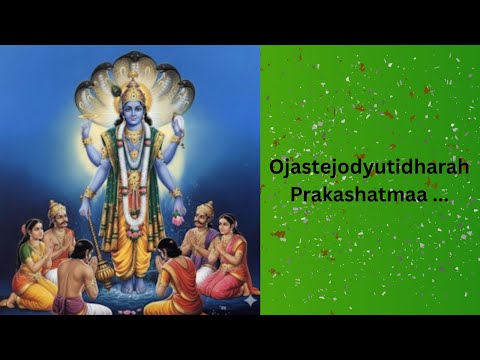
We are exploring the boundless ocean of wisdom that is the Vishnu Sahasranamam. With every name, we uncover a new facet of the Supreme Lord, a new perspective on the reality that permeates all of existence.
Today, we will immerse ourselves in a shloka that is a symphony of light, energy, and clarity. It describes the very essence of the Divine as a force of brilliance and power, yet also one of profound peace and precision.
First, let us listen to the verse in its original Sanskrit:
ओजस्तेजोद्युतिधरः प्रकाशात्मा प्रतापनः ।
ऋद्धः स्पष्टाक्षरो मन्त्रश्चन्द्रांशुर्भास्करद्युतिः ॥
This verse is like a prism, taking the singular white light of the Divine and revealing a spectacular spectrum of its attributes. Let's delve into the deep meaning of each of these beautiful names.
The first name is ओजस्तेजोद्युतिधरः (Ojas-tejo-dyuti-dharah).
This is a magnificent compound name, a fusion of three types of energy and the one who holds them. Let's break it down.
- ओजस् (Ojas): This is the essential life-force or vitality that pervades a living being. It is the core energy that governs our immunity, our strength, and our mental vigor. Lord Vishnu is the bearer of the Ojas that animates the entire universe.
- तेजस् (Tejas): This means brilliance, spiritual fire, might, and valor. It’s the inner fire of courage and wisdom. The Lord is the ultimate source of this Tejas, which empowers the gods and illuminates the minds of the sages.
- द्युति (Dyuti): This translates to a gentle radiance or a beautiful effulgence. Think of the soft glow of the moon or the captivating luster of a precious gem. It represents beauty and divine charm.
And the final part of the name is धरः (Dharah), which means 'the bearer.'
So, ओजस्तेजोद्युतिधरः means: He who is the bearer and ultimate source of all life-force, all spiritual fire, and all divine radiance.
The next name is प्रकाशात्मा (Prakāśātmā).
This is a name of profound philosophical depth. It means, 'He whose very nature, whose very Self, is light.' Think about it. We use light to see other objects, but light itself needs no other source to be seen. It is self-luminous. The Lord is described in the same way. He is not merely luminous; He is light itself. This is the light of pure consciousness, the ultimate reality that dispels the darkness of ignorance.
Following this, we have the name प्रतापनः (Pratāpanaḥ).
This name means 'The one who provides warmth or heat.' It has two beautiful aspects. On one hand, as the sun, He provides the warmth that sustains all life. For his devotees, He provides the warmth of His grace and protection. On the other hand, He scorches evil and injustice with his fiery power. This name reminds us that the Divine energy is both creative and destructive—all in the service of upholding Dharma.
Next, we come to the name ऋद्धः (Ṛddhaḥ).
This means 'The one who is supremely abundant and prosperous.' This is not just material wealth. The Lord is completely full and perfect in every conceivable quality: knowledge, glory, strength, virtue, beauty, and dispassion. There is nothing He lacks; He is absolute completeness in Himself.
The next name is स्पष्टाक्षरः (Spaṣṭākṣaro).
This wonderfully layered name has two key meanings, stemming from the word अक्षर (Akshara).
- First, अक्षर can mean a syllable. In this sense, the name means His words and teachings, like the Vedas, are perfectly clear and unambiguous. He is the clear manifestation of the sacred syllable 'Om'.
- Second, अक्षर means imperishable. The name also means, 'He who is the clearly manifest, imperishable Truth.' For a seeker with a pure heart, His true nature is not hidden or complex; it is a clear, self-evident reality.
Then comes the name मन्त्रः (Mantraḥ).
The classic definition of a mantra is 'Mananāt trāyate iti mantraḥ'—'That which protects or liberates when contemplated upon.' Lord Vishnu is Himself the Mantra. Chanting His name is the greatest mantra that frees us from the fears and sorrows of this world. He is the life-force and the power behind every sacred formula.
And now we come to the final pair of names in this verse, which present a beautiful, divine balance.
The first is चन्द्रांशुः (Candrāṁśu).
'Chandra' is the moon and 'Amshu' is a ray. The name means, 'He who is like the rays of the moon.' This reveals the compassionate and soothing aspect of the Lord. For souls scorched by the heat of worldly troubles, His grace is like the cool, calming rays of the moon, bringing peace and solace.
And to complete the verse, the final name is भास्करद्युतिः (Bhāskaradyutiḥ).
'Bhaskara' is the Sun, and 'Dyuti' is brilliance. So, the name means, 'He whose brilliance is like that of the Sun.' This brings us back to His supreme, dazzling, and effulgent nature. He is simultaneously as powerful as the sun and as gentle as the moon. He is the moon for His devotees and the sun for the wicked.
So, in this one verse, we have journeyed through the multifaceted nature of the Divine's light. He is the holder of all energy, His very being is light, and He is the ultimate source of warmth and coolness. He is complete and abundant, His nature is clear and indestructible, and His essence is the mantra that saves us.
By meditating on these names, we invite that very light, that energy, and that divine balance into our own lives.





English
Vishnu Sahasranama
Click on any topic to open
7
30
Astrology
Bhagavad Gita
Bhagavatam
Bharat Matha
Devi
Devi Mahatmyam
Ganapathy
Garuda Puranam
Glory of Venkatesha
Hanuman
Kathopanishad
Mahabharatam
Mantra Shastra
Mystique
Practical Wisdom
Purana Stories
Radhe Radhe
Ramayana
Rare Topics
Rigveda Explained
Rituals
Sages and Saints
Shiva
Spiritual books
Sri Suktam
Story of Sri Yantra
Temples
Vedas
Vishnu Sahasranama
Yoga Vasishta
26
17
10
0


