Story of Gajendra Moksha
प्राणः – प्राणितीति प्राणः – that which blows, the life force, air, Sri Hari is the life force.
'सर्वाणि हवा इमानि भूतानि प्राण-मेवाभिसंविशन्ति प्राणमभ्युज्जिहते'
सर्वभूतोत्पत्तिप्रलयहेतुरूपलिङ्गात् ब्रह्मण एव प्राणशब्दवाच्यता
Prana means parabrahma, paramatma. All these beings, they enter into prana, they dissolve into prana at the time of pralaya. They also emerge out, spring back out of prana only at the time of creation. This is what parabrahma is. Hence prana means parabrahma, paramatma. Being the origin and end of all beings, parabrahma is called prana.
The pancha pranas in the body – prana, apana, vyana, udana and samana – which are the driving forces of all the activities within the body such as respiration, excretion, digestion, energy distribution, circulation – they are all his own various forms only. He is behind all these pranas. Why pancha pranas, even the other five upa pranas. They are him only.
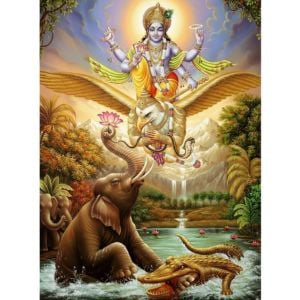
There was a king called Indradyumna, a staunch devotee of Bhagavan. Once, he was immersed in meditation. That time sage Agastya came in. Indradyumna did not notice him. The sage was offended. He cursed that you will be born as an elephant.
Indradyumna became an elephant, a leader of elephants. There was a water body in the forest, with a lot of lotuses in it. One day, when the Gajendra got into it, a crocodile caught him by his foot. Gajendra tried everything to release himself from the grip of the crocodile. The crocodile was very strong. They pulled at each other for thousand years. Gajendra thought of himself as strong and powerful. After all he was the king of elephants. Everybody was scared of him. But, even after thousand years, he could not become free.
He realized his helplessness. He took refuge in Bhagavan. He realized that he was wrong to be arrogant of his strength and false notion of self-sufficiency. He started taking the lotuses one by one and performing archana of the Lord. He kept on doing this with an attitude of surrender, of complete surrender.
In some time, Bhagavan appeared mounted on his Garuda and, with his Sudarshana chakra, cut the crocodile into two pieces. He gave the Gajendra the position of his parshada, sarupya. The crocodile was a gandharva who became a crocodile because of a curse. He also went back to swarga loka.
This is also a beautiful analogy. Gajendra is man – proud of his own capabilities, his own power, proud to the extent of arrogance, who thinks that he can achieve everything, do everything by his own capability. The water body is the world, samsara. The crocodile is vasanas, desires, worldly delusions. He gets caught in them and, even after thousand years of struggle, not able to come out.
The means of release are also available in the samsara itself – the lotuses, performing archana with them, sadhana, with an attitude of surrender, sharanagati. And, when that is done with sincerity, Bhagavan Shri Hari takes over.





English
Vishnu Sahasranama
Click on any topic to open
7
30
Astrology
Bhagavad Gita
Bhagavatam
Bharat Matha
Devi
Devi Mahatmyam
Ganapathy
Garuda Puranam
Glory of Venkatesha
Hanuman
Kathopanishad
Mahabharatam
Mantra Shastra
Mystique
Practical Wisdom
Purana Stories
Radhe Radhe
Ramayana
Rare Topics
Rigveda Explained
Rituals
Sages and Saints
Shiva
Spiritual books
Sri Suktam
Story of Sri Yantra
Temples
Vedas
Vishnu Sahasranama
Yoga Vasishta
26
17
10
0


