Sri Hari as Vishnu and Mahadeva as Digambara Are One and the Same
शर्वः –
शृणाति संहरति संहारयति सकलाः प्रजाः इति शर्वः
At the time of pralayā, he ends (saṁharati), he causes to end (saṁhārayati) all beings. Causes to end means through his own aspect called Rudra.
स्वशरीरभूतानामशुभं शृणातीति शर्वः – He ends, destroys the aśubha. शृणाति means destroys.
His body, his own creation, the universe — he removes all miseries, inauspiciousness, grief from it. Hence Shri Hari is Sharva.
Sharva is a name commonly used for Lord Mahadeva.
Time and again, in every scripture, this fact has been highlighted — that Sri Hari and Mahadeva are not different from each other. But our ignorance has no limits.
We still are susceptible to the propaganda that they are different.
When every name of Sri Hari says that there is nothing in the universe but him, where is the question of a smaller god or a demigod?
Brahma Vaivarta Purana says both Srimannarayana and Mahadeva have originated from Lord Krishna.
It says Rudra is the left side of Sri Krishna.
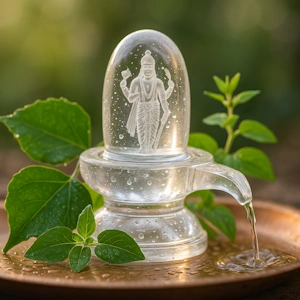
He had the brilliant lustre of clear crystal — at the time of his origin from the left of Sri Krishna Paramatma’s body, he had the brilliant lustre of clear crystal.
This is why worship of sphatika linga is very auspicious.
Sri Hari’s this aspect — called Mahadeva — had five faces, and he was Digambara — he wore the entire space as his cloth.
Digambara means what — the directions were his clothes. Clothes are the limits of your body, the boundaries of your body. Clothes are beyond your own body. Clothes are at the periphery of your body.
The ten directions are his body — means, he filled everything inside of the ten directions.
Up to as far as you can visualize, Mahadeva filled everything.
It is the same attribute that we talk of about Sri Hari.
So when the scripture says, Sri Hari fills the universe — he is Vishnu, vyāpanāt viṣṇuḥ —
And again when it says Mahadeva is Digambara, he fills everything in the ten directions up to infinity —
Directions are endless. There is no boundary to any direction. You can keep on going in any direction —
So when it says Mahadeva also is Digambara, fills the entire universe —
We should have that much common sense that they are not different from each other.
Some people sulk when these names — Sharva, Shiva, and Sthāṇu — come within Vishnu Sahasranāma.
Where these names have come inside Vishnu Sahasranāma —
Is my copy adulterated? Adulterated by the Shaivas?
Mahadeva, when he came out from Sri Krishna Paramatma’s body, he had a jata which had the color of heated-up gold.
The three eyes were present in all the five heads, so he had fifteen eyes put together.
He was the lord of mrityu. Mrityu became subservient to him.
Mrityu only obeys his orders. He says end — and mrityu ends.
So, Rudra is that aspect of Sri Hari which causes saṁhāra.
Just before describing the origin of Mahadeva from Sri Krishna, the Purana says Srimannarayana also originated from Sri Krishna.
That we have no problem — that is acceptable.
But when it comes to Lord Shiva — we find it difficult to comprehend.
This is dullness of the mind.
When the scriptures divided the Parama Purusha into Brahma, Vishnu, and Shiva, they didn’t mean to divide — they meant to unite.
They wanted to show that they all came from the same source, and they are not different.
And we ended up dividing ourselves.
Thank God Brahma is not worshipped anymore, otherwise we would have had one more fanatic sect.
These propagandists are like people who watch the movie up to interval, come out and go around telling the story.
They don’t know the whole story. They don’t want the whole story.
Because when you know the whole story — there is no conflict, there is no controversy.
There is no fun.
The thrill that comes out of bad-mouthing, gossiping, ridiculing — is gone.
And see — they don’t even spare God.
Bad-mouthing, gossiping about, ridiculing everyone around is over — no fun anymore.
They catch the God himself.
Take one aspect of him and start the same.
Even God is not spared.
So, Rudra is that aspect of Sri Hari who is permanently in the state of complete knowledge and bliss — because he causes the prapañcha to end.
Prapañcha is only an experience, which is unreal. He causes this to end.
And then he remains as the complete knowledge — as compared to incomplete knowledge, which is world experience.
He exists as complete knowledge in the state of ānanda.
This aspect of Sri Hari — called Rudra — alone gives that state, that state of complete knowledge and bliss — which happens when saṁhāra of ignorance, saṁhāra of the virtual reality called prapañcha ends.
Prapañcha is only virtual reality.
When man can create virtual reality through devices, isn’t God capable of this?
Prapañcha is only virtual reality.
And he ends this virtual reality by showing us that — look, this is only a device. What you are experiencing is not true.
We were born hooked on to these devices — these devices of virtual reality — which we never knew.
And we go on thinking that they are for real.
Sri Hari blissfully shows us these devices — which through our sensory organs cause the illusion of world to us.
This aspect of Sri Hari which ends this illusion is called Sharvaha — or Mahadeva Rudra.
alright — brand-new set, tightly on theme: unity of Sri Hari and Mahadeva, samhara, prapanch as VR-like appearance, sharing, and humility. no recycled templates.
-
Why does the name ‘Sharva’ sit inside Vishnu Sahasranama without conflict?
Names map attributes, not separate rivals. One reality shows a ‘destroyer of impurity’ aspect as Sharva and a ‘pervader’ aspect as Vishnu. Attribute shifts; substratum stays one. -
What does ‘directions as clothing’ (digambara) teach about the ego?
Clothes mark boundaries. If space itself is the garment, boundaries dissolve. Practically, hold a wide mind; drop the urge to reduce Bhagavan to your side. -
If prapancha is VR-like, what is the ‘headset’ and where is the ‘logout’?
The senses and a restless mind are the headset. Logout is viveka plus nama-japa: see the screen for what it is, then place awareness on the One wearing all roles. -
How do I practice samhara of ignorance without becoming harsh with people?
Subtract false labels in your speech: ‘ours vs theirs’, ‘higher vs lower’. Keep courtesy. Burn the error, not the person. -
Can a Vaishnava use a sphatika linga and still be faithful to Vishnu?
Yes. You are honoring the same One through a ‘purity and clarity’ symbol. Anchor intention: ‘Sri Hari, the remover of inauspiciousness, I worship you.’ -
What changes in the body when this unity vision starts to settle?
Breath lengthens, jaw unclenches, pulse steadies after stress, and sleep deepens. Calm physiology signals that grasping is loosening. -
How do couples keep sect rivalry out of the home?
One deepa, two names in the same sankalpa, alternating stotras, zero sarcasm about each other’s practice. Respect is the yajna fuel. -
What can children be shown so they grasp ‘two names, one power’?
Water and waves: one bowl of water labeled ‘Bhagavan’, draw waves named ‘Vishnu’ and ‘Shiva’. Two flowers to one diya. Let understanding grow through play. -
How should meals reflect both sustenance and samhara?
Offer the first morsel mentally, eat clean, and stop before excess. You honor the giver and ‘end’ the urge to over-consume. -
What micro-practice ties the two names without confusion?
Four breaths of ‘Om Namo Narayanaya’, four of ‘Om Namah Shivaya’, then sit one minute in silence. Principle: one presence, many doors. -
When two festivals overlap, how do I choose without anxiety?
Follow family parampara for sequence, hold a single sankalpa: ‘O One, worshiped by these names, accept this.’ Unity first, calendar next. -
How do I read texts without drifting into camps?
Track equivalence lines: where a text identifies the One as the doer, knower, and substratum. Keep an ‘equivalence notebook’ of such verses. -
If the world is appearance-like, why still care for health?
The body is a mandir and instrument of sadhana. Lakshmi honors order — regular sleep, unprocessed food, steady movement, clean breath. -
What stops online family fights about ‘my deity vs yours’?
Refuse mockery forwards, share a verse on unity, propose a joint japa count. Replace heat with shared practice. -
How does humility operate when the intellect wants to ‘test’ the divine?
Switch from audit to witness. Acknowledge limits, continue practice, and let insight arise rather than be forced. -
Where does Lakshmi flow when rivalry drops?
Into sufficiency: bills paid on time, fewer impulse buys, tidier rooms, and warmer mealtimes. Order outside mirrors order inside. -
What is a clean daily rule for any action in this path?
If it reduces ego, increases compassion, and keeps discipline, do it. If it feeds pride or contempt, drop it — however ‘religious’ it looks.





English
Vishnu Sahasranama
Click on any topic to open
7
30
Astrology
Bhagavad Gita
Bhagavatam
Bharat Matha
Devi
Devi Mahatmyam
Ganapathy
Garuda Puranam
Glory of Venkatesha
Hanuman
Kathopanishad
Mahabharatam
Mantra Shastra
Mystique
Practical Wisdom
Purana Stories
Radhe Radhe
Ramayana
Rare Topics
Rigveda Explained
Rituals
Sages and Saints
Shiva
Spiritual books
Sri Suktam
Story of Sri Yantra
Temples
Vedas
Vishnu Sahasranama
Yoga Vasishta
26
17
10
0


