Ambareesha Saw Sri Hari Even in a Demoness
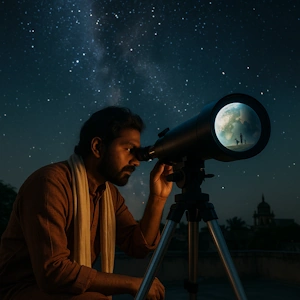
भूतभव्यभवत्प्रभुः – भूतं – PAST, भव्यं – FUTURE, भवत् – PRESENT.
प्रभु – THE LORD OF THESE THREE.
कालत्रयवर्तिनां स्वामी – LORD OF ALL THAT EXISTED IN THE PAST, EXIST AT PRESENT, AND WILL EXIST IN THE FUTURE.
This is yet another maya – to make you function, time is divided into past, present, and future.
Light travels at the speed of three hundred thousand kilometers per second. One light year is the distance that light travels in a year. So far, we have discovered a galaxy called MACS0647-JD which is 13.3 billion light years away from us. That means light leaving that galaxy would reach our eyes after 13.3 billion years. Forget that big figure.
Let us say another earth is 50 light years away from our earth. How do we see something? When light produced by or reflected by that object reaches our eyes. If the object is close by, you will not even notice the time that light takes to travel from the object to our eyes.
It takes light 8 minutes and 20 seconds to travel from the sun to the earth. That means when you see a sunset, it has already taken place 8 minutes and 20 seconds earlier. The sunset that you are seeing is not real-time. It has already happened in the past and you are seeing it and believing that it is happening right before your eyes.
In the same way, you are looking at the earth that is 50 light years away with a telescope and you see a newborn child. But what you are seeing is what was there 50 years back, because the light that has reached your eyes now is the light that left the other earth 50 years back. By now the child is grown up, married, and has a 24-year-old son and a 22-year-old daughter. He will soon be a grandfather.
So what is past and what is present? It is again a limitation – in this case, a limitation imposed by the speed of light. Albert Einstein said that the separation between past, present, and future is only an illusion, although a convincing one. The same as what our scriptures say – time is maya.
Sri Hari has absolute control over this maya, because maya is his own creation. Out of this maya he created the universe. So he is called Bhutabhavyabhavat Prabhu.
There was a king called Ambarisha. He, along with his wife, observed Ekadashi vrata for one year. On completion of this, puja of Sri Hari was organized in a grand way.
At the end of upavasa, parana is to be taken –
पारणं पावनं पुंसां सर्व्वपापप्रणाशनम् ।
उपवासाङ्गभूतञ्च फलदं शुद्धिकारणम् ।
The first meal taken after the upavasa is called parana. Taking this meal is as important as doing the upavasa. Parana has great purifying power.
Towards the end of the puja, Maharshi Durvasa arrived. Durvasa is famous for his short temper. Ambarisha offered respects to him and requested him to have food. Durvasa said he would take bath and come back, and left towards Yamuna nadi.
Only a few minutes were left in Dwadashi. If parana is not taken during Dwadashi, then the upavasa is broken and it will not yield any result. The king got worried – what if the Maharshi got late? But to take food before the offering to the guest is improper. It was a dilemma.
As per the advice of scholars present, Ambarisha took a little bit of the charanodaka of Sri Hari and completed the parana thus, and then waited for Durvasa to come back.
Durvasa, with his tapa shakti, immediately came to know that the king had taken parana when he was gone for taking bath. He was infuriated. What an insult! He pulled out a hair from his jata and threw it on the ground. From that hair came out a terrible demoness. She rushed towards the king to kill him.
Ambarisha was unperturbed. He was a real devotee. He could see only Sri Hari everywhere. Even in that horrifying form approaching to kill him, he could see only Sri Hari.
Bhagawan’s Sudarshana chakra came for the king’s protection. Sudarshana chakra burned the demoness to ashes and turned towards Durvasa. Maharshi started running in fear for his life. Who could help him?
The Lokapalas and even Indra said no. Who could protect him from Bhagawan’s chakra? Lord Shiva said – go to Sri Hari.
Durvasa rushed to Vaikuntha and fell on Sri Hari’s feet. Bhagawan said – I am helpless. I am bound by the devotion of my devotees. I am not in a position to help you. I am not acting on my own. You put a devotee in trouble. This Sudarshana chakra is chasing you on its own. I have no control over it. You go to Ambarisha and ask for mercy.
Ambarisha was equally worried. Durvasa had to run away because of him. He went away without having food. He had only made him angry.
Durvasa came back running after one whole year. The chakra was still chasing him. As Durvasa begged for mercy, Ambarisha felt very embarrassed. The great sage was asking him for mercy. He started praising Sudarshana chakra. The chakra was pacified and it disappeared.
That is the power of bhakti. That is the power of a bhakta.
-
Is time really divided, or is that just how we operate day to day?
Time feels split because our minds and senses work in sequence. In reality, what we call past and present depends on how long light takes to reach us. -
If light takes time to travel, what am I actually seeing right now?
You are seeing delayed snapshots. Near things look almost live; far things are old news by the time their light reaches you. -
Why do sunsets prove that my senses lag behind reality?
The sun you see near the horizon has already moved. Your eyes receive light that left minutes earlier. -
Does this delay make past, present, and future less absolute?
Yes. The boundary is softer than it feels. Observation is chained to signal speed, not a perfect clock. -
So what anchors truth if perception is delayed?
Truth rests on what is, not just on what is seen. Perception needs context, not blind trust. -
What does it mean to say the universe runs on maya?
It means appearances hold you, but they do not have the final say. Reality is deeper than what the senses report. -
How can devotion override terrifying appearances?
A steady mind fixed on the divine refuses panic. Fear loses grip when vision stays centered. -
Why is taking parana after a fast treated so seriously?
The closure seals the vow. Without it, the effort remains incomplete. -
What should one do when two duties clash, like hospitality and a vow?
Choose the path that honors both in spirit. Minimal, lawful action that completes the vow while keeping respect is the way. -
Is anger a sign of strength in a sage or a crack in discipline?
It is a crack. Power without restraint turns on its owner. -
Why do stories give divine weapons a will of their own?
To show that cosmic law runs impartial. Justice does not bend to status. -
Can a devotee’s sincerity really change the course of danger?
Yes. Pure intention and surrender calm forces that raw power cannot. -
What lesson sits at the heart of the chase-and-forgiveness arc?
Humility ends what pride begins. Seeking pardon closes loops that force cannot close. -
Why is seeing the divine in an enemy considered the highest vision?
Because it ends otherness at the root. When the heart sees unity, hatred finds no seat. -
Does spiritual freedom cancel cause and effect?
No. It places you above panic while you honor cause and effect with clarity. -
What protects better in a crisis: ritual detail or inner steadiness?
Inner steadiness. Ritual thrives when the heart is firm. -
How should power be used when you are in the right?
With mercy. Victory without compassion leaves a stain. -
What does it actually mean to say the divine is lord of past, future, and present?
It means the source stands outside the clock, while holding every moment within reach.





English
Vishnu Sahasranama
Click on any topic to open
7
30
Astrology
Bhagavad Gita
Bhagavatam
Bharat Matha
Devi
Devi Mahatmyam
Ganapathy
Garuda Puranam
Glory of Venkatesha
Hanuman
Kathopanishad
Mahabharatam
Mantra Shastra
Mystique
Practical Wisdom
Purana Stories
Radhe Radhe
Ramayana
Rare Topics
Rigveda Explained
Rituals
Sages and Saints
Shiva
Spiritual books
Sri Suktam
Story of Sri Yantra
Temples
Vedas
Vishnu Sahasranama
Yoga Vasishta
26
17
10
0


