Sarada Devi: The Holy Mother
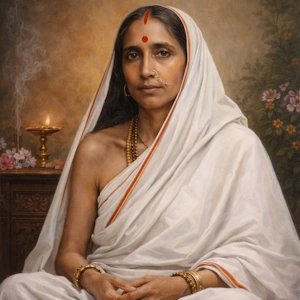
Sarada Devi is known to her devotees as the Holy Mother. She was the spiritual consort and wife of the great saint Sri Ramakrishna Paramahamsa. But her identity goes far beyond that of a wife. She was a realized soul in her own right, a teacher, a mother figure to thousands, and a living example of what spiritual life looks like in its simplest and purest form.
The Early Years and Her Marriage
Sarada Devi was born on December 22, 1853, in a small village called Jayrambati in Bengal. Her family was poor but deeply religious. From childhood, she was known for her gentle nature and her quiet inclination toward devotion.
She was married to Sri Ramakrishna Paramahamsa at a very young age, as was the custom in rural Bengal at that time. But this was no ordinary marriage. Sri Ramakrishna Paramahamsa had already taken a vow of complete renunciation and was deep in spiritual life. From the very beginning, their relationship was built on spiritual companionship, not on the usual expectations of married life.
When she came to live with him at the Dakshineshwar temple, she did not come merely as a wife. She came as a student and a seeker.
Thirteen Years of Sadhana
First, understand the context. Sadhana means spiritual practice. It requires discipline, surrender, and sustained inner effort. Sarada Devi practiced under the direct guidance of Sri Ramakrishna Paramahamsa for thirteen years.
She did not learn from lectures or books. She learned through daily living. She absorbed his teachings by watching him, serving him, and following his guidance with complete dedication.
Sri Ramakrishna Paramahamsa guided her through deep tantric and Vedantic practices. He also performed a special worship called the Shodashi Puja, in which he worshipped her as the Divine Mother herself. This was a profound recognition. He was saying, in his own way, that she was not merely his student. She was a manifestation of the Divine.
She reached what the tradition calls the highest degree of spiritual realization. This means she did not just understand spiritual truth as an idea. She experienced it directly. She lived in it.
The Quiet Force Behind the Movement
After Sri Ramakrishna Paramahamsa passed away in 1886, many expected the movement he had built to lose its direction. The disciples were young. The work was vast. The world was large.
Here is what actually happened. Sarada Devi became the quiet, steady force that held everything together. She never gave public speeches. She did not manage institutions. Yet for nearly thirty-four years after his passing, she was the invisible pillar of the entire Ramakrishna movement.
Swami Vivekananda and the other monks treated her with the highest reverence. They came to her for guidance, blessings, and clarity. She gave initiations. She accepted disciples from all walks of life, including people of different castes, backgrounds, and even those whom society had rejected.
There is an important detail here. She once said that she had not come to this world to eat and sleep. She came to serve. That spirit of selfless service defined every year of her life after the passing of Sri Ramakrishna Paramahamsa.
What She Was Like as a Person
Those who met her described the same things again and again. Grace. Simplicity. Warmth. An extraordinary inner stillness.
She lived without any display of greatness. She cooked. She cleaned. She sat with ordinary people and listened to their troubles. Yet in her presence, people felt deeply seen and deeply at peace.
Sister Nivedita, the Irish disciple of Swami Vivekananda and one of the most perceptive observers of this movement, described Sarada Devi's life as one long stillness of prayer. That is a precise description. Her life was not marked by dramatic events or public acts. It was marked by a continuous inner prayer that expressed itself in everything she did.
Sister Nivedita also spoke of her great open mind. Sarada Devi had no narrowness in her. She accepted people with a breadth that was almost startling. When someone once asked her about a notorious dacoit who had sought her protection, she said simply that he was her son just as much as anyone else. That was not a performance of kindness. That was how she genuinely saw the world.
She also possessed what Nivedita called unerring intuition. She could read a person's spiritual state and inner need without effort. This did not come from cleverness. It came from the depth of realization she had already reached.
The Ideal She Represented
Now look at the deeper point. Sarada Devi has often been described as the culmination of the ideals of Indian womanhood. But this phrase needs careful understanding.
It does not mean she was simply a good wife or a model of domestic virtue. The tradition is pointing at something much larger. She combined within herself qualities that are rarely found together. She was a wife, yet she lived as a renunciate in spirit. She was a teacher, yet she never sought authority. She was a mother to thousands, yet she belonged to no one in a possessive sense.
Sister Nivedita wrote that she was Sri Ramakrishna Paramahamsa's final word as to the ideal of Indian womanhood. What this means is straightforward. If you want to understand what a fully realized human being looks like in the form of a woman, according to Sri Ramakrishna Paramahamsa's own vision, Sarada Devi was his answer.
But Nivedita also recognized that this ideal went beyond national character. It was not narrowly Indian. It was universal. The qualities Sarada Devi embodied, purity, compassion, inner freedom, and selfless service, belong to no single culture. They are the marks of a soul that has moved beyond ego entirely.
Her Final Days and Passing
Sarada Devi passed away on July 20, 1920, in Calcutta. She was sixty-six years old. In her final days, she was physically unwell, but those around her noted that her inner stillness never broke. Even in suffering, she remained what she had always been.
Before she passed, she left behind a message that has stayed with the tradition ever since. She said that if you want peace, do not look at the faults of others. Look at your own faults. Train yourself to see what is good. This was not a formal teaching from a platform. It was a mother's final word to her children.
The Deeper Takeaway
Sarada Devi's life teaches something that is easy to overlook. Spiritual greatness does not always announce itself. It often looks like simplicity, patience, and steady love for all beings.
She lived without drama. She served without ambition. She taught without imposing. And in doing so, she became something rare. A human being whose presence itself was a teaching.
That is what the tradition means when it calls her the Holy Mother. It is not just a title. It is a recognition that she carried within herself the quality of unconditional love that the word mother points toward, opened wide enough to include every person she ever met.





English
Sages and Saints
Click on any topic to open
7
30
Astrology
Bhagavad Gita
Bhagavatam
Bharat Matha
Devi
Devi Mahatmyam
Ganapathy
Garuda Puranam
Glory of Venkatesha
Hanuman
Kathopanishad
Mahabharatam
Mantra Shastra
Mystique
Practical Wisdom
Purana Stories
Radhe Radhe
Ramayana
Rare Topics
Rigveda Explained
Rituals
Sages and Saints
Shiva
Spiritual books
Sri Suktam
Story of Sri Yantra
Temples
Vedas
Vishnu Sahasranama
Yoga Vasishta
26
17
10
0


