The Role of Rishis in Shaping Society
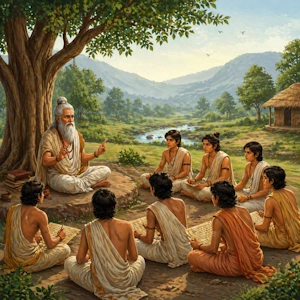
Rishis were not saints sitting away from society.
They were the architects of civilization.
They did not rule kingdoms.
They shaped those who ruled.
They did not write laws like modern lawmakers.
They revealed dharma.
Understand this clearly.
A king could control land.
A rishi controlled direction.
That is the difference.
A rishi did not ‘invent’ knowledge.
He discovered it.
The Vedas were not written like books.
They were heard.
This is why they are called Shruti.
A rishi becomes a rishi only when his mind becomes silent enough to receive truth without distortion.
So what comes from him is not opinion.
It is alignment with reality.
Now see what this does to society.
Every system in ancient India had a rishi behind it.
Education was not random.
It came from the gurukul system.
Students did not just learn skills.
They learned how to think, how to live, how to restrain themselves.
That foundation came from rishis.
Kings did not act freely.
They were guided.
When confusion came, they went to rishis.
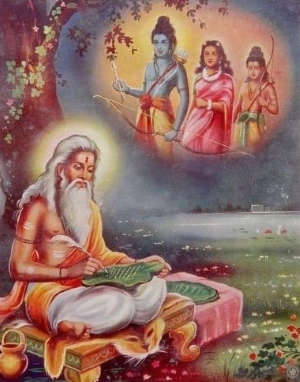
Look at Rama guided by Vasistha.
Look at Krishna guiding warriors and rulers.
Power was always under wisdom.
Without that, power becomes destruction.
Rishis designed society around dharma, not convenience.
They understood human tendencies deeply.
Desire.
Anger.
Greed.
Attachment.
They did not deny these.
They structured life in a way that these forces are handled, not suppressed blindly.
That is why there were ashramas.
Brahmacharya for discipline.
Grihastha for responsibility.
Vanaprastha for withdrawal.
Sannyasa for liberation.
This is not random.
This is psychological engineering.
Even rituals were not blind acts.
A yajna was not just fire.
It was a way to align human intention with cosmic order.
You sit.
You chant.
You offer.
But what is really happening?
Your mind is being trained.
Your ego is being reduced.
Your awareness is being sharpened.
Rishis encoded this into society.
They also controlled excess.
A king becoming arrogant was not new.
But a rishi could stop him.
Through knowledge.
Through presence.
Through fear of dharma.
This balance prevented collapse.
Where there is no one above power, corruption is guaranteed.
Ancient India solved this.
Rishis also ensured continuity.
Empires rise and fall.
But knowledge continues.
Why?
Because it was not stored in buildings.
It was stored in people.
Disciple to teacher.
Teacher to disciple.
An unbroken chain.
Even if kingdoms fall, the knowledge survives.
Here is the real point.
Ancient India was not held together by armies.
It was held together by understanding.
A shared sense of dharma.
A shared vision of life.
That came from rishis.
Remove them, and the structure collapses.
Keep them, and society sustains itself.
Today the mistake is clear.
We have information.
But no inner clarity.
We have systems.
But no guiding wisdom.
That is exactly what rishis provided.
Not control.
Clarity.
Not force.
Direction.
That is why their role was not important.
It was foundational.
Vedadhara is working to bring these forgotten foundations back into everyday understanding.
If this gave you clarity, share it. Let this knowledge travel again.
Q1: What gave rishis authority if they held no political power?
A: Their authority came from clarity, not position. A king could command armies, but he could not command truth. Rishis aligned with dharma, and that alignment created natural authority. People followed them not out of fear, but because their words worked in real life.
Q2: How did rishis influence society without controlling it directly?
A: They shaped the decision-makers. Instead of ruling, they guided rulers, teachers, and householders. When the source of action is corrected, the entire chain changes. This is indirect control, but far more stable than force-based systems.
Q3: Why was knowledge kept in living lineages instead of written systems?
A: Because knowledge is not just information. It includes tone, precision, and inner state. A book can preserve words. A teacher preserves meaning. Rishis ensured that knowledge stayed alive, not mechanical.
Q4: What problem were rishis actually solving in society?
A: The instability of the human mind. Every conflict in society begins inside the individual. Rishis addressed desire, ego, fear, and confusion at the root. By stabilizing the individual, they stabilized the collective.
Q5: Why did even powerful kings submit to rishis?
A: Because power without direction leads to collapse. Kings understood that victory in battle does not guarantee right action. Rishis provided the framework to decide what should be done, not just what can be done.
Objection 1: Rishis were just religious figures with no practical role.
Reply: If that were true, kings would not depend on them. Policies, wars, education systems, and social structures were shaped under their guidance. Their role was practical at the highest level, not ceremonial.
Objection 2: This is idealized. Real societies run on power, not wisdom.
Reply: Power runs short-term control. Wisdom ensures long-term survival. Many powerful empires vanished quickly. The Indian civilization sustained because it balanced power with dharma.
Objection 3: Oral tradition is unreliable compared to written records.
Reply: In most cases, yes. But the Vedic system used strict memorization techniques with cross-checking across multiple lineages. This created a level of precision that even written copying errors could not match.
Objection 4: Rishis controlled society in a subtle way and limited freedom.
Reply: They set boundaries, not control. Every system needs structure. Without it, chaos takes over. Their goal was not restriction, but alignment with how life actually functions.
Objection 5: Such a system cannot work in today’s world.
Reply: The form may change, but the principle does not. Every system today still needs guiding intelligence beyond raw power. The absence of that is exactly why confusion and imbalance are increasing.





English
Sages and Saints
Click on any topic to open
7
30
Astrology
Bhagavad Gita
Bhagavatam
Bharat Matha
Devi
Devi Mahatmyam
Ganapathy
Garuda Puranam
Glory of Venkatesha
Hanuman
Kathopanishad
Mahabharatam
Mantra Shastra
Mystique
Practical Wisdom
Purana Stories
Radhe Radhe
Ramayana
Rare Topics
Rigveda Explained
Rituals
Sages and Saints
Shiva
Spiritual books
Sri Suktam
Story of Sri Yantra
Temples
Vedas
Vishnu Sahasranama
Yoga Vasishta
26
17
10
0


