Saint Tyagaraja: The Musical Maestro Who Found God Through Devotion
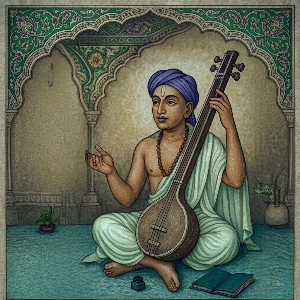
Thiruvaiyaru, situated on the banks of the Cauvery in the Thanjavur district—the cultural capital of Tamil Nadu—immediately brings to mind Saint Tyagaraja and his immortal kritis (compositions). Among those who refined Carnatic music into its modern form, he holds the most prominent place.
Birth and Early Life:
Tyagaraja was born on May 4, 1767 (Sarvajit year, Chithirai month) in Thiruvarur. His father, Ramabrahmam, was a distinguished scholar and an exponent of the Ramayana, while his mother was Seethamma. Tyagaraja inherited his musical passion from his grandfather, Giriraja Kavi.
Proficient in Sanskrit and Telugu from a young age, Tyagaraja received formal musical training under the tutelage of Sonti Venkataramanayya.
Rama Bhakti: The Breath of Life:
Tyagaraja’s entire life was saturated with devotion to Lord Rama. He did not view Rama merely as a deity, but as a friend, a father, a child, and his very soul.
When his elder brother, Japesa, grew concerned about their poverty and urged him to sing in the court of King Serfoji II for gold and wealth, Tyagaraja responded with the famous kriti, “Nidhi Chala Sukhama?”.
Musical Revolution and Compositions:
It is said that Tyagaraja composed nearly 24,000 kritis, though only about 700 to 800 are available to us today. His songs are primarily composed in Telugu.
- The Pancharatna Kritis: The “Five Gems” are considered the crown jewels of his musical genius. Composed in five different ragas (Nata, Gaula, Arabhi, Varali, and Sri), these are performed collectively by musicians worldwide during the Tyagaraja Aradhana.
- Musical Innovations: Tyagaraja introduced the concept of 'Sangathi'—the practice of singing a single line with melodic variations to reveal different dimensions of a raga. This significantly enriched the texture of Carnatic music.
- Musical Operas: He also authored two famous dance dramas: Prahlada Bhakti Vijayam and Nauka Charitram.
Simplicity and Principles:
Throughout his life, he followed the practice of 'Unchavritti' . He never craved fame or fortune. When his elder brother once threw his idol of Rama into the river out of spite, Tyagaraja’s soul-stirring compositions, such as “Endaro Mahanubhavulu,” reflected the depth of his anguish and ultimate devotion.
Salvation and the Aradhana:
In 1847, on the day of Pushya Bahula Panchami, Saint Tyagaraja attained Mukti (salvation). He had taken Sanyasa (renunciation) shortly before his passing. His Samadhi, located on the banks of the Cauvery in Thiruvaiyaru, is now revered as a sacred shrine.
Every year in January, the Tyagaraja Aradhana is celebrated with great fervor. Thousands of musicians gather there to pay a musical tribute to the saint by singing his compositions in unison.
Conclusion:
Tyagaraja was not just a musician; he was a visionary, a saint, and a philosopher. His core message to the world was “Sangita Jnanamu Bhakti Vina” . As long as Carnatic music exists, the name of Tyagaraja will live on.





English
Rare Topics
Click on any topic to open
7
30
Astrology
Bhagavad Gita
Bhagavatam
Bharat Matha
Devi
Devi Mahatmyam
Ganapathy
Garuda Puranam
Glory of Venkatesha
Hanuman
Kathopanishad
Mahabharatam
Mantra Shastra
Mystique
Practical Wisdom
Purana Stories
Radhe Radhe
Ramayana
Rare Topics
Rigveda Explained
Rituals
Sages and Saints
Shiva
Spiritual books
Sri Suktam
Story of Sri Yantra
Temples
Vedas
Vishnu Sahasranama
Yoga Vasishta
26
17
10
0


