Sage Vishwamitra Wants to Take Shri Rama with Him to Fight Rakshasas
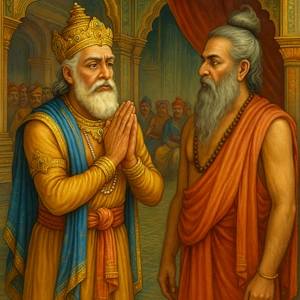
Vishwamitra wanted to take young Lord Rama with him, to fight rakshasas who were disrupting his yaga. When Dasaratha heard this, he didn’t reply instantly. He started thinking what to say, how to convince the sage?
But as he kept on thinking, he started freezing in fear.
He started realizing the gravity of the situation.
What is he asking for?
The king said,
Oh sage, oh lord, Rama is not even sixteen. How is he going to fight rakshasas?
See, I have got a whole akshuhini of sena with me.
I will come myself, to fight the rakshasas.
Each and every one of my commanders, they are like lions who can pounce upon herds of mad elephants and destroy them.
I will myself take weapons and lead them.
We are capable of facing even the army of devaraja Indra.
Rama is a child. He doesn’t know anything about war or warfare. He has no capability of assessing the enemy’s power.
He has only played a mock war. He has only played games inside the palace with his friends. Not real war.
He doesn’t know how to use weapons, he doesn’t possess any astra of his own.
Forget war, he wouldn’t be able to manage even if a few people surround him.
He doesn’t know how to manoeuvre himself amidst soldiers on the battlefield.
So far he has only roamed around with his friends in the safe gardens of Ayodhya.
And my misfortune, of late he looks like a withered flower. He has become pale.
We don’t know what has happened to him.
He doesn’t eat properly, he doesn’t sleep properly.
He has become so silent.
We are not able to understand what is troubling him.
In this state, how will I be able to send him with you?
People may say, I am not following dharma, I am doing adharma by not sending him with you, you are asking to send him for a noble cause.
But there is no affection greater than affection for one’s own children.
You can give up anything, but not your children.
Nobody will be able to satisfy their children.
And rakshasas are very cruel, crooked and deceitful, my Rama fighting them, I can’t even imagine.
Pardon me oh lord, I can’t leave him even for a moment.
I have got these four sons after great difficulty. The greatest among them is Rama. Without him, his brothers will not survive.
You want to take Rama to rakshasa who are death itself in physical form. This will kill all his brothers.
With my sons gone, I will not be able to survive myself.
King Dasaratha is saying all these very politely.
So, in effect, you are pushing all of us towards death.
Please don’t take away Rama.
I will come myself, with my whole army.
Just tell me who are these rakshasas, how many of them are there, I will deal with them.
Or are they Ravana’s people by any chance, in which case even I won’t be able to do much.
Because somehow, he is invincible now. This is the law of nature. Sometimes such powerful people are born, nobody can touch them.
If that is the case, let us all stay out of trouble.
We are human beings. Even devas, yakshas, gandharwas — nobody can touch Ravana as of now.
He is so powerful.
We can’t go near even his son, Indrajit.
This is something natural.
Even in the past, this has happened.
Even if it is not Ravana, even if it is Lavanasura, I am not going to send Rama.
Even if it is Mareecha and Subahu, I am not going to send Rama.
And if you forcefully take him away, I will fall dead here and now.
-
A true leader cannot abandon dharma out of fear or personal attachment. If the king breaks his promise to a sage, the public loses its trust in righteousness.
-
Dharma is heavier than emotion. Even the love for one’s child should not override one’s vow, especially when that vow supports a noble purpose.
-
Affection, though powerful, becomes selfish when it obstructs a higher good. Real love knows when to step aside for dharma.
-
Emotional pain is no excuse for escaping duty. The king’s grief about Rama's condition clouds his judgement, but his role demands clarity.
-
Rational fear of powerful enemies like rakshasas or Ravana should not lead to retreat from moral responsibility.
-
Overprotectiveness weakens the protected. Shielding Rama from danger now would deny him the very growth he was born for.
-
Personal suffering doesn’t justify abandoning collective welfare. A leader’s life is meant to uphold a larger order, not personal comfort.
What happens when a ruler breaks a vow made in public?
It sets a terrible example. If the highest authority chooses emotion over dharma, people will feel free to abandon their own duties when inconvenient. Society runs on trust in truthfulness. A king’s faltering means collective collapse.
Why is dharma more important than love for one's child?
Because dharma sustains everything. Personal affection may feel overwhelming, but it’s limited. Dharma benefits all. Sacrificing narrow love for broad good is the mark of greatness.
Isn’t it human to hesitate when your child’s life is at stake?
It is human, but the question is — are you just a human or a king? A leader must rise above personal bonds when the stakes affect the larger world. That’s the price of authority.
Why must a promise to a sage be honoured, even if it endangers one's child?
Because sages are protectors of sacred order. Dishonouring them invites inner and outer collapse. Vows made to them are spiritual contracts. Backing out from such a word isn't just personal failure — it's cosmic disorder.
What if keeping the vow feels impossible now?
Then too, the attempt must be made. Dharma isn’t about ease, it’s about integrity. Even struggling to fulfil it strengthens character.
Why can’t the king renegotiate or offer an alternative?
He can, but that doesn’t nullify the original failure. Offering alternatives is better than denial, but trust, once broken, leaves cracks. Dharma isn’t a transaction; it’s alignment.
Isn't a father's fear for his son justified?
Yes, but justified doesn’t mean right. It’s natural to fear, but wisdom lies in overcoming it for the right cause. Emotion without balance clouds judgement.
What if the son truly seems unfit at the moment?
Then prepare him, don’t shield him. A role awaits him — fear must not delay destiny. Growth lies in challenge, not in comfort.
What if the father feels the son’s loss will destroy the family?
That’s attachment speaking, not truth. One soul’s journey can’t be held back for imagined outcomes. Holding too tight often breaks what you're trying to protect.
Why is Dasaratha overwhelmed by emotion if he knows what is right?
Because even kings are parents. Dharma doesn’t cancel emotion — it tests it. The challenge is to act despite pain, not in its shadow.
What should he have done instead of pleading?
He should’ve reflected on his dharma as a king and made a choice grounded in clarity, not desperation. Dharma shines when followed through pain.
If dharma is so important, why do emotions still interfere?
Because we are human. Dharma isn’t about not feeling — it’s about not letting feelings lead. Emotion is the fire; dharma is the wick.
Is it wrong to worry about threats like Ravana?
No, it’s smart to assess risks. But fear cannot decide action. Ravana may be powerful, but shrinking from duty empowers him more.
Can human effort win against someone deemed invincible?
Yes — history is full of such upsets. What matters is righteousness, not size. Dharma gives strength unseen to those who act fearlessly.
But if even devas can't stop Ravana, how can humans?
That’s the mistake — assuming strength lies in species, not spirit. It’s not about being human or deva. It's about standing for truth without compromise.
Why is overprotection dangerous?
Because it stunts inner strength. A child constantly shielded won’t develop resilience. Battle-readiness comes from exposure, not pampering.
What’s the harm in letting him stay in the safe gardens?
Safety breeds softness. Dharma needs steel. Gardens don’t train warriors; struggle does.
How can play inside a palace prepare one for real war?
It doesn’t. Games mimic danger, but without real stakes, they don’t train the mind to endure or decide. Real courage is forged in real fire.





English
Yoga Vasishta
Click on any topic to open
7
30
Astrology
Bhagavad Gita
Bhagavatam
Bharat Matha
Devi
Devi Mahatmyam
Ganapathy
Garuda Puranam
Glory of Venkatesha
Hanuman
Kathopanishad
Mahabharatam
Mantra Shastra
Mystique
Practical Wisdom
Purana Stories
Radhe Radhe
Ramayana
Rare Topics
Rigveda Explained
Rituals
Sages and Saints
Shiva
Spiritual books
Sri Suktam
Story of Sri Yantra
Temples
Vedas
Vishnu Sahasranama
Yoga Vasishta
26
17
10
0


