King Dasharatha Refuses to Send Sri Rama With Sage Vishwamitra
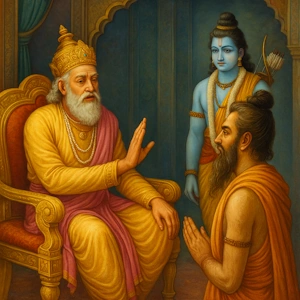
Dasharatha politely refused to send Lord Rama along with Sage Viswamitra.
He said, 'Rama is a young boy, not equipped to face the fierce rakshasas. I will come myself with my army. But if it is Ravana, even I will not be of much help.'
Viswamitra became very upset. 'This conduct of yours is highly unbecoming of Raghu vamsha. What did you say, that you are at my service? You will obey all my orders? You just have to say, this entire kingdom is at your feet.
And I ask for something and you are going back on your words. Refusing to honour your own promise. This is not how kings of Raghvamsha used to be. Now, if you want to prove that you are a liar, I will go back.'
Viswamitra was really angry. The earth started trembling. Devas started panicking.
Earth started trembling in fear because king is the maheepathi, the lord of earth. If he gets cursed, the earth will be affected. Without a ruler, there will be just chaos on earth, evil alone will prevail.
Devas panicked because what if Viswamitra creates someone powerful? Now that Dasharatha is refusing to send Rama with him, what if Viswamitra creates another Rama himself? He is quite capable of that.
The present Rama is Lord Mahavishnu himself who has taken avatara on earth, who is their own protector, who is always by their side. If Viswamitra creates another Rama, he may not have any such allegiance to devas. He could become their enemy.
What if this happens? Devas started worrying.
Sage Vasishta intervened. He told Dasharatha, 'Oh king, why are you doing this? Why are you deviating from dharma? Your predecessors in Ikshvaku vamsha have never done such a thing.
You yourself are famous in the three worlds for your dharma buddhi. It is said that you are a birth of dharma itself in human form. Why are you doing this now?
Don’t do that. You have already made a promise. While honouring him at his arrival, you said that you will comply with whatever he wanted, you will meet whatever his needs are. Why are you turning back on your words now? Send Rama with him.
This is not just about you. If you don’t follow dharma, your people also will not. You are setting a bad example. In a country where the king doesn’t honour words, how will the citizens behave?
Not just in your kingdom. The other kings will also think — if someone as great as Dasharatha of Ikshvaku vamsha can break a promise, why not us?
And everyone in this world — they observe righteousness by observing how great people like you conduct themselves. Your not honouring your words is going to harm the entire humanity.
Do you know why the amruta kumbha remains safe in swarga? Because Agni protects it from all around. Sage Viswamitra here is like Agni. When he is with Rama, nothing can happen to him. Nobody can touch him. Rama may not know how to fight — still, when Viswamitra is around, he will be safe.
Viswamitra doesn’t have an equal in power. Don’t you know that? In the three worlds, there is no one as powerful as him. There is no equal to him in tapa shakti. All the devas, asuras, yakshas, gandharvas put together are also not equal to Viswamitra.
And he is dharma. He protects dharma. He always stands for dharma.
When Viswamitra was a king, Lord Shiva gave him all 100 astras. Pleased with his tapasya, Rudra gave all the hundred divine astras — astras that were born as sons of Jaya and Suprabha.
Jaya and Suprabha were daughters of Daksha Prajapati. Their husband was Krishashva. Jaya gave birth to 50 astras and Suprabha gave birth to 50 astras. They are the most powerful and lethal weapons in all three worlds. And Viswamitra is in command of all these astras now.
What is there to fear when Rama is going to be with Viswamitra?
When with Viswamitra, even if death approaches someone, Viswamitra is capable of giving him amaratva then and there.
'Don’t lament like a foolish ordinary human being, oh King Dasharatha,' said Vasishta Maharshi.
-
A ruler’s integrity sets the moral tone for an entire society. If a king breaks his word, it gives license for everyone else to do the same. That collapse spreads quickly — from palace to village.
-
Dharma is not just about private conduct but also public leadership. When a powerful person strays, the damage isn’t personal — it poisons collective values.
-
Words of promise carry power. Once spoken, especially in a moment of honor or duty, turning back on them erodes personal truthfulness and weakens the cosmic order.
-
Great sages like Viswamitra are not ordinary humans. Their tapas shakti (power born from intense spiritual austerity) can rival and even surpass the might of kings and devas.
-
Viswamitra's anger is not ego — it’s the cosmic reaction to dishonesty. His wrath could destabilize the elements, unsettle the devas, and shake earthly balance.
-
Vasishta’s role is to redirect emotional reaction back toward dharma. He reminds Dasharatha that devotion to truth is the legacy of his lineage.
-
Fear for Rama’s safety is misplaced. With a sage like Viswamitra, even the untrained are protected — because real power flows from spiritual purity, not just weapons.
-
Rama’s divine identity isn’t the issue here — the focus is on the principle that true protection comes from association with dharma and sages, not from royal muscle.
-
A leader’s lapse creates a precedent. If even Dasharatha can break his word, why should smaller kings or citizens behave differently?
-
Cosmic safety relies on humans upholding satya (truth) and dharma. When dharma breaks, even divine objects like the amrita kumbha require divine guardians to remain untouched.
-
Viswamitra’s possession of the hundred astras (celestial weapons) reflects his spiritual authority, not just combat readiness. He earned them through tapas, not warfare.
-
A sage who can give amaratva (immortality) through his spiritual merit shouldn’t be doubted as a protector. Dasharatha’s hesitation stems from worldly fear, not wisdom.
-
Vasishta warns against emotional weakness. Kingship demands steadiness, not sentimentality — especially when the stakes involve dharma.
What is the main reason Dasharatha’s refusal was considered dangerous?
It wasn’t just a broken promise. As king, his conduct shaped the ethical fabric of his people and set a precedent for rulers everywhere. When someone in that position bends truth, society follows — and dharma collapses from the top down.
Why does a king’s mistake affect the entire world?
Because kings are cultural mirrors. If the head of state fails in character, others imitate it. That ripple ruins the very structure of trust, responsibility, and righteousness that holds civilization together.
Isn’t this too much pressure on one person?
It’s not about burden — it’s about the influence that comes with power. If someone holds fire, they must respect its danger. The higher the role, the greater the impact of its fall.
Why was Viswamitra’s anger taken so seriously?
Because his tapas had built enormous cosmic power. If he cursed Dasharatha or reacted harshly, it could cause elemental imbalance, frighten the devas, or even summon destructive forces.
Can anger from sages really cause such damage?
Yes — their emotions aren’t personal. They carry the force of universal law. When a sage like Viswamitra expresses anger, it’s like a faultline cracking — it shakes the unseen fabric of the world.
How do we know this isn’t exaggeration?
It’s not emotional drama — it’s cosmic accountability. Sages who embody dharma hold it in balance. Breaking their trust disturbs more than relationships — it disturbs the cosmos.
Why did Vasishta urge Dasharatha to stand firm on his promise?
Because promises made in honor must not be broken. They carry sacred weight, especially when made publicly. Upholding them affirms truth and safeguards dharma.
What if keeping a promise feels dangerous or unwise later?
That’s where courage and discernment come in. Dharma isn’t always comfortable — it tests resolve. But abandoning it out of fear creates bigger dangers, like moral decay or divine backlash.
Isn’t it practical to reassess a promise if conditions change?
In worldly matters, maybe. But when it involves dharma, sages, and moral leadership, you don’t retreat. The cost of breaking it is higher than any risk it avoids.
Why did Vasishta say Rama would be safe with Viswamitra?
Because Viswamitra had earned divine astras through spiritual merit. His power wasn’t dependent on armies — it came from his connection to cosmic law. Rama’s presence with him was under that protection.
How can spiritual strength protect someone in physical danger?
Real protection doesn’t always need weapons. When dharma is on your side and guided by a tapasvi, even fate bends. That’s the unseen force that makes miracles possible.
Is that just poetic talk — or is it practically real?
It’s practical in a deeper sense. History is full of stories where those aligned with dharma were saved against impossible odds. It’s not poetry — it’s a principle of how the universe responds to inner strength.
What’s the significance of the hundred astras and their origin?
They symbolize the fruits of intense spiritual discipline. Born from divine beings, these astras were given to Viswamitra by Lord Shiva — showing that divine power bends before true tapasya.
Why does the source of astras matter?
Because their origin reveals their sacredness. They aren’t just tools of war — they’re embodiments of cosmic forces. Being gifted by Rudra makes them part of dharma’s arsenal, not mere destruction.
Does this mean spiritual merit can grant superior power than royal lineage?
Absolutely. A sage who earns divine gifts through effort outranks a king born into privilege. Power rooted in tapasya is deeper than power from inheritance.
Why did devas panic when Dasharatha hesitated?
Because they feared Viswamitra might create a new Rama — one who didn’t protect them. The current Rama was Mahavishnu himself, loyal to the devas. Another might not be.
Can sages really create such beings?
Yes. Through mantra shakti and tapas shakti, sages can manifest extraordinary forms. If provoked, a sage like Viswamitra could alter cosmic balance — even unintentionally.
Isn’t this just mythology, not logic?
It’s metaphorical logic. The devas represent cosmic balance. If protectors fail, sages must act — but their creations don’t always serve old structures. That uncertainty was the devas’ fear.





English
Yoga Vasishta
Click on any topic to open
7
30
Astrology
Bhagavad Gita
Bhagavatam
Bharat Matha
Devi
Devi Mahatmyam
Ganapathy
Garuda Puranam
Glory of Venkatesha
Hanuman
Kathopanishad
Mahabharatam
Mantra Shastra
Mystique
Practical Wisdom
Purana Stories
Radhe Radhe
Ramayana
Rare Topics
Rigveda Explained
Rituals
Sages and Saints
Shiva
Spiritual books
Sri Suktam
Story of Sri Yantra
Temples
Vedas
Vishnu Sahasranama
Yoga Vasishta
26
17
10
0


