Punishments of Sri Hari Are Not Forever
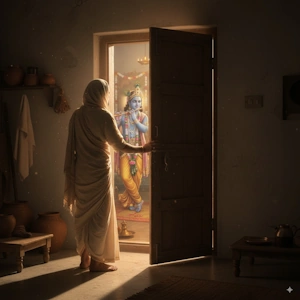
अग्राह्यः
When we discussed the divya nama Aprameya we found that Sri Hari cannot be comprehended through the six established ways of comprehension. This is in particular with respect to the sensory organs, jnanendriyas, meaning he cannot be perceived through the jnanendriyas or through the six established means of comprehension — that is pratyaksha, anumana, upamana, arthapatti, anupalabdhi and shabda.
Agrahya means he cannot be held or grasped with the karmendriyas — the organs of action of the body.
Which are the karmendriyas? Speech — that is mouth, tongue and other speech-related organs, hands, legs and the two excretory organs through which all actions are performed.
Here again, particular reference is to speech. He cannot be held by speech.
If someone wants to confine him to certain definitions and descriptions making use of the karmendriya called speech organs — that is not possible. Grahana means take hold of completely. There is a stone lying on the floor, you lift it, hold it in your hand inside your palm, then it is called grahana. Mere touching is not grahana, it is only sparshana.
The speech organs can touch upon his vastness. But never hold him completely. Never confine him to their scope.
He cannot be confined by words. He cannot be described by words. He cannot be defined by words. He is beyond definition. He is beyond description. With him, words fail. The words and the mind go to him to size him up, fail, and come back.
यतो वाचो निवर्तन्ते अप्राप्य मनसा सह
So he is beyond the grasp of all the jnanendriyas and karmendriyas, both as Aprameya and Agrahya.
Bhagawan takes avataras for paritranaya sadhunam and vinashaya dushkritam — to protect good people and destroy the evil.
What is this destroying of the evil?
Is it simply destroying their physical body? For that Bhagawan doesn’t have to take avatara. That is a small thing. He can get into any existing human body or empower any existing deva and do it — even though the so-called evil is very powerful.
He does something else in the process. He makes these evil powers realize their mistake and repent.
And once they do that, he even rewards them.
He gives lessons to others to observe and learn for themselves. That is the real avataroddesha.
Bali snatched deva’s empire and power. Sri Hari took avatara as Vamana and restored order.
He sent Bali to Patala, but once Bali realized his mistake and repented, he said Bali would be the next Indra himself. After the present manvantara is over in which Purandara is the Indra, chief of Swarga, he will be replaced by Bali. Sri Hari’s punishments are not forever. Once someone realizes his mistake and repents, he is rewarded by Sri Hari.
In the same incident, Shukracharya was trying to prevent Bali from doing the daana sankalpa, so that he is not tricked into giving up everything by Vamana. For doing the sankalpa, after pronouncing what he is about to do, he has to pour water onto the ground from the kamandalu. Then only the sankalpa comes into effect. Shukracharya got inside the naali of the kamandalu and obstructed the flow of water. Vamana took a blade of darbha grass and inserted it into the naali and punctured Shukracharya’s eye.
Shukracharya was doing his duty as asura kula guru, but ultimately aiding evil. Bali had no right to capture Swarga. Bali even deprived devas of their food. Devas were starving.
But after order was restored, Shukracharya also repented for what he had done and started praying to Sri Hari.
Bhagawan appeared before him and touched Shukracharya with the tip of his shankha. And Shukracharya got his eyesight back. This touching with Bhagawan’s shankha is also very peculiar. That is one of the ways in which he blesses.
He did this for Dhruva also. When Dhruva said, I have no words to praise you, Bhagawan did the same to Dhruva, and he got words to praise him.
-
If he is beyond senses and words, how does devotion actually reach him?
Through intention. When the will turns toward him with humility and steadiness, that inner movement is the prayer. Mantra and ritual are vehicles; sincerity is the driver. -
Do words and mantras matter if words cannot contain him?
Yes, as tuning forks. They shape the mind, clear noise, and align you with his grace. The sound is for you; the response is his. -
What is the point of ritual touch and sacred objects if he cannot be grasped?
They train your attention and soften ego. When attention becomes single-pointed, grace flows easily, like water through a clean channel. -
How does justice work if punishments are not forever?
Justice restores order; mercy restores the person. When repentance is genuine, grace completes justice by transforming the heart. -
Why do stories of repentance end in reward instead of mere pardon?
Because transformation is the goal. A heart that turns is fit for higher responsibility; reward signals restoration to dharma. -
What should I do when my speech cannot do him justice?
Keep it simple, truthful, and kind. Let silence carry what words cannot. Speak less, remember more, and act better. -
How can this help my health in practical terms?
Daily remembrance calms the stress system and steadies breath and pulse. A serene nervous system improves sleep, pain tolerance, and recovery. -
What is a bhakti habit that protects the body on busy days?
Short breaths of devotion: three slow breaths with his name before meals, calls, and sleep. Tiny anchors prevent the day from carrying you away. -
How do I deal with guilt after I realize I went wrong?
Admit clearly, repair promptly, and return to remembrance. Guilt loses poison when it becomes accountability plus prayerful action. -
How do I bring this spirit into family conflicts?
Begin with restraint of tongue. Listen fully, state your part without blame, and ask what repair looks like. Pray for the other’s good and then act on one concrete kindness. -
What is a sign that my devotion is maturing?
You argue less with reality, recover faster from anger, and choose truth over face-saving. Peace becomes default, not exception. -
If he is beyond definition, how do I keep my devotion personal?
Use a chosen form and name to love him, while knowing the limitless stands behind it. Form holds the relationship; limitlessness holds your trust. -
How do I respond when I feel spiritually numb?
Do the next small right thing: a clean apology, a kept promise, a five-minute japa. Action invites warmth when feeling is absent. -
What is the role of discipline if grace ultimately saves?
Discipline keeps the door open. Grace walks in through doors you keep open consistently. -
How should I guide children without forcing religion?
Model calm speech, shared service at home, and short daily gratitude. Let them see devotion making you kinder and steadier; example teaches better than lectures. -
What do I do when prayers seem unanswered?
Stay with the practice, widen the time horizon, and look for subtler shifts: less fear, more clarity, better choices. Often the answer appears as strength before outcome. -
How do I align work life with devotion without losing ambition?
Offer effort, not anxiety. Set clear goals, act fairly, and accept results as prasad. Ambition purified by fairness becomes seva. -
What daily checklist keeps me on track?
One page, five lines: remembrance on waking, honest work, kind speech, one repair if needed, gratitude at night. Repeat until it becomes your second nature.





English
Vishnu Sahasranama
Click on any topic to open
7
30
Astrology
Bhagavad Gita
Bhagavatam
Bharat Matha
Devi
Devi Mahatmyam
Ganapathy
Garuda Puranam
Glory of Venkatesha
Hanuman
Kathopanishad
Mahabharatam
Mantra Shastra
Mystique
Practical Wisdom
Purana Stories
Radhe Radhe
Ramayana
Rare Topics
Rigveda Explained
Rituals
Sages and Saints
Shiva
Spiritual books
Sri Suktam
Story of Sri Yantra
Temples
Vedas
Vishnu Sahasranama
Yoga Vasishta
26
17
10
0


