There Is Something About the Choice of Sri Hari
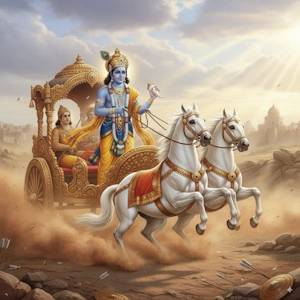
शाश्वतः – शश्वत् सर्वेषु कालेषु भवतीति शाश्वतः
We saw that dividing time into past, present and future itself is maya. But, within that maya also, if you see, he is there at all these times, he is there everytime. He is there any time. Hence he is called shaashvataha.
There is something about his choice.
Why did he choose to be with Pandavas?
Why did he choose to make Yudhishthira the emperor?
All were at his disposal. Everyone would have gone with any decision that he made.
He could have chosen Balarama, his own brother,
Or Pradyumna, his own son,
Or Aniruddha, his own grandson.
Nobody would have objected.
Agreed that Kunti was his own aunt and Pandavas were their sons.
But he had other aunts also – Shishupala and Dantavakra – they were also sons of his own aunts.
Moreover, they were his bodyguards in Vaikuntha – Jaya and Vijaya – their rebirths on earth.
Why did Bhagawan choose Arjuna for Geethopadesa, not Uddhava?
Uddhava also had surrendered himself completely to him.
As far as Yudhishthira's case is concerned, you can argue that he was amsha of Dharmaraja himself. Dharma was to be re-established in the world post Kurukshetra. Destruction of evil is one thing and establishing dharma is another thing.
Who else can establish dharma other than Dharmaraja himself?
Dharmaraja had two avataras on earth at that time – Yudhishthira and Vidura. But Vidura was a non-kshatriya and vairagi. He had no interest in administration.
But is that the only reason?
Sri Hari is bhakta vatssala.
He belongs to those who are devoted to him. This is his weakness.
Surdas was blind. Once, while walking around the streets of Vrindavana, he fell into a pit. Bhagawan came as a Balakrishna, offered his hand and pulled him up. Surdas instantly recognized the touch of his hand.
Balakrishna shook his hand, got it released and ran away.
Surdas said:
हाथ छुडाए जात हो निबल जानिके मोहि
हिरदे से जब जाहुगे मरद बदोंगे तोहि
You are running away from me, going away from me. Releasing your hand. It’s ok.
I will call you a man if you are able to go away from my heart.
It’s a challenge. I will accept that you are a man, you have courage if you are able to go away from my heart.
Real devotees know this. They experience this. They know his weakness.
पर्युष्टया तव विभो वनमालयेयं
संस्पर्धिनी भगवती प्रतिपत्निवच्छ्रीः
यः सुप्रणीतममुयार्हणमाददन्नो
भूयात्सदाङ्घ्रिरशुभाशयधूमकेतुः
You will often find him wearing dried up vanamala. Mata Lakshmi has to stay on his chest by the side of this dried up vanamala. Why? Because he doesn’t have the heart to take it out, even if it has dried up. A bhakta has given it to him. He wouldn’t remove it with his own hands. If and when another bhakta comes with a fresh vanamala and takes the old one out with his own hand, it is fine. Sri Hari won’t do it himself. Let Mata Lakshmi be uncomfortable, does not matter.
This is his attachment to his devotees.
Bhaktas can make him dance to their tune.
That too if the devotee is helpless and without any other support, then he has got him fully, completely.
This was the case with Pandavas.
Their father Pandu had passed away when they were at Tapovana.
When Kuntimata came to Hastinapuri with her sons, hate is all that they faced.
Total helplessness.
And they had surrendered completely to Sri Hari.
Both absolute faith and helplessness.
See the faith, Arjuna chose him against a whole akshauhini sena.
That’s the faith.
Sri Hari doesn’t accept incomplete surrender, incomplete faith. He wants complete surrender. Complete faith.
And his mercy is also never incomplete. When he gives, he gives completely, he gives himself completely.
-
Why does Bhagavan side with those who look helpless rather than the obviously strong?
-
Because helplessness plus responsibility equals total surrender; it removes ego and clears the channel for grace.
-
Power without surrender blocks help; power with surrender becomes service.
-
In families, the member who drops ego first becomes the bridge for everyone’s uplift.
-
For health, admitting limits early gets you timely care, discipline, and steadier recovery.
-
-
What does complete surrender look like in daily decisions?
-
Choose dharma over convenience, even when it costs you time or pride.
-
Start work with prayer, act fully, accept results without drama.
-
Keep clean money, clean food, clean speech; this invites divine backing.
-
Review each night: where did I act for show, where for truth? Correct next morning.
-
-
Why does partial faith fail to move mountains?
-
Half trust keeps a backup idol called control; that splits attention and outcomes.
-
Mixed intention leads to mixed results; single intention draws direct help.
-
In relationships, half apologies harden hearts; full apologies heal quickly.
-
In health, half routines stall; full routines compound.
-
-
How do I choose Bhagavan over a large visible resource without being reckless?
-
Take the stance: I want only what aligns with dharma and service; then act diligently.
-
Say no to gains that demand inner compromises.
-
Consult wise counsel, then commit; faith is not laziness, it is clean courage with effort.
-
Track small proofs of support each week; faith grows with audited memory.
-
-
Why does Bhagavan keep a devotee’s small gift even when it seems inconvenient?
-
Love values the giver more than the object; memory of love becomes worship.
-
This tells you your sincere effort is never wasted, even if crude or late.
-
At home, preserve children’s small efforts; it trains their heart in devotion and duty.
-
For health, honor small wins; bodies heal better when gratitude is stored.
-
-
What qualifies someone to be a carrier of dharma in society today?
-
Truthful earnings, dependable word, and steady mind under pressure.
-
Ability to correct without humiliating; mercy with firmness.
-
Willingness to be last in credit and first in accountability.
-
Daily sadhana that keeps anger and envy below threshold.
-
-
Why was a warrior chosen to receive guidance rather than a scholar in seclusion?
-
Dharma must land where stakes are highest; battlefields test philosophy.
-
Action clarifies teachings that books alone leave abstract.
-
In your life, take counsel when decisions burn; clarity arrives fastest under duty.
-
Apply learning through service projects; wisdom stabilizes only when used.
-
-
How do I know if my dependence is devotion or escapism?
-
Devotion energizes action; escapism avoids it.
-
Devotion accepts consequences; escapism blames fate and people.
-
Devotion keeps promises; escapism keeps excuses.
-
Pulse check: after prayer, do you move or stall? Move — you are aligned.
-
-
What does re-establishing dharma look like inside a family?
-
Transparent money matters; shared budgets and honest disclosures.
-
Rituals that gather everyone weekly; shared food without screens.
-
Boundaries around speech: no contempt, no mockery during conflicts.
-
A family service vow: one act of help to someone outside the home each week.
-
-
How can bhakti strengthen the nervous system during illness or caregiving?
-
Regular mantra breathing lowers stress hormones and steadies pain perception.
-
Surrender reduces catastrophic thinking; the body conserves energy for healing.
-
Gratitude journaling after japa improves sleep quality.
-
Caregivers gain stamina by pairing seva with short, non-negotiable prayer breaks.
-
-
What is the right balance between asking for miracles and doing my duty?
-
Ask big, but tie the request to dharma and service.
-
Do the next loyal action even if the full path is hidden.
-
Drop theatrics; keep steadiness. Grace lands on clean, consistent effort.
-
Review monthly: what changed in character, not just in circumstances.
-
-
How do I become a person Bhagavan chooses to back publicly?
-
Keep vows small and unbroken; reliability attracts divine trust.
-
Protect the weak without performative posts; do the work quietly.
-
Return good for insult once; set boundaries next; never nurse revenge.
-
Treat success as prasada and failure as instruction; both keep you usable.
-
-
Why does choosing a guiding presence beat choosing a huge army of options?
-
A living center aligns scattered forces; options without center create noise.
-
Guidance reduces regret loops; armies of choices enlarge them.
-
In health plans, pick one disciplined protocol under a trusted guide; stop hopping.
-
In family goals, pick one shared north star for the year; say no to side quests.
-
-
What is the practical test of advancing bhakti?
-
Faster recovery from anger; shorter sulk times.
-
Cleaner food and speech without forcing yourself.
-
Joy in service that used to feel like burden.
-
A quiet certainty: I am held; therefore I act bravely.
-
-
How do I stand firm when society rewards cunning over character?
-
Remember: outcomes given without integrity are liabilities, not assets.
-
Keep a small circle that values truth; take their feedback seriously.
-
Document your processes; light removes rumor power.
-
Offer the fruits back mentally each night; sleep becomes fearless.
-
-
What should I do when I have no human support left?
-
Take refuge openly: daily sankalpa, japa, and a short reading from scripture.
-
Seek one dharmic mentor and one physician; combine grace with science.
-
Serve someone weaker; service unlocks unexpected doors.
-
Keep a weekly testimony log of help received; despair loses its script.
-





English
Vishnu Sahasranama
Click on any topic to open
19


