Pundareekaksha - Meaning
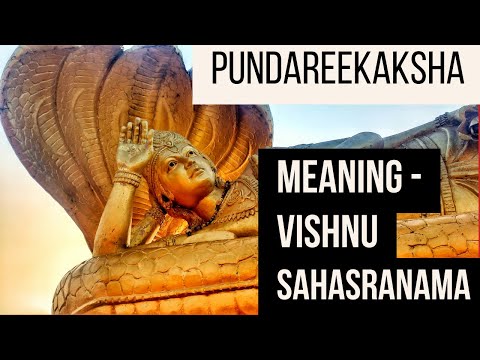
Today we will see the meaning of the divya nama pundareekaksha and learn a little bit about shankha.
पुण्डरीकाक्षः –
Pundareekam means white lotus – अन्यपुष्पाणां गर्वं पुण्डति चूर्णीकरोतीति पुण्डरीकम्.
Lotus pulverizes the pride of other flowers, hence lotus is called pundareekam.
The lord's eyes resemble lotus petals, so he is pundareekaksha.
यत्पुण्डरीकं पुरमध्यसंस्थम् – that lotus in the heart, at the middle of the pura called body,
पुण्डरीकमश्नुते – पुण्डरीकाक्षः – he occupies pundareeka, the lotus in the heart, hence called pundareekaksha.
पुणडरीकाकारे अक्षिणी अस्य – his eyes resemble lotus petals.
पुण्डरीकं परं धाम नित्यमक्षरमव्ययम्।
तद्गतानाम् अक्षिभूतः पुण्डरीकाक्ष ईरितः।।
Pundareeka is Vaikuntha. Those who have reached there, for them Sri Hari is as precious as their own eyes, hence he is pundareekaksha.
He is always in their eyes, visible to them. So he is pundareekaksha.
See one name, how many meanings it conveys:
The beauty of Bhagawan's eyes, that he occupies the hritpadma, the lotus at the middle of the chest, that he is perpetually visible to those who attain Vaikuntha.
अपवित्रः....
Whether you are pure, impure, or in any state, just remember pundareekaksha. You are purified both internally and externally.
Why so?
As we saw earlier, he occupies the heart lotus. He has control over the heart lotus. He can take you to the heart lotus.
What is in that heart lotus?
Chidakasha. It is internal space.
Just like there is space outside occupied by various objects and beings, there is space inside you which is also occupied by various thoughts and emotions.
After silencing all these only, you can attain samadhi and yogavastha. In that state, your internal space, the chidakasha within the heart lotus, is pure, devoid of any kind of thought or emotion.
That is Sri Hari's connection with pundareeka. He keeps on watching your internal space. He supervises it and guides you as to how to make it pure. His eyes are always set on your pundareeka, your chidakasha, to make it pure at the appropriate time.
In Bhagavad Geetha, if you see at the commencement of the battle, this shloka is there:
पाञ्चजन्यं हृषीकेशो देवदत्तं धनंजयः।
पौण्ड्रं दध्मौ महाशङ्खं भीमकर्मा वृकोदरः।
अनन्तविजयं राजा कुन्तीपुत्रो युधिष्ठिरः।
नकुलः सहदेवश्च सुघोषमणिपुष्पकौ।।
The lord and the Pandavas are blowing their own respective shankhas.
It was Bheeshmacharya who blew his shankha first from the Kaurava side, announcing the beginning of the battle. In reply, Bhagawan and the Pandavas blew their own conch shells.
Bhagawan – Panchajanya
Yudhishthira – Ananta Vijaya
Bheema – Paundra
Arjuna – Devadatta
Nakula – Sughosha
Sahadeva – Manipushpaka
What are these? Names of their shankhas. They are in fact varieties of shankhas, very rare shankhas found at specific places.
Panchajanya is found in Kushasthali which is Dwaraka, particularly in Chakra Teertha.
Yudhishthira's shankha Ananta Vijaya belongs to Somateertha.
Paundra is found where river Kaveri joins the sea.
Arjuna's shankha Devadatta is from where river Tamraparni joins the sea.
Sughosha, Nakula's shankha, is from the confluence of Yamuna and the sea.
Nakula's Sughosha is from Shankha Teertha.
Sahadeva's shankha Manipushpaka is from Agni Teertha which is to the west of Rameswaram.
You know there are two varieties of shankha – dakshinavarthy and vamavarthy.
There is a third variety which is called Ganesha shankha. This is very very rare and resembles Lord Ganesha.
Vamavarthi is common. Dakshinavarthy is rare. While vamavarthy is used to worship Bhagawan, dakshinavarthy shankha itself can be worshiped.
Just having dakshinavarta shankha at home itself is very auspicious. Lakshmi stays at that home forever.
If you sprinkle water upon yourself with water from a dakshinavarthy shankha standing in a river which flows towards the east, then all your papas thus far will be gone. If it is water mixed with sesame seeds, it is even better.
But never ever drink water from shankha. It can be used only for sprinkling upon oneself.
In some temples I have seen this – the archaka giving teertha from shankha for sipping. This is strictly forbidden. You can only sprinkle or pour it over your head.
-
If the lord watches the inner space, how do I make that space calm enough to feel it?
Sit straight, slow the breath, and chant 'Om Namo Narayanaya' or Vishnu sahasranama softly. The mind follows the breath; japa steadies both. Start with 108 names daily. Within weeks, pulse and anxiety reduce, and attention stays longer on the nama. -
Why chant names when thoughts keep wandering?
Thoughts will wander; bring them back to the next nama without drama. Each return is training. Over time, the nama becomes the default mental track, and distractions shorten on their own. -
What is the practical link between lotus-like vision and my daily reactions?
Lotus eyes mean cool, steady seeing. Before a tense reply, do 12 beads of nama. This inserts a pause. Blood pressure and tone drop, and your response becomes firm and kind, not harsh. -
How does japa purify without complicated rites?
Nama is contact with the one named. Repetition engrains remembrance; remembrance dissolves restless impressions. Start and end the day with sahasranama or the dvadasa nama. Keep it clean, countable, and regular. -
Can a household use conch and nama without turning the home into a temple?
Yes. Keep a clean shankha for sprinkling only; never sip from it. On Sundays, sprinkle water while repeating a set of names. It sets a sacred tone for the week and gently resets moods at home. -
What should a couple do when arguments escalate fast?
Call a two-minute nama break. Each chants quietly, then returns. The break is not avoidance; it is centering. Most sharp edges soften after even 54 names. -
How can children connect without feeling forced?
Make a short family round: each says 5 names aloud in turn. Keep it joyful and brief. Small, consistent doses work better than long lectures. -
Does chanting help with sleep or only with devotion?
It helps both. Slow japa before bed cues the nervous system to downshift. Use a gentle pace; keep posture easy. Many find they fall asleep between names, which is fine. -
What do I do on days of guilt or impurity?
Do not delay. Wash hands and face, sit, and chant. Nama is meant for every state. Consistency on the worst days becomes the backbone of your best days. -
How do I keep progress measurable and honest?
Fix a small, non-negotiable count: for example, 108 names at dawn. Track the days. Add optional rounds in the evening. Let the log, not mood, decide whether you showed up. -
Where should attention rest during japa?
Keep it in the heart area, visualising a soft lotus. Let the sound of nama rise from there. When attention slips, gently place it back without self-talk. -
How do I take the temple feeling into office stress?
Carry a mental bead count. Before a difficult call, do 12 silent names. After the call, do 12 more to clear residue. This brackets stress and keeps steadiness through the day. -
Is there a rhythm that deepens chanting?
Match one nama to one calm exhale. This anchors breath and sound together. If breath is short, shorten the nama cluster, not the calm. -
What if family members do not join me?
Do your round quietly and cheerfully. Let results speak. Over weeks, your steadier mood and kinder speech become the invitation. No pushing, only patient example. -
How do I connect japa to charity and service?
After completing your daily count, dedicate the merit to someone at home or a person in need. Then do one concrete helpful act that day. Nama inside, dharma outside.
How can you say Bhagavan's eyes are like lotus petals? Isn't that just poetic exaggeration?
Lotus petals have a calm, soft radiance. The comparison is not about physical measurement but about the quality of beauty and serenity. In every culture, metaphors are used to describe things beyond ordinary words. Here, lotus is the closest natural symbol to express divine charm.
You say Bhagavan lives in the heart lotus. Where is the proof? Can you show it under a microscope or scan?
The 'heart lotus' is not a physical organ but the inner consciousness space — what yogis call chidakasha. Just as thoughts, dreams, and emotions cannot be dissected in a lab yet undeniably exist, the inner lotus is a real experiential plane accessed in meditation.
If chanting Pundareekaksha purifies someone, how does a sound remove impurity?
Impurity here is not dirt but the mental clutter of anger, greed, fear. Repetition of divine names alters thought patterns the way consistent music alters mood. It rewires the mind, steadies the breath, and clears negative conditioning. That effect is the purification.
You mentioned shankhas producing results like removal of sins. Isn't that superstition?
Shankha is not just a shell. It is a natural spiral resonator. When blown, it produces vibrations that affect both the environment and the human body. This is measurable in sound frequency terms. The tradition attached spiritual significance to these natural effects.
Why are some shankhas rare and linked to specific rivers or seas? Isn't that myth-making?
Geological and marine conditions differ from place to place. Certain varieties of conches form only in certain beds due to pressure, minerals, and currents. Ancient people identified and preserved these differences, giving them names and stories.
If water from a shankha is sprinkled, why should that remove sins? Isn't it just ordinary water?
Water takes on the vibration of the vessel it rests in. A shankha's spiral structure and sound resonance alter water molecules, much like tuning forks alter vibrations in air. Modern studies on water memory hint at this. Tradition explains it in spiritual terms as removal of sins.





English
Vishnu Sahasranama
Click on any topic to open
7
30
Astrology
Bhagavad Gita
Bhagavatam
Bharat Matha
Devi
Devi Mahatmyam
Ganapathy
Garuda Puranam
Glory of Venkatesha
Hanuman
Kathopanishad
Mahabharatam
Mantra Shastra
Mystique
Practical Wisdom
Purana Stories
Radhe Radhe
Ramayana
Rare Topics
Rigveda Explained
Rituals
Sages and Saints
Shiva
Spiritual books
Sri Suktam
Story of Sri Yantra
Temples
Vedas
Vishnu Sahasranama
Yoga Vasishta
26
17
10
0


