More About Precision in Vedic Yajnas
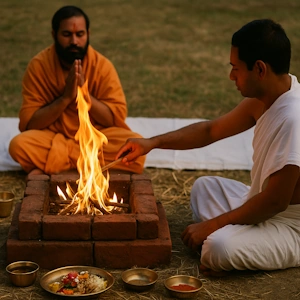
In Vedic rituals, precision is very important. That is why Vedic rituals are very powerful.
Vedic rituals are meant to manifest something that is non-existent, as in the case of yajnas. Yajna is a process of creation. Creation, if it is natural, happens on its own. But if you want to create something that is non-existent, then it is not a layman’s job.
Creative people are very few. And each one is obstinate about what he or she does. A writer would write again and again, tear away hundreds of sheets of paper until he is satisfied with what comes out. Even if you are not using paper anymore and write on your PC, the case is the same.
There are very clearly defined rules and procedures in Vedic rituals, and they are very scrupulously followed by people who are trained to do so.
As an example, we will take the case of Saamidheni. Saamidheni is a step in a yajna — adding fuel to Agni which is already installed.
समिन्धे सामिधेनीभिर्होता
This is done after Agni is installed and offerings are made. Agni should be ignited, made strong so that it can burn the ahutis being given.
There are two persons involved here. The Rigvedic priest chants the mantras — he is called Hota. And the Yajurvedic priest keeps the samidhas or the sticks of firewood into the fire. His designation is Adhwaryu.
The Hota sits or stands to the west of Agni and recites with his hands held in Anjali Mudra. He faces east. The Adhwaryu sits or stands to the northwest of Agni, meaning the kunda. So, it is not like they all sit around the kunda and do this. Everything is specified.
There are 11 mantras from Rigveda chanted by the Hota, the Rigvedic priest. Even in these, the first and last are chanted three times each — so a total of 15 mantras.
This is in the case of the ritual called Darshapurnamaseshti done in connection with Amavasya and Purnima. In another procedure, 13 mantras are used, making it a total of 17 chantings.
The way the mantra is chanted is very peculiar. Each mantra has three padas. The Hota breathes at the end of the second pada — meaning, if he has to breathe, he does so at the end of the second pada because the last pada has to merge into the next mantra. He will not be able to pause for taking breath there. Like this till the end.
At the exact junction of the two mantras merging, the Adhwaryu places one stick in Agni.
Swara is not applied to the mantra. It is said in medium speed and medium volume. There are specific instructions in the Shrauta Sutras and Brahmanas for these.
The pitch, volume, and speed of the mantras — the same mantra may be used in different places — they can vary. But you cannot violate the prescription. If medium speed is prescribed at a particular place, then it has to be medium speed. It can't be slow or fast.
The coordination between the different priests is also admirable.
So much of precision and care have gone into Vedic rituals. We are almost on the verge of losing them forever. But for the hard work, dedication, and commitment of a very few Agnihotris who keep their Agnis unextinguished, the system would have disappeared long back.
It is important that we at least understand a little bit of this all-encompassing tradition of ours.





English
Rituals
Click on any topic to open
7
30
Astrology
Bhagavad Gita
Bhagavatam
Bharat Matha
Devi
Devi Mahatmyam
Ganapathy
Garuda Puranam
Glory of Venkatesha
Hanuman
Kathopanishad
Mahabharatam
Mantra Shastra
Mystique
Practical Wisdom
Purana Stories
Radhe Radhe
Ramayana
Rare Topics
Rigveda Explained
Rituals
Sages and Saints
Shiva
Spiritual books
Sri Suktam
Story of Sri Yantra
Temples
Vedas
Vishnu Sahasranama
Yoga Vasishta
26
17
10
0


