Making You Focus on Your Body? That’s Harm, Not Help
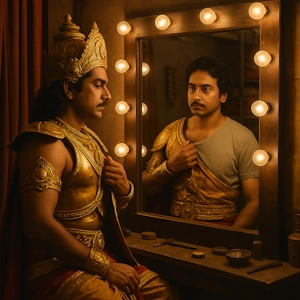
These people are drunk, says Lord Rama. They have lost their mind.
Those who are so much obsessed with this body, live their life only bothering about this body—its needs, its status, its position—they are mad.
Those who spend so much time beautifying it, keeping it dressed up, groomed, worrying about its complexion, height, weight, shape, whether it is too bony, whether it is obese, whether the hair is falling, matching dress, matching footwear, matching accessories, matching bag.
It should not pain, it should not develop fever, it should not develop rashes.
It should not feel weak.
It should not be hungry, it should not be thirsty.
So much of obsession with the body is madness.
It is going to wither and die after a few years.
There is no escape. If not after 10 years, after 20 years, 30 years, 40 years—
it will definitely disappear from the face of earth.
Why are we so fussy about it?
The Lord is again and again pointing towards one fact—
This body is not you.
This body is something that is with you for some time.
May be a vehicle, may be a co-traveller.
May be a resting place.
Don’t give importance to it beyond this.
A minimum upkeep is necessary.
Even if you are staying in a rented house, you keep it a bit neat and tidy.
No problem.
But if that house becomes your obsession—
You have gone to the city for a job, you got transferred there.
You took up a rented accommodation.
But then you don’t make the upkeep of that house the purpose of your life, right?
You don’t resign your job because you have to take care of that house, right?
You don’t tell your boss, 'Sir I can’t work anymore, I have to take care of my house,' right?
Not even family—it is the house, the structure, the concrete structure—that you are getting obsessed with.
Isn’t the Lord right calling this madness?
I am not this body.
I am not even a friend or enemy or relative of this body.
I don’t own this body.
This body doesn’t own me.
It is with this constant thought that man should live.
Then he will not be trapped into the conspiracies of this body.
Every person who praises this body, and you feel great about it—he is pushing you down into the ditch of ignorance and suffering.
Every person who makes fun of this body and you feel hurt because of that—he is pushing you still down into the ditch of ignorance.
If someone tells you, 'Oh you look so weak, what happened?'
You should say, 'So what should I do, throw away this body?'
This is the attitude you should have towards your body.
People who bring back your attention more and more towards your body—
they are not your well-wishers.
They are your enemies.
They may not be doing this intentionally.
But that is who they are.
They are pushing you towards misery and suffering.
A person who sympathises with you when you are sick—
he is making you more aware of your body,
more focused on your body,
pushing you down to more and more suffering.
He is not your friend.
He is not your well-wisher.
He is your enemy.
This body is so possessive—
it doesn’t want you to look beyond her.
She is madly obsessed with you—like an obsessive lover.
She will thwart every attempt that you make to break free from her clutches.
She wants you to perish with her.
She wants you to commit suicide with her.
She will never let you free.
This is her intention.
And all those who make you aware of your body—
its status, its reputation, its looks, its health, its ill-health—
they are all on her side.
With her.
To destroy you.
Be careful with such people.
Body is just a medium through which you experience the world.
You are reading a horror story book.
Will you accept it as your gospel thereafter?
Your holy scripture thereafter?
You know the story in there is just fiction.
In the same way, this world experience is just fiction.
The body is the medium through which you get the experience of the world.
Like how the story reaches you through the book as a medium—the physical medium as the book, paper, ink—
the body is also like that.
How can you consider the body as the holy truth when what it gives you itself is fiction?
You are living by what others tell you.
You are conditioned by what the world around tells you.
What your parents tell you,
what your teachers tell,
what your neighbours tell you,
what the social media tells you,
what the news channels tell you,
what the politicians tell you,
what the advertisements tell you—
you are taking all that to be true.
You are shaping your whole life around these.
Someone sells you a bottle of sulphuric acid, calls it water, and tells you to drink it when you are thirsty.
You are living under this hope that 'I don’t have to worry about thirst, I have water with me.'
You are about to get into a river—a beautiful crystal-clear river with pure water.
Someone says, 'No, don’t. That is acid. It will burn you.'
You believe.
This is how we are living life.
This body is not of any use to me.
Nor is it of use to anyone else.
This is just a wrong notion.
Its origin itself is from falsehood,
false impressions,
false ideas,
false expectations.
It is a storehouse of falsehood.
I have no respect for this body.
I have no love for this body.
It is just a piece of grass for me.
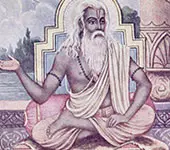
Saying all these to Sage Viswamitra, Lord Rama concludes the 18th sarga of Vairagya Prakarana of Yoga Vasishta.
-
Being overly focused on the body's appearance, comfort, or reputation is seen as a sign of delusion and madness.
-
The body is temporary and perishable; no matter how well it is maintained, it will decay and die.
-
Obsessing over bodily upkeep is like becoming attached to a rented house during a temporary stay.
-
The body is not your true self; it is a tool or vehicle for experience, not your identity.
-
Basic maintenance is fine, but prioritizing the body above purpose or truth is a serious distraction.
-
Emotional reactions to praise or insult about the body indicate spiritual ignorance.
-
People who constantly draw your attention to your body are not allies but obstacles to freedom.
-
Even well-meaning sympathy during illness strengthens attachment and deepens suffering.
-
The body behaves like a jealous lover that won’t let you detach or evolve; it wants you to perish with it.
-
Friends or society who increase your focus on bodily status are unknowingly serving that possessive nature.
-
The world experienced through the body is fictional, just like a story in a book; treating it as ultimate reality is a mistake.
-
You live by others’ conditioning—parents, teachers, media, politicians—and shape your life based on their illusions.
-
Misguided beliefs fed by external voices lead you to value things that may harm you, mistaking danger for comfort.
-
The body's origin is built on falsehood—wrong ideas and assumptions—and therefore has no inherent worth.
-
True freedom begins with disidentifying from the body and refusing to let it dictate your thoughts or life choices.
What does it mean to be obsessed with the body?
It means living your life constantly worrying about your looks, comfort, health, and social status based on physical appearance. This attachment blinds you to your deeper self and makes bodily issues seem like your entire world.
Why is being body-conscious seen as madness?
Because it's like obsessing over a rented house—you’re treating something temporary as permanent. It distracts from your real journey and keeps you stuck in surface-level thinking.
Isn’t it normal to care about your health and looks?
Basic care is fine, but when it becomes your identity or life’s purpose, it turns destructive. The body ages, breaks down, and dies—relying on it for meaning is like building on sand.
How should we treat the body if it isn’t who we are?
Like a useful but temporary tool. Maintain it enough to function, but don’t become emotionally entangled with it.
Can I still enjoy dressing well or exercising?
Yes, as long as it’s for functional upkeep and not emotional dependency. The key is inner detachment, not outer neglect.
What’s wrong with loving the body if it’s mine?
The body isn’t truly yours—it doesn’t obey you, doesn’t last, and constantly changes. Loving it blindly leads to suffering when it decays or fails.
Why is praise or insult about the body dangerous?
Because reacting to it means you’ve identified with the body. It hooks your ego and traps you in dualities—pride and shame, joy and sorrow.
How do I stop getting affected by what people say about my appearance?
Shift your identity. When you know the body isn’t you, their words feel like commenting on your clothes—not your soul.
Isn’t it natural to feel good when someone compliments us?
It’s natural, but not helpful. What starts as a small ego boost soon becomes dependence on external validation. That’s a slippery slope.
Can someone who sympathises with your illness harm you spiritually?
Yes, because they draw your attention back to the body and reinforce your identification with suffering.
How can support during sickness become a trap?
When it encourages self-pity or emotional fixation on pain, it deepens your bondage rather than offering real healing.
Isn’t empathy a good thing?
Empathy that uplifts is good. But if it ties you tighter to your body-consciousness, it’s a silent enemy in disguise.
What is the body's role in our downfall?
It acts like a jealous lover, obsessed with keeping you bound. It resists every attempt you make to rise above physicality.
Why does the body behave like this?
Because it’s designed to survive and dominate your awareness. If you let it, it will hijack your purpose and pull you down.
How can something so close to me be dangerous?
Familiar doesn’t mean safe. A flame is warm, but if you cling to it, you burn. The body’s closeness makes it harder to see as separate.
What’s wrong with making bodily reputation important?
It keeps you tethered to society’s illusions—chasing praise, fearing judgment. This delays freedom.
Isn’t taking care of your body a sign of self-respect?
True self-respect comes from knowing who you are beyond form. The body is just your current outfit—not your identity.
Isn’t body image important in relationships and career?
Maybe externally, but shaping your self-worth around it is a trap. When the body declines, so does your confidence. That’s not sustainable.
Why does the passage call the world a fiction?
Because everything experienced through the body is impermanent and subjective. Like a horror story in a book—it may feel real, but it’s just a scene.
Then what is real if not this world?
That which doesn’t change with time—your conscious self. The body, sensations, and stories change; awareness remains.
How can the world be false if it feels so vivid?
Feeling real doesn’t make it true. Dreams feel vivid too, but you wake up and laugh at them. This waking world is just a longer dream.
Why do we live based on others’ ideas?
Because from childhood we are conditioned—by parents, schools, media—to accept certain norms without questioning.
How can I stop letting society define my choices?
Start by observing where your beliefs come from. When you see they’re not truly yours, you begin to detach.
Isn’t it risky to reject collective wisdom?
It depends on what’s being rejected. Blind belief is riskier. True wisdom is tested and lived, not borrowed.
What’s the meaning behind the acid and river example?
It shows how we blindly trust others and ignore our own intuition. What’s harmful is sold as safe; what’s pure is labelled dangerous.
How does this apply to daily life?
We often avoid things that could heal us—truth, solitude, discipline—because others warn us against them. We accept pain as normal.
Isn’t it safe to follow trusted sources?
Not always. Even trusted voices can be wrong. Wisdom lies in self-inquiry, not blind acceptance.
Why does the body originate from falsehood?
Because it is born from mistaken ideas about who we are and what brings fulfillment. It reinforces illusion from the start.
Then what’s the right attitude toward the body?
See it as a shell, a passing form. Don’t hate it, don’t worship it. Use it with clarity and let it go when it’s time.
Isn’t that a bit too harsh on something that gives us life?
No. Life comes from consciousness, not the body. The body is just the stage—not the actor. Respect the actor, not the costume.




English
Yoga Vasishta
Click on any topic to open
7
30
Astrology
Bhagavad Gita
Bhagavatam
Bharat Matha
Devi
Devi Mahatmyam
Ganapathy
Garuda Puranam
Glory of Venkatesha
Hanuman
Kathopanishad
Mahabharatam
Mantra Shastra
Mystique
Practical Wisdom
Purana Stories
Radhe Radhe
Ramayana
Rare Topics
Rigveda Explained
Rituals
Sages and Saints
Shiva
Spiritual books
Sri Suktam
Story of Sri Yantra
Temples
Vedas
Vishnu Sahasranama
Yoga Vasishta
26
17
10
0


